
Subscribe to The Model Health Show:


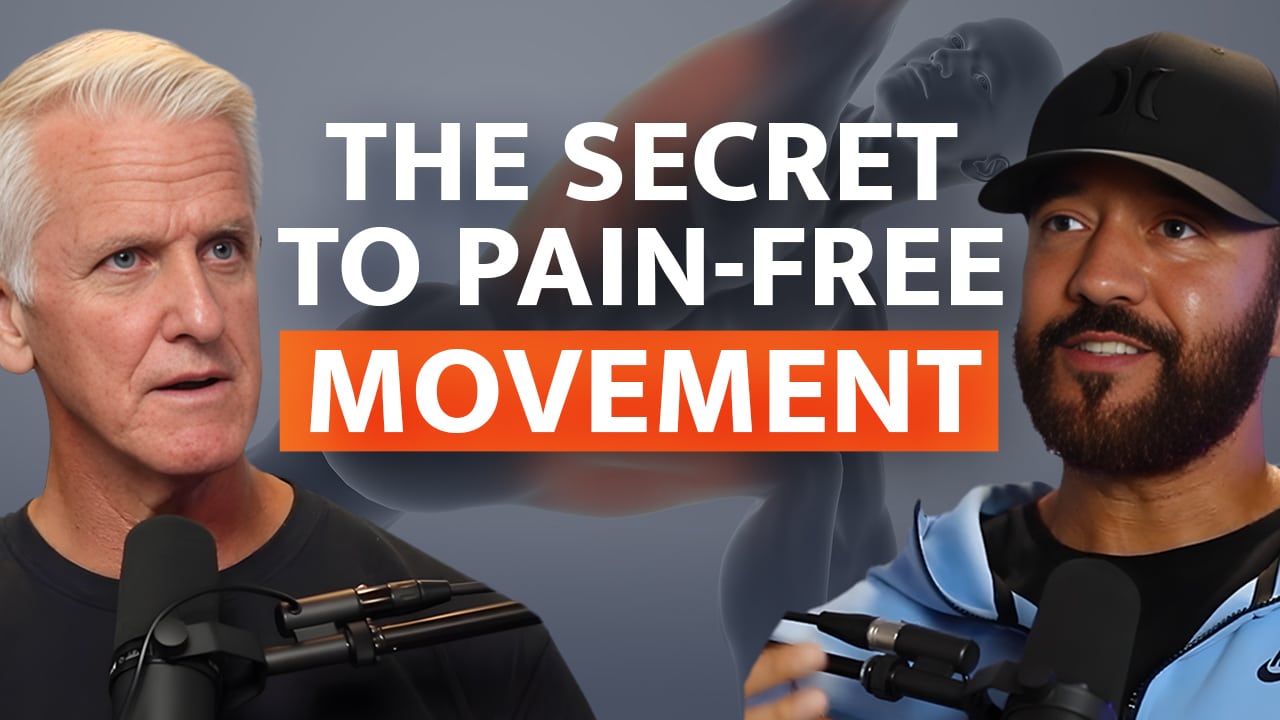
TMHS 955: Use Fascial Maneuvers to Get Out of Pain, Restore Function, & Transform Your Health – With Garry Lineham
Fascia is an important part of your body’s structure, yet it’s something we rarely think about. Your fascia surrounds every part of your body, and if it’s not in good condition, it can tighten, restrict movement, and cause painful symptoms. Today, you’re going to learn about techniques to enhance movement, release stress, and restore function.
On this episode of The Model Health Show, our guest is Garry Lineham, the co-founder of Human Garage. Garry’s mission is to empower folks to heal themselves from chronic pain and stress using self-care fascial maneuvers. He’s here to discuss how to relieve pain and tension, improve your environment, and feel better – for good.
This conversation highlights what fascia is and how it works, the role of hydration and mineral for human health, and how things like microplastics and stress can impact your well-being. Garry is also sharing resources you can use to start practicing fascial maneuvers, no matter what your overarching goal is. I hope you enjoy this episode!
In this episode you’ll discover:
- What fascia is and its role in the body. (3:24)
- The definition of fascial maneuvers. (6:19)
- What to do if you experience knee pain. (16:23)
- The #1 pain issue most people experience. (18:54)
- How minerals work in the body. (24:23)
- Why there’s a shift happening in human health. (32:55)
- How demineralization can cause dehydration. (34:01)
- The benefits of supplementing with silica. (36:34)
- How to start incorporating fascial maneuvers. (47:47)
- What stress actually is and how to reduce it. (53:10)
- The difference between resilience and adaptability. (57:42)
Items mentioned in this episode include:
- Peluva.com/model – Get 15% off barefoot shoes with my code MODEL!
- DrinkLMNT.com/model – Get a FREE sample pack of electrolytes with any order!
- Lower Body Reset – Try this series to reduce lower body tension!
- Barefoot Sprinter Routine 2 – Try fascial maneuvers for running!
- Human Garage Supplements – Check out supplements for fascial health & more!
- 15 Minute Stress Reset – Bring down your stress levels with this simple exercise!
- 28-Day Life Reset – Enroll in the program today!
This episode of The Model Health Show is brought to you by Peluva and LMNT.
Peluva’s barefoot minimalist shoes support postural alignment, proprioception, and overall functionality. Get 15% off your order by using code MODEL at peluva.com/model.
Head to DrinkLMNT.com/model to claim a FREE sample pack of electrolytes with any purchase.
Transcript:
SHAWN STEVENSON: What if every tool that we need to get out of pain to improve our performance just to feel better was already there within us? What if there is an internal toolkit, or dare I say, a human garage where we can unlock all of these capacities? Today, you're going to get a masterclass understanding about your fascia, alright. Now this is gonna be taken to another level because the conversation around muscle and movement and fascia has been emerging and growing very quickly. But to take this into the realm of our fascia, having a supreme intelligence in how we move and how we respond and react to things in our environment is incredibly powerful.
And so we're gonna be directed inward to understand how our bodies work at another level. And also we're gonna travel into some weird domains as well. We might even talk about what they're spraying up there. Little chemtrail talk as well. That's one of those things that's controversial, of course. But just to dive into these different domains, like what could be affecting us in our environment. That's the big question. And also, what agency do we have, regardless of what's going on in our environment. How are our bodies responding to the stress inputs that we're exposed to today more than ever, whether it's coming from the sky or whether it is in this rampant consumption of ultra processed foods, and the chemicals that are making their way into our water supply, our food supply, and all this stuff in our environment, let alone our homes.
You know, it can get really murky and crazy really quickly, but you have so much more power, not just to try to insulate yourself from these things, but to be, and here's the key word, adaptable, in the context of this new environment that we're living in. And so this episode is incredibly powerful. And without further ado, let's get to our special guest and topic of the day.
Garry Lineham is the co-founder of the superpowered Super Popular Movement team, known as The Human Garage. With nearly 2 million social media followers, Garry and the Human Garage team are helping millions of people all over the world to get out of pain, to move better, perform better, and live better. Garry says that an extraordinary life starts with a realigned body and a clear mind. You're about to discover the real reason behind pain and restricted movement, overlooked conditions in our environment that are keeping people sick, and how to use fascial maneuvers to instantly feel better starting. Now, let's dive into this conversation with the incredible Garry Lineham. I'm so excited to talk to you, and I wanna start off by talking about number one, what is fascia?
GARRY LINEHAM: Yeah.
SHAWN STEVENSON: And number two, what are these fascial maneuvers that you're teaching people? You just even taught me a little bit.
GARRY LINEHAM: Yeah.
SHAWN STEVENSON: Before we got started.
GARRY LINEHAM: Well, fascia, if you wanna talk about it from the clinical side or the sports side, it's a tissue that resides, but below the skin that holds everything together. We used to call it connective tissue, which kind of diminished its capacity. But we now know today that it has a brain called an interstitium. And that interstitium has these sensory processing, call it like nerve ending index. And your, let's say your brain has a hundred billion of these sensory processing cells, or let's say, and it's not directly a cell, but the fascia has a hundred trillion.
And the, so, we have all these things like the fascia is what it covers, the organs is what we're told. And then it covers the muscles and nerves, the tendons of glands in the brain. But to tell you the truth, we're actually born in fascia. So there's a ball of plasma when we're born and inside that, in the first six weeks, there's these two nerve clusters that connect. And then after six weeks, the muscle skeletal system grows around that, that fluid is fascia. It's a plasma. And so interesting thing from a scientific point of view, the only thing you can cut everything outta the body, you can cut your eye, you cut teeth out. You know, in dissection you cut every bone, every nerve, every tendon, every organ out, but you can't remove fascia. So if you look at it from a more of a systems process is we are fascia and inside of it is all the things that we currently study around human health. But I want to throw one curve ball at it. We have five senses, sight, sound, touch, taste, hearing.
But we have these other senses that, that the other 10 of them, like Claire audience, Clairsentience, we have the perceptive senses that people use once in a while like I just feel like, or I knew that was gonna happen. Athletes, they call it the zone, when they tap into those other senses. Those are exist outside of us and somehow inside of us, we're notified to move or act on them. And so I propose that the fascia actually starts at that in bio tropic field or the aura and tropic field, bioenergetic field, which we can now measure with science. So I say that the fascia starts there and its frequency and is, and it, that's the tentacles to what we see inside, underneath the skin.
SHAWN STEVENSON: Fascinating. Fascinating.
GARRY LINEHAM: I say fascinating.
SHAWN STEVENSON: Fascianating? I knew it. I knew it. I was about to, I was about to parlay into a word. Wow.
GARRY LINEHAM: And then you asked about fascial maneuvers.
SHAWN STEVENSON: Yes.
GARRY LINEHAM: So fascial is not technically a word. It's a word we created when we knew that we wanted to talk about something and we wanted to make it different. 'cause you say fascia, everybody thinks connective tissue. You cut it, round it. And so we invented the word fascial. And, so fascial maneuvers is also, we could trademark it. We could use it intellectually and stuff like that. So fascial systems or fascial maneuvers, it's moving the fascia. And what it does is it creates counter rotation and pressure in the body. Just like when you're an athlete and you wind up to throw a ball or hit a ball or, something like that, or you're springing out.
Torquing in a springing, which creates adaptation or power in the body. It's that winding torque spring. Well, that fascial system is actually, what, what drives that? So all the fascial maneuvers are based around this counter rotated or spiral, and it's based around compression of the body and then putting the body in a, what the body feels is a compromised position.
But safe, like when we twisted earlier, that actually compresses your lungs and your body says, well, lungs breathing is important. So what it seems to do is it seems to go all around the lower rib cage and open up the fascial layers on those bottom ribs, and that's where your greatest oxygen conversion happens in those last two ribs. And, so that's what I would say fascia maneuvers is, there's a lot more as we start to go through it as what happens when you practice. But that's the best description I can give you.
SHAWN STEVENSON: Amazing. So for example, so it's breathing into like, when, when the body is rotated and the lungs, I guess there's a slight constriction there.
GARRY LINEHAM: Yeah. You're, you're torked so they can't fire.
SHAWN STEVENSON: But didn't we purposefully breathe deep?
GARRY LINEHAM: Right.
SHAWN STEVENSON: Okay.
GARRY LINEHAM: Because your body says there's something wrong with my breathing. And then since breathing is the most important priority of the body, the body sends resources to resolve it. So right around the center area, right where your diaphragm is, it actually gets hot right away, like within a couple breaths.
SHAWN STEVENSON: Yeah, you're right. Yeah, it sure did.
GARRY LINEHAM: And that opens up for the diaphragm to move better, to pull your lungs down. That's one of the things that like pro athletes, like Novak Djokovic and stuff like that, they're using these movements because they, it resets the nervous system as you go through a game, you get tighter, and if you reset, then you get more oxygen flow. 'Cause as you go through a, especially in a rotational sport, as you, you get tighter and tighter and tighter as you move through the sport. That's the job, the job of it. 'cause your body goes, Hey, this is good, but I want to, at some point I want you to rest.
And so it creates more constriction until you become tired. Now if you release the constriction, your body goes, oh, I'm back into parasympathetic quicker so I can give you more energy again. So your body regulates and gives you more energy. So in the middle of a sporting event, it feels like you get more energy when you do one of these movements.
SHAWN STEVENSON: Fascinating. I love it.
GARRY LINEHAM: Fascianating.
SHAWN STEVENSON: Fascianating.
GARRY LINEHAM: I was gonna correct you.
SHAWN STEVENSON: So, okay, if we're in this domain with fascia and, you know, speaking of all of the nerve capacity there, as you know, much of our education revolves around the brain is controlling everything. The brain is controlling movement. And just based on some of the stuff that you talked about, like this, even our ability to react to things or to even foresee things has to do with some intelligence in the fascia itself. So what's really moving the body? Is it just the brain or is the fascia involved too?
GARRY LINEHAM: So, you know, this was something that bothered me for years. I'm just a systems analytical guy. I came from systems development, software programming, encryption, and I think of things in numbers and puzzles. And when I got into practicing healthcare, I noticed that there were all these parts of the puzzle that said didn't exist. They said, that's just how the body is. And I'm like, no, there, it's not that, that's a way of saying, I don't know, I don't understand, or it's too great for me to think of. That's a cop out. They, there is a reason for everything that happens in the human body. And, it's, the body is precise. It's the best computer on the planet.
So I said, what if we think about it differently? What if the body's the computer and the brain is just a processor? Because that's kind of what it does. It runs programs and if it gets stuck running a program, it creates this loop, and we call it a repetitive thought.
So a computer that doesn't sound too intelligent, that sounds more like a processor that just got stuck, and then you have to turn the power off and turn it back on. That's what we do with our phones. So if we think of the body, like the computer, the brain would be the processor. And the idea of the brain running the body. We did nerve conduction testing in the clinic. We had the US Olympic team, like Tyson Gay is the fastest runner in the world next to Usain Bolt.
We had the Dodgers in there like Andre Eer, and we had the management. We had all these elite celebrities and athletes here, and we were just, we were open to solve problems that the teams and other people and that the doctors that had been going to couldn't. And we were working outside the boundaries. And so we would do tests and we ran on 10,000 active patients. We ran tens of thousands of tests on them. And one of them was one day we were doing a nerve conduction testing where you put conduction equipment on and you stimulate a nerve and you watch it go all the way up into the brain. And we had an EEG on and watch it go through the brain, back down into the foot for motor control.
And, that whole pathway took a second and a half. And I'm like, wait a second here. So if that's true. Then how do we move when we step on glass? And they said, oh, dummy, you, you're not a doctor. You don't know this. It's, this is, this is a, the nerve reflex, it's called a ganglion reflex. Using a bunch of words make me feel stupid. And it's like when you hit your knee, you go like this. And I say, when I step on glass, I don't spring and a point I move intelligently to safety. That's an intelligent movement, not a reflex movement. So I said like at that time I said, I, I don't care that you can't explain it, but to tell me that it's this, it's not that for sure.
It's not a reflex. It's some sort of intelligent movement. And, and it drew me to, into this world of fascia to say, what's moving the body? Because the brain didn't even know. You think about it, if it was the second half, it'd be one 1000. Ouch. Move. But when we step on glass, we move right away. So something was leading me to look past that mechanism. And then once I thought, well, what if fascia's moving the body? Then I had to start to rethink things like, what's the brain's job? And the way I see the brain is as a circuit connector, we can see everything in the brain. And just like a circuit board, I could push buttons on a circuit board and it'll affect the machines on either end.
So that's what the brain looked like it was doing to me. And taking it a step further, we were looking at things like, okay, so I originally practiced chiropractic, so none of the bones in the body touch except for your teeth, your ribcage in your ears, like take your knee joint. That knee joint has one muscle crossing it about this big. And what holds it up? Well, that muscle ain't holding up. I know that tendons keep you from pulling too far apart. Meniscus, if you touch, you're gonna be in problems. It's gonna tear. So the only two things left is connective tissue and skin and skin's not holding you up. So I just jumped all the way to make this assumption that your bones technically float inside the connective tissue and that's your fascia.
And so if your bones are technically floating, they're not structure. So then the whole idea of structure, 'cause I was adjusting structure from chiropractic point of view. And if it's not structured, then what do they do? And what do muscles do? And, again, I'm gonna tell you some things as we talk today, depending on how deep we get, I'm gonna give you my opinion. And I've been doing this so long to know that every time I think I know it, I find something new. So I'm gonna say I don't know shit, but what I've observed over the time, and I could be completely wrong with what I say, but I create a story to help explain what I see because we have a result in practice that we have no science yet to back, but the practice can't be denied.
Like people move faster. They are, they through fashion maneuvers, they run better. That calms trauma, stress, it takes the cools, the body down does all these things that we can observe, but we have no science for it. So, that's why I am, I'm open to anybody's version of science around this and we're encouraging scientists all over the world that's happening right now with tens of thousands of people starting to study our belief system. And, I'm open to change my beliefs, but I'm just gonna give you a story as we go along.
SHAWN STEVENSON: You're already one of my favorite people to sit up here and to broadcast and to say, I don't know shit.
GARRY LINEHAM: Yeah.
SHAWN STEVENSON: While you're helping so many people. Because that's one of the things that I really noticed immediately where all these success, well, what we call success stories. But just people affirming and expressing their gratitude for being able to move better, to get out of pain, to do stuff that they thought was impossible. It was, it is really, it's shocking how many of those stories that you guys have accumulated and that's, it's only a slice that we would see on social media. But it's, evidence that something is working, but also being able to be open to, like, there's more, there's always something, there's always a new way to perceive something as just it, it speaks to a very evolved human being.
And if you could, I want to ask you about that since we talked about the knee, alright. With fascial maneuvers, if somebody's experiencing knee pain, I mean, again, I know that it's gonna be individually based, but are there some simple practices or some things for people to consider?
GARRY LINEHAM: Sure.
SHAWN STEVENSON: With knee pain.
GARRY LINEHAM: Yeah. We have a, you know, our primary product is free. So you go out there, there's thousands of fascial maneuvers and hacks, and the basic core 10 essential fascia maneuvers are there. So those 10 essential are designed to move the entire body, kinda like yoga. And then amongst there, there's a, there's thousands of different combinations or interventions that you can do? I don't wanna say hacks 'cause it's not really a hack, it's just ways to apply it differently. So we have a lower body reset if you have a knee problem, you don't only have a knee problem, you have a, an ankle problem, you have a hip problem, you have a shoulder problem and a jaw problem all on the same side. And that, anybody who's a structural integration, a therapist or a chiropractor, they'll, they know that these things exist. And so focusing on the knee, we'll call the knee the symptom.
SHAWN STEVENSON: Mm-hmm.
GARRY LINEHAM: And that, while those other things were malfunctioned, the knee was overcompensating and said, I can't do it anymore. So your body says, I just need you to look at this, but usually a knee issue, we have two things. Lower body reset. And Barefoot Sprinter routine number two. It's on our, it's on our YouTube. It's free of charge. If you have any issue or hip issue, usually within three to seven times applying that over a course of a week, most of the time it'll go away completely or really close to it.
And, again, you can find anything you want on the free stuff. And what we've started to do is curate programs specifically so we can fund our movement in different ways. We started to curate things that, that, that are more specific to an athlete or to a person or to a practitioner.
SHAWN STEVENSON: Okay. This is fascinating. So..
GARRY LINEHAM: Fascianating.
SHAWN STEVENSON: Fascianating! So specifically mentioning Barefoot. So what. And I already, I see where this is going already, but can our shoes be hurting our biology? Can it be hurting our knees, for example?
GARRY LINEHAM: Yeah. As a matter of fact, the biggest culprit is shoes. Most people have neck, you know, traps, shoulders, neck and jaw tension. And that's because they wear floaty shoes. If you wear floaty shoes , the body's biotensegris. So we're like a balloon. And, we have 2000 pounds of pressure on the outside of us, 14.7 pounds per square inch. So pushing down and we have 2000 pounds of opposing pressure. And just like an animal balloon, we have areas of pressure that's blocked off. And when we move, when we have no stability on the bottom, the upper body has to move more to compensate, to balance. And what the upper body says is I need to be more stable. So it starts to tighten up, up here for those cloudy shoes that everybody's running on or walking on.
And so I've known this for a long time. I've been wearing barefoot shoes. We vivo, barefoot was my go-to standard all the way back into like 2014 or whenever I started with them.
And the number one issues that people are having in health today is, I mean, there's a, there's a lot of reasons why, but if you crush your feet and you don't get proper movement here, every organ is connected there and it has to touch your feet have to articulate and touch. And if it doesn't, this, these are feedback mechanisms which go to your organs, your systems, your glands, your nerves, your brains, your back, your spine and everything suffers when your feet don't touch. One of my co-founders, he just made, decided to make a point, he's gone everywhere around the world with bare feet. I mean, we're talking restaurants, airports. He doesn't wear shoes anywhere to prove a point. And, you know, and I go pretty far that way. I wear my vivo barefoot when I'm traveling, when I'm moving back and forth. But 90% of the time I'm barefoot.
SHAWN STEVENSON: Amazing. Amazing. You know, just thinking about all that data that our feet are picking up and informing our movement basically. And what happens when you mute that? Right. And I guess it would dramatically increase our risk of injury, let alone pain.
GARRY LINEHAM: Yes. That's where a lot of injuries are coming from. So think about it this way. You have 206 bones in your body, half of them in your hands or feet. People don't think about it this way, but if you look at the real science of it, calcium is a mineral, or sorry, is a mineral, but is also a metal. So your minerals are actually metals and you have over half of the metal in your body, in your hands and feet. And that metal is sending signals through your bioelectric nervous system to give information, not just proprioceptive information, but signals and density.
And that's why babies are always like foot in the mouth, you know, or hands in mouth. And, and the reason why is because they're picking up a lot of information. And it's information, not just movement and movement is the biological explanation for how humans live. But before we move, we have electrical impulses that come into our body from that tropic field. By the way, with Russian bio tropic measurement field. So we can actually measure this stuff today, it's just not talked about in mainstream science. So before there's a movement in the body, there is an electrical impulse somewhere outside of us that sends a signal that we interpret and we move. And, again, we can see it in the field. Now how it all works, I don't even think we'll ever really know. Like I don't think human beings are smart enough to figure this out, but we can observe it.
SHAWN STEVENSON: Yeah. I gotta ask you, what's, what's screwing up this connection? You know, obviously we mentioned shoes, but what are some of the things that we can consider to be villains? And I use these words loosely. Villains are maybe enemies to our natural functioning that's causing this pain that we're experiencing. I'm grateful to have you here because as you know, we are experiencing an epidemic of pain.
GARRY LINEHAM: Yes.
SHAWN STEVENSON: Right?
GARRY LINEHAM: Like never before.
SHAWN STEVENSON: Just like loss of function, pain. And it's really pulling away and diminishing quality of life, creativity, joy for so many people. You can get trapped in pain. What is it about our society that's causing so many problems with us physically?
GARRY LINEHAM: Okay. Again, this is my opinion from observation of working personally with 10,000 people, but also now watching millions of people go through these programs of feedback information. So I have a very large set of information to deal with. Here's what we are blaming everything for our health functions. Everything from vaccines to food, to diet styles, to EMFs, and they all are contributing. But there is one thing that is at the root of every part of it that I have found. Okay. You didn't get to touch me before, but I'll let you do it afterwards and you'll see that I'm 80% water.
I like, I look like I have muscles, but this is actually very watery, very, very soft like a baby. In medical school, 30 years ago, we were taught that 70% the, the body was 70% water. Today, right now they're teaching in medical and nutrition school at 60 to 65%. 30 years previous to that, so if we go 50, 60 years ago, they taught that the body was 80% water. So somewhere along the line, we've gone from 80% to 60%.
And since our primary construction is water, not the water that we drink, not H2O, it's H 3 0 2. So it's structured water. It's in a gel format. If you cut us, water doesn't drip out of us. That structured water is a primary building block of the human being. Like, say if you make a cake and you get the milk or a wrong or the sugar wrong, the weight, it's gonna dramatically impact how that cake grows and performs.
Well, if we take away 20% of our water, or in the last 30 years, which we're talking about all these dysfunctions coming up, 10% of our water. And then the other ingredient is silica sand, basically. And so silicon sand make up, make up roughly 95% of the body. And then we have bacterias. And if you think this way, viruses won't go there. But that's the construction. So we're like a quartz crystal, and if the primary ingredients are low, then we're gonna have a malfunction. And minerals are metals that conduct electricity through that plasma gel that, that water we hold in our body. And if any of the minerals are missing, each one of those minerals has a specific pathway.
It's like, for those of you guys who are data people, it's like a, it's like an SVC or like a virtual pipeline through that cloud. That's how your iPhone connects to your part of the cloud through this virtual circuit. It creates, well, that's what the me metals or the minerals do in our body, and we're deficient in them. And there are some culprits to why we're deficient in them, but I can say that, that when we restore the minerals and then the water and the body and move it into the fascial tissue, so we break it up and give adhesions, get the adhesions outta the way. I have seen that every disease that I know of today, everything from cancers to fibromyalgia to traumas to autoimmune diseases, they start to change and their symptomatic behavior starts to drop away.
And what I can tell you is that we have had tens of thousands of people report changes including autoimmune diseases where they have diagnosis and then they have another diagnosis, says they don't have it. And they've shared that information with us over the years. And in the tune, like you said, results, like in the tune that we don't even keep it anymore. It's like tens of thousands. We don't even have a place for it anymore. But people just share openly. And I can say that because I'm sharing their evidence. It's not me saying that our maneuvers do that. What they're doing is they're saying, we're applying this and it seems to be working and here are the results.
SHAWN STEVENSON: Yeah. Just starting with the ingredients that make up a human being, being different is al that should just be the biggest aha.
What are those? The cry of a generation. Pointing at uncool footwear. Nobody wants to show up with anything janky on their feet. Everybody wants to be cool. But in our society today, in our ultimate quest for coolness and sometimes even in our ultimate quest for comfort, we've abandoned our focus on healthy footwear for optimal human function. Because your foot has 26 bones, 33 joints, 19 muscles, 107 ligaments, and each one of your feet has over 200,000 nerve endings, and it's all there for collecting data to determine your movement. That contact with your foot to the ground is literally informing everything up the chain. How to move and respond in our world. So whether this is performance in the things that we love to do, or whether this is being able to gather ourselves, if we should bump into something or meet with some kind of obstacle to maintain ourselves to adapt and to prevent injury. It starts with our feet. Truly, our functionality is built from the ground up.
And our modern shoes essentially mute or disrupt thousands of data signals that would normally be transmitted from your feet up through your kinetic chain and modulate appropriate movement. The results we have, epidemics of foot dysfunction, foot and ankle injuries, knee injuries, hip injuries, and more. That can be rooted back to modern footwear. And again, don't get me wrong, I'm not trying to be at the other end of what are those. And this is why today we have an opportunity to get plenty of rehab and prehab for our feet with some stylish science-backed footwear. Now, this was not an easy quest when we're talking about shoes that have a wide toe box and five toe functionality for each one of those incredible toes to fit into.
But that's what you find with the incredible footwear at pva. Go to Peluva.com/model right now and you're gonna get 15% off when you use the code model. That's P-E-L-U-V a.com/model and use a code model for 15% off store wide. I've been wearing my Peluvas for a couple of years now, and I absolutely love them. Again, this can be prehab and rehab. If you still wanna wear your other shoes, that might be uncomfortable, but you just adapt to it. You push through, you can utilize your Peluvas to rehab and rehab your feet to get normal function restored. It's also signs backed to help to reverse even some really gnarly conditions that can happen with our feet and things up the chain as well.
But things like, you know, uncomfortable bunions and the like, can be greatly improved by wearing Peluvas. And so after I leave the studio today, I'm headed home, I'm gonna throw my peluvas on and I'm gonna get out there on the streets. And rehab prehab my feet from all the work that I'm doing today, standing and my stylish kicks. So it doesn't have to be all or nothing. It could be a both end world. But if you catch me out there walking or even training, you're probably gonna notice that I'm rocking my peluvas. So again, head over there, check 'em out, peluva.com/model. Use the code model at checkout for 15% off. And now back to the show.
SHAWN STEVENSON: We were just talking about these ancient cultures, these very physical cultures, a lot of physical literacy that we marvel at. And you know, one of the questions that was posed by the researcher I was talking to was, you know, we know that they had these bodies, but are they the same bodies?
GARRY LINEHAM: That's my question all the time. And I, this is the author you interviewed earlier? Yeah. So I believe that when you ask the same type of questions, you'll come to the, you'll, you'll get the next question like. How do we, I believe I'm 80% water and I'm obviously that I'm very, very, I'm very dextile. Like I can, I can move, I can function, I can.
SHAWN STEVENSON: For people that are listening, your ability to just pull your foot up to your mouth like a baby is remarkable. Let alone, I could see like your arms, you look very strong. But then when you grabbed your muscles, your gra.
GARRY LINEHAM: Soft.
SHAWN STEVENSON: It's so pliable.
GARRY LINEHAM: Yes.
SHAWN STEVENSON: Like I'm, it's shocking.
GARRY LINEHAM: Yes. Shocking. It is. So that was my goal. My goal was to see if I could, because I used to be a bodybuilder, so if I could diminish my muscle content to a point where the fascial content had to be dominant in my construction, that's what my goal was. And I, and I did that through mineralization movement, moving in a certain way, these fascial maneuvers, moving fascially. So the funny thing that triggered me when you said that is that I looked at it and said, how do I know that every body wasn't like this? I know that bodies were 80% water 60 years ago, and, and I know I'm 80% water.
Was everybody like this? They kind of, I kind of look like them. I look lean, I don't look super muscular. I optically look like them, but we don't have anybody to touch and feel to know that that's actually the case. So the greater question is, yeah, were we actually different? And I believe we are because when I started working in clinical practice, let's call it 2012, I started noticing these behaviors, and people, and I noticed that 70, 80 year olds were still moving and they, and back then, but today, a 70, 80-year-old doesn't move.
So they're more dehydrated, they're more restricted. But in my short time of 15 years or so, that wasn't true 15 years ago. So we have a, we have this sliding degradation of ability in human beings, but we can't see it because we're so focused on our daily rat race. We don't really look at the bigger picture. And you said earlier about sickness. I ask a simple question on this world tour, I ask how many people when I started the tour and, we officially started May 2024, but we, up to that January, we were testing it. So I'd ask people, how many people here have a chronic issue or somebody in their immediate family or close friends has a chronic issue?
And, a year and a half ago, that was 30% of the audience. Today it's 90 plus percent of the audience, and that's in just 18 months. So we're, I believe we're in the world's largest shift in human health. We are sicker than we've ever been, but simultaneously we're using more therapy, more nutrition, more counselors. Everybody's a health coach. Everybody's got a new method, a new modality, and we're using more ancient practices and shamanic practices and plant medicine. And the contribution of all of these things are, we've used them more now than ever in human history, but simultaneously we're sicker. So something isn't working.
And from a logic standpoint, when you break down systems, if you have all of those things that aren't working, it's one of two things. It's the formulas. The formulas are like the programs, the diets, the practices like, you know, like chiropractic and acupuncture and all that, or something's wrong with them. And I said, we can't be with all of them. So it has to be something else. It's either the formulas or what you're formulating against, which is what is a human body. Back to that thing, how are we made, how are we constructed? Is our belief system about how this thing works? Is it accurate? Is it true? I do know that we're supposed to be more water and when we do add more water disease and dysfunction goes down and performance goes up.
And by the way, before, because I know this is gonna come up, the number one cause of dehydration in the body is the overconsumption of water. Because our water's all polluted. We drink demineralized water and demineralized water strips water from your body. The current trend is reverse osmosis, which is made, which is a device that was used for making, for making medication. Reverse osmosis water should never be drinking by human. Never even put on your skin. Nevermind. We got people drinking it 'cause it does, it cleans everything out, but it takes all the minerals out of your body. And then water collects stuff as when it goes over a rock. It wears a groove and a rock over time on a waterfall.
So if you don't have minerals in your water, then just like the rock, you become the rock and the minerals are stripped outta you. And so the overconsumption of water, just drink eight glasses a day or drink half your weight in gallon or in gallon or liters or whatever it was. These things here are causing this chronic dehydration that people can't get out of. And these are like well accepted belief systems.
SHAWN STEVENSON: Universal solvent.
GARRY LINEHAM: It's a universal solvent.
SHAWN STEVENSON: Right? So..
GARRY LINEHAM: Should never be drinking.
SHAWN STEVENSON: Alright? With this being said, what do we need to do? What should we be drinking? How do we solve this issue with this change that's happened in our ingredients?
GARRY LINEHAM: Okay, so there's a lot of debate about this. I'll just tell you what I did that worked for me and what I've observed millions of people doing that's working. Number one is you need minerals. There's a base element of mineral because of now it's clear. I got shut down in my clinic for talking about chemtrails. This is in 2019, 2018. The banks took our money. The state came in. We were being attacked by boards, by, by states, by the banks shut us down. And I was talking about why people were so dehydrated. I noticed and I noticed from hair follicle testing that they had barium, strontium, aluminum in their, in their fascia and their hair. Everybody did from every, all parts of the world.
We had clients from all, sorry, we had patients from all over the world and everybody had this in their hair. I started looking at what does barium do to the human body? That's a geoengineering put out there. Barium, depletes silica. Silica is the primary thing that you're made out of. If you deplete silica, all the other minerals start to malfunction 'cause it's building blocks. You need elements and then minerals. And if the elements don't exist, if any of the elements don't exist, they start to malfunction. But the primary one, silica. So if you take silica and to make it deficient, then the body cannot properly hydrate. And so 600 milligrams of silica is what we gave to 10,000 active patients as an experiment.
And we did it, rotated it in a triple blind, our own study again, just just as us trying to figure it out. And what we noticed is when silica was added instantaneously, hair and nail skin and changed right away, cognition went up, absorption went up in their digestive tract, all these things started to happen. And that meant that a lot of people were probably even taking minerals. A lot of people listening to this podcast probably taking minerals and they're still not working, and that's because you're missing silica. You take silica and then all of a sudden everything else starts to work. And these are not, these interventions require virtually no money. So nobody wants to talk about 'em from an economic point of view, and nobody wants to do science on them. That's the challenge. And since we were like our, we're an impact driven organization, so we, like, I don't have a salary. None of my co-founders have salaries. We don't have homes that we're paying for like this.
We live in a community, work as a community. We travel as a community to keep our costs down and also to increase our productivity. But we are, we turned all of the money that we make into creating more expansion and helping more people and driving more messages, because that's, if we do it that way, we can actually make an impact. But everybody else is fighting over things that, that drive money. And even the current biohacking space and longevity space is primarily driven at revenue. And if revenue is the outcome, it will always be wrong at some point. It may be right, today. But look at the biohackers now, getting sick, you know, I'm not gonna mention names, but a lot of 'em come back to me who were patients of the clinic when we were there. And they're coming back now because things aren't working.
SHAWN STEVENSON: Two questions. So where do we ideally source the silica and what should we be drinking?
GARRY LINEHAM: Okay, so structured water, I mean, do the best that you can. Reverse osmosis. If you got it, get rid of it, throw it out or put another filter. And mineralize, you can get a mineralize and a filter so you can remineralize the water, but it's still dead and it's mineralized. So you want a structuring device, and there's different ways you can do it. There so many I can't even begin to tell you. And I'm, I don't wanna direct you to any, it's not a sales pitch. You can actually take it in a glass phase, put crystals in the bottom, you could swirl it around in the sun and leave it out in the sun and swirl it, that will actually restructure your water.
So structuring the water so your body can adapt to it. It's, that's the one thing. And the minerals that you can get this, like horsetail is a good one. Silicone dioxide, you can, you can get that's like in BioSil or something like that. But I have chosen to use Diatomaceous Earth, which is something that I. And not now, but a year ago I was getting shut down the media for because it's also an anti-parasitic, it's like, kind of like ivermectin, but 20 bucks last year for two years. And so it has the same holistic effects of some of the pharmaceuticals, and I believe that's why we were getting shut down at that time.
But literally, they shadow banned us for talking about structured water and Diatomaceous Earth. So those are the ones that we recommend that we actually have a free supplement guide. People can just go to our website and download it and we have a hydration guide. They can go download it and that information's just there for them to and it doesn't tell 'em to buy our products. It tells 'em why and how. And it points to ways they can get it naturally. And we have some products that they can purchase as well.
SHAWN STEVENSON: Where, where's this at?
GARRY LINEHAM: It's on our website, just on human garage.net.
SHAWN STEVENSON: Boom. Okay. Now question, you mentioned chem trails.
GARRY LINEHAM: Yeah.
SHAWN STEVENSON: All right. This can be a dirty word out here.
GARRY LINEHAM: I think it's, it's getting better.
SHAWN STEVENSON: Yeah. Recently. There are some who be considered, you know, some credible scientists who are speaking out about this. Because again, you look up in the sky, you see, you know, these various trails. It's just like, oh, that's, that's just the, you know, water vapors or whatever the case might be. But just looking at getting actual analysis of what, what is contained in this, as you mentioned, the aluminum being found is crazy. And the purpose behind it, again, in a strange way. I'm not gonna say altruistic, but that's the word that's coming up, trying to reduce global warming. Right. We can kind of create this filter. I think that's one of the premises behind it. If the chemtrails are real, you know, but if you could share more on this so that people can, you know, start to form a more educated opinion about it.
GARRY LINEHAM: Sure. I think you just need to look at geoengineering and there's patents that exist, US patent office and you'll see that we've been doing it since 1956 where we've been modifying weather. I have a lot of, spent a lot of time in Dubai, been working with the royal families and the governments over there. And there's only a year ago that the streets people were swimming down the streets and you taking boats on the streets because they, their weather modification, they overstepped and it rained and it flooded everything.
So there's no question that we're modifying weather. They call it geoengineering and whatever else is being done, there's something called stratospheric aerosol injection, which is even more nefarious than you could ever think. 'cause it, you can put anything you want in there and we're breathing it. It's just like, it's like inhaling a drug. We inhale drugs now we get in inhalers. Well, we're inhaling drugs. So let's just talk about the basic ones. Barium strong team aluminum. And the US patent office has patents on geoengineering. You can go see it. There's, it's out there. RFK talks about it. The states, like Florida State has actually put a state law banning it.
Mexico is banning it so it can no longer be said that they don't exist because we're writing laws to, to stop it. So if they're, if you're out there saying it's only a contra on a plane and I don't really believe it. We're writing laws. We don't write laws about things that don't exist. And the idea behind why they're doing it. Like, I have my belief systems, but they're like, we're spraying aluminum. Aluminum has been known to cause every neuromuscular disease, dementia, Parkinson's, everything like that. They're telling you not to, you know, now they're letting you say, Hey, watch out the aluminum you put on your underarm spray that may be causing it.
Meanwhile, you're consuming copious amounts of it every day while you're breathing. And strontium is just horrible. It lands in the lungs and it sits on the oli. And what it seems to do is it seems to cause something called pulmonary edema when we get sick, pulmonary edema. That means you get fluid in your lungs. If you get a flu, you get fluid in your lungs called pulmonary edema. They've actually named that with a C word. They've named that, that symptom. So we have all these things and we get, we get barium and all this other stuff, the normal particles like I went into, 'cause I've been investigating ways that medicine starts to become more holistic.
And I found one device that I believe in, and there's a couple versions of it, but in Pheresis, not just Pheresis, where they clean your blood. I took all my blood out, all 6.3 liters, put it through a 0.1 mic filter, like a filter like in your, in your water filter. And it filtered all the spike proteins, heavy metals and plasma and microplastics. I'm the most careful guy that you'll ever meet. I carry sheets, I carry water filters. Like I, I literally control my environment. I had microplastics, they give you this bag, this inflammation, you can see a little line of microplastics. And I've got some stuff. If you look at Garry cleans his blood.
You'll see a quick reel on it. But I got a documented piece coming out where I show the actual microplastics and at the bottom the heavy metals. I'm like, where am I getting this from? Well, heavy metals, you, we have it from the exhaust, from cars. All over the place. That's one place. Microplastics, it's like people wearing gym clothes made out of plastic. All of our sportswear is made out plastic. That's why I, you know, I've, I've worked with organizations like PAC or Riker because they're making clothes and gym clothes that is actually made outta wool and cotton and fits and, and stuff like that. So if we are wearing plastic and we sweat, then that microplastic goes into our system and goes into our blood.
We hear plastic bags, all these things that we're doing. So, we have this environmental issue, which people are medicating, taking supplements, going to practitioners, and they're doing all these things to try and make themselves better. But it's like swimming up a stream that with a current coming at you. Because if you have a lot of microplastics in your blood and a lot of heavy metals, then everything you do is going to not work as well. And it, I was shocked at how much microplastics came outta my system. I mean, bizarre.
SHAWN STEVENSON: Wow. And you're somebody who's careful about it.
GARRY LINEHAM: Super.
SHAWN STEVENSON: You know, intentional. That's amazing.
Like, so with this being said outside of people going and getting their blood filtered, what can people do?
GARRY LINEHAM: Simple things. Okay, first and foremost is think about this. This is your tissue. If it gets hard and dehydrated over time, it's like this surface of this table. It's kind of hard. The water's gonna run over it, but if I scuffed it and sanded it, the water would be porous and it would, it would sink into the wood or the enamel. So our tissue has become dehydrated. So it become kind of like this table, it's kind of like this was where water fluids just kind of rushed by. So those things that I'm talking about exist in your fascial tissue, which is around your muscles and through your muscles, around your organs, inside your organ.
But it's in that fascial tissue and underneath the skin and that, so that needs movement there is, you can take, it doesn't matter how many chelations you do, how many supplements you do, it doesn't matter what biohacking procedure you do, if you don't move your tissue, it's still there. And I got this 'cause I did a second blood cleaning and it got more microplastics and more heavy metals in the first one, which mean the first one, the blood was at capacity, couldn't handle anymore.
Clean my blood and then it goes, whoof takes another round of it. So the simple thing is this is to take silica 600 milligrams a day, take all 102 minerals. You can take Irish CMAs, which is really easy to get, and bladder rack that gives you all 102. Those two there, take your minerals and your elements, the silica, and then do a movement routine that creates, that uses pressure, and it doesn't have to be fascial maneuvers.
There's other things like yin yoga will start to get you there. I just noticed that fascial maneuvers works better. You can do fascial maneuvers, like try our 15 minute stress reset. It's free. Just go try it and try it one, two times a day. And if you do that, you'll start to notice that the compression and rotation in the body like we were doing earlier, causes all the fascial tissue. When you compress it and rotate it, it creates friction and that fascial tissue. And the reason why you feel so alive after doing that is 'cause that friction creates a fiso electric field. So it creates electricity inside your fascia. So you'll feel better and you'll get friction that'll break it up.
And those tissues will be able to come out as a result or as the, sorry, the minerals and the plastics will be able to come out. There's things like tamarind. Tamarind has been shown really powerful to remove microplastics. And then you can take with your minerals and like Diatomaceous Earth, the one we recommend, and moving the tissue, you'll even start to remove the heavy metals and you can do heavy metal detox, but those heavy metals, the parasites, like the heavy metals. So it actually, by doing this all together in one system, you could do this. So we have a 28 day reset, which you can go do online, you can do it. You con contribute a dollar, you can contribute, you can go on a structured program, like a guided program, or if you don't have money, you can send us and we'll give it to you for free.
But you can do that 28 day reset and you'll get a daily movement of 15 to 20 minutes that precisely will start to move you through that process. If you add our supplement recommendations to it, you'll find that you detox and move and your body changes within the course of that first month.
SHAWN STEVENSON: Hmm. Amazing, amazing.
When it comes to energy and performance, it all starts with the powerhouse power plants of ourselves called the mitochondria. Our mitochondria are so abundant, they actually make up about 10% of our overall weight as adult human beings. We got a lot of mitochondria to run a lot of processes. Now we wanna make sure that we're not gumming up that process of energy creation. And not only that, how can we add to it to create more mitochondria and more energy efficiency? But one of the most important components nutritionally has to do with these incredible minerals that carry an electric charge called electrolytes. In particular, something like magnesium, for example, is required to make new mitochondria.
It's a process called mitochondrial biogenesis. The creation of new mitochondria depends on magnesium to be present. Pretty amazing. Plus we've got this remarkable sodium potassium pump that has a lot to do with the energy exchange going on throughout all of ourselves. It isn't just about the mitochondria. Of course, there's a huge data network that runs this amazing human entity. But again, it all works together, and those three electrolytes in particular are an important place for us to focus. And so we wanna make sure that we're getting plenty of electrolytes from our diet, but today, more than ever, whether it's high performance athletes, top CEOs, or just everyday folks looking to fuel their days and fuel their performance.
Supplemental electrolytes are one of the most popular things in the world, but for decades, that medium has also been a source that has been rampant with artificial colors, artificial flavors, and ridiculously high amounts of refined sugars. And to that, we've said no more enter the age of LMNT. It has no artificial colors, no added sugars, and no dodgy ingredients, and it has science-backed ratios of those three key electrolytes based on hundreds of thousands of data points with real people. When people utilize LMNT, they truly notice the difference, whether it's in their stamina, their cognitive performance, helping to manage hunger and cravings.
There really isn't a metabolic process in the body that an electrolyte supplement like this cannot support. And right now, when you go to drinkLMNT.com/model with every electrolyte purchase, you're going to get a free sample pack with two. Servings, each of their four most popular flavors. Incredible. Go to drinkLMNT.com/model right now to take advantage of this incredible offer. This very special gift element is a big part of my life, my team's life, my family, friends. It's really an incredible supplement. Super easy to travel with. I always have their little packets on the go with me when I'm traveling. Also, when I'm working out as just in my water bottle today, during my workout, truly love element. Head over, check them out. It's drinkLMNT.com/model to take full advantage of this very special offer and a special gift. And now back to the show.
SHAWN STEVENSON: I think for a lot of people, they're aware of the changes, you know, with our diets, with our sedentary behavior, lack of sleep, all these things that are contributing to these health issues. But this is revolutionary and thinking about, again, the ingredients that make us up, let alone the food, but in particular we're mostly made of water. And being intentional about that. But something else that it, it has one big, broad name, but it is, it might be, if we're keeping it in a big broad name, it might be the thing that's hurting us the most and is stress.
GARRY LINEHAM: Yes.
SHAWN STEVENSON: So can you talk about the role that stress has on our biology?
GARRY LINEHAM: So let's unravel that a little bit. What is stress? Most people, if you ask, including practitioners and doctors and therapists, they'll say, stress is your job. Stress is your home life, stress is your IRS and these are all stressful things. You know, like these are all things that, but that is not stress. Even the, even things like, sorry. Even things like electricity and, and EMFs, those, that's not stress. Those are stressors. Stress is our body's response to the stressor.
SHAWN STEVENSON: Mm.
GARRY LINEHAM: And a simple analogy to help that helped me understand this was when I was hung over, lights were stressful. Somebody tapping on a table was stressful. The TV was stressful because I had no capacity to take any more information in. So when our bodies are hungover, we have more stress and our bodies are always over when we're dehydrated, like when you drink, you get hung over 'cause you dehydrate your brain. Our bodies are dehydrated. It means we're always slightly hung over. So the answer is hydration. We have a 15 minute stress reset that takes out 75 to 90% of the stress in your body no matter how you measure. It's on our YouTube. It's free of charge and you can do that right now. And your physical stress and emotional stress will diminish within that first 15 minutes, usually within seven to 10 minutes.
So we have, if we do that over a period of time, it's just like anything else. Stress is cumulative, but so is care. If I care for myself over time, if I care for myself one night, I eat a good food, get a good sleep, that's not gonna solve my health issue. But if I do that repetitively over overnight after night and over weeks and after months, I'm going to start to move the needle. Well, the same thing with stress, but stress you can unwind faster than anything else. Mineralization water, which are the primary ingredients of stress, because when you're dehydrated, even breathing becomes stressful. Because if you're tight, if you're dehydrated, you're tight around your ribcage. If I just slightly contract your ribcage and just give it five pounds of pressure and you breathe, your body will go into stress.
And that's what's happening globally to us. But since it's happening all at once, our body just says, okay, that's the way it is. So I challenge people to really look at stress a different way and say, stress is something that not I can manage. I can reduce the amount of tension or in my body so that I can accept more stressors. 'Cause likely you're not gonna change your traffic, your job, your situation, your relationship's not gonna change overnight. And running away from, it's not gonna help. But, giving our bodies more capacity to receive and transmute that stress 'cause that stress is also energy in motion. In other words, emotional.
So if we give our bodies more capacity, then we can actually move that energy through our body. We can connect it again through the fascia and then release the emotion, which is the greatest stressor of all.
SHAWN STEVENSON: Hmm. It reminds me of Whitney Houston. Greatest love of all. It's the opposite of that. It's the opposite. Wow. Obviously this isn't, the world that we live in is radically different from our ancestors, but it's still, we still have the same basic wiring and the stressors are different, right?
GARRY LINEHAM: Sure.
SHAWN STEVENSON: But these are stressors and it's still even thousands of years ago, it was still gonna be based on how your body's responding to the things.
GARRY LINEHAM: Sure.
SHAWN STEVENSON: Today. And so we can essentially make ourselves more resilient, train ourselves, help to, make a healthier response to things. But we need those basic ingredients, is what I'm hearing. And I love that because it's empowering, you know, because I think, especially today, we're so stressed, we just feel, we say it, I'm stressed out. I'm just, I'm carrying so much stress to be able to better metabolize stress, but also to build up it. What's a good analogy for how our bodies maybe get overwhelmed with stress? Is it kind of like, you know, like digging a hole maybe? Like, what's a good analogy for this?
GARRY LINEHAM: Okay, so I'm gonna, I'm gonna pick apart a word you said earlier, just to illustrate a point. Close your eyes. I'm gonna say a word. Resilience, adaptability. Resilience, adaptability. Which one feels better?
SHAWN STEVENSON: Adaptability.
GARRY LINEHAM: Right? When I tell myself that I have to be more resilient, that means I have to fight more. That's the beginning of stress. The fluid adaptive biological computing system that we, that we call a body, is meant to be adaptable. And if we're adaptable, and you, you can think about it a couple of different ways. Our bodies either compensate or they adapt. And there's the only two things. Compensation is stressful. Adaptation is not stressful. And so at the core of it, all of the idea of the biohacking world. And this whole thought is to be more resilient and the concepts are built around being more resilient when we wanna be adaptable.
Let me give you like an analogy that kind of works for me. And these analogies is the ones I tell myself so that I can grab a better inner standing of the issue. You have a bathtub, and in that bathtub is your body, your human experience, and that water is gonna be performance. And so the current model is I want to perform better. So what we do is as the water is rising, we turn up more water, we turn more water, and more water and more water. But what's stopping that water from performing is, or what's stopping the body from performing is the amount of water in the tub. So we need to keep it at this base level.
And so what we're doing in our current culture is we're turning more power on, we're turning more force on, we're creating more resilience or we're creating more force or we're doing more workout to try and be better. But what we really need to do is just pull the plug and let the water drain out to a natural level again. And that's pulling the plug is pulling, the plug on your stress. If you don't have a way, and most people, we live in this stressful environment where our jobs are work, everything is, the stressors are all already there, and we just get used to this baseline of about a six to a seven stressor every day. And if we can't remove that and pull that down to a two every day, then eventually the accumulation of that resilience, the body's resilient until it's not.
And then the body starts shutting down, compensating. And those compensations are what put the body not at ease. And when the body's not at ease over a long period of time, that's where disease comes from. And disease is just the body not being able to adapt for a long period of time in a specific way and compensating. And then eventually it says, dude, I can't do this anymore or dudett, whatever.
SHAWN STEVENSON: Yeah. Get the towels, get the plumber. You know, you gotta get all this assistance to try to deal with that overflow. It makes so much sense. So can you give us, you mentioned the stress reset, which we'll put a link for everybody to utilize the full version, but can you give us some context on what does that look like?
GARRY LINEHAM: So we did it before, I mean, one of the things that, that you do is it's a counter rotated movement, so you can try it right now. Pull the microwave a little bit. Yeah, yeah. And it's your left. So I'll do my left. Okay. Take your left, take your left hand, put it underneath your right armpit, right arm on top.
Turn your head to the left and your body to the right. Now. Push your lips, breathe in and hold it. Go. Hold it there. Breathe more. Hold it, breathe more. Exhale. Do it again. More. More. Exhale. One last time. Breathe in. More. More. Exhale. Now. Breathe through your nose now through your mouth. Six times. Go. One last one. Unwind from that.
SHAWN STEVENSON: You feel like almost gonna take a nap.
GARRY LINEHAM: So. There.
SHAWN STEVENSON: It's, first of all, I got very hot after the first one.
GARRY LINEHAM: That's the, just the warmth, that's the fascia removing restrictions in a non-threatening way.
SHAWN STEVENSON: It's not my Nike tech.
GARRY LINEHAM: Yeah.
SHAWN STEVENSON: It's not that.
GARRY LINEHAM: And it's not, you know, like when we stretch or we do yoga, we create resistance in the body, and the body fires a stress signal against it, which I mean, they're all great. The body needs stress, but this takes the body into relaxation instantaneously. It drops it so fast that what you're feeling is serotonin and dopamine, oxytocin going up.
SHAWN STEVENSON: I didn't want to come out of that.
GARRY LINEHAM: Yeah. Isn't that cool?
SHAWN STEVENSON: Yeah.
GARRY LINEHAM: So think about that. It's both sides of that. Both legs over. And then a one called anti-gravity, which anti-gravity literally makes you feel like you lost 20 pounds. Then, what we call pallet swipe. You know what it does? Is it, you see a lot of people now getting facial symmetry, mewing, and using their thumbs to pull their jaws apart. Pallet Swipe is a gentle version of that, which allows you to reset the palette of the mouth open up your airways.
SHAWN STEVENSON: Hmm. Human garage, where'd that name come from?
GARRY LINEHAM: There's a lot of story around it. There's two storylines. One is the guy who named it helped me name it, Dan Istic from Wild Branding. One of the best creative minds ever. I've been using 'em for 35 years. He watched me work with people and he says, you're like a mechanic, you tinker. They get up and walk, they come back, you tinker around. And so originally that was the idea. He goes, you look like a mechanic. Where does a mechanic work? A body garage. So it's a human body garage and for marketing yet too long. So it take human body garage, take body out and make human garage.
But ironically, in Venice, California, when we started this, we actually started in the garage on Doreen Place at Lincoln Place Apartments. That's the actual place where we birthed the human garage, the actual, the therapy portion of it. And we were seeing people in our, in our garage. It got too hot. So in this 800 square foot apartment, we took out all the furniture, kept our room, and everything else was a clinic. And we saw people, we see people 6:00 AM to 10:00 PM at night. We had mainstream celebrities like Brandon Roth, who's Superman and Katie Lots, and we had all of these mainstream celebrities and athletes coming to this little apartment. Why? 'Cause it worked and we were just, I look back at it, we were just experimenting and we were having a great time doing it. And that's, that's where it came from.
SHAWN STEVENSON: Wow. That's very human. Human garage. You know, this is obviously this very practical as well. It's very practical. Some of the thinking can be complex, but if people are wanting to work on themselves, right, to tinker, to become more pliable. Right. And to interact with their fascia, like what are some of the things that you recommend or their, like certain tools that you use? Should people be like foam rolling using their hands?
GARRY LINEHAM: I get the tools. The best tool, recommendation, the best, the best one. It's, it's like the, there is a set of tools that was designed long, long time ago, and these tools were some of the most complex tools ever to be used to work with the human body and, and they're so complex that nobody understands them, but they're so simple. Everybody uses them already. It's called your hands and your mouth. You need nothing else other than that. You don't even need to go to a gym. We did this sitting here. You can do it in your car, you can do it anywhere, anytime. And that's what makes it work, because people have busy lives. They don't, they can't take another hour out to go do a program, but they can spend five minutes to do one seated maneuver, like you felt relaxed after one.
You can do that at work. We have seated maneuvers. You can go do 'em at your desk, you can do 'em standing in line. Lots of lines happening these days. You can do 'em anywhere, anytime I do it in the airport, I do it on a plane. That's really what makes it work. It's because, and the other part too is you don't, you can't do it wrong. You don't need to be an expert the first time you do it, good or bad, you have a result. And if you do it more, you just get better at it. But you can't, you can't screw it up. Amazing.
SHAWN STEVENSON: So where can people connect with you? Get more information. Just get more into your world.
GARRY LINEHAM: I listen, we get it up to a million dms a month, so if you're DMing me, you're not DMing me. Just so you know. We, the best way to connect to us if you, we have programs that are set out in these resets and you'll see us talking and teaching through those. And a lot of them are free anyways. So online, any social media account, if you wanna take the next step, go into a structured program, like a introduction of fascia maneuvers, a seven day reset, a 28 day reset, and again, pay what you feel.
Right? Pay us a dollar, pay us $20, pay us $200. Whatever works for you. You could do those programs. If you wanna work with me in particular, our co-founders, the only way to do that today is to join our coaching program. We have. Over 50 million people practicing. And that's the best number we can give you. I believe it's more, but that's the one I could substantiate with numbers. And what we have is we have less than like right now, probably 1500 coaches or less. And we just launched a coaching program where we have the inverse problem that most people have. We have everybody wants to do it or already doing at home, and they want help and we don't have the help.
So if you want to really connect with us, you're a practitioner, you're an individual, you're a mom, you're a pro athlete, take our coaching program. And, if you want, we have a business accelerator. We connect you to with the people who want the help, which is kind of cool. You take that program and that's where I'm spending my time because. It doesn't make sense for me to fix people anymore. I've done that for years. I put my hands on tens of thousands of people. But what it makes sense for me to do is to help people that are helping people. And that's where I spend all my time today. If you're helping people at scale, then I will help you. And, sometimes that's, that's a, that's an athlete or sometimes that's a celebrity or it's a doctor because if I help them, I help them shift their viewpoint. They actually go and help more people. And that's really the only place I put my time. So you can't book an appointment with me, ever.
SHAWN STEVENSON: Yeah. Website again?
GARRY LINEHAM: Humangarage.net or human garage on any social count. We got millions of people. So just join along and do a 15 minute stress reset if it works for you. Share it. That's all we ask. Share this with the people. Share what you know. Don't wait. Don't become an expert. If it works for you today, share it tomorrow.
SHAWN STEVENSON: Amazing. This has been fascianating and I appreciate you so much. You came in here, your team immediately got to moving.
GARRY LINEHAM: Yes.
SHAWN STEVENSON: In the other room, by the way.
GARRY LINEHAM: Absolutely.
SHAWN STEVENSON: Do you guys practice what you preach? You're about that life live, you know, it's, it's very apparent and I just appreciate it very much. Thank you.
GARRY LINEHAM: Yeah. I really, really appreciate you for having us.
SHAWN STEVENSON: Boom. There you have it. Garry, human garage, baby. Thank you so much for tuning into this episode today. I hope that you got a lot of value out of this. Make sure to check the show notes if you're looking for resources and connections to be able to utilize so much free. Content from the human garage to help us to tap into this inner toolkit that we all have to help our bodies to heal, to perform better, and just to feel better. If you enjoyed this, please share this out with the people that you care about.
Of course, you could share this on social media. Wherever you're listening, please remember that sharing is caring and we need to get this information shared into more people's hearts and hands more than ever. I truly do appreciate that. We've got some epic masterclasses and world class guests coming your way very, very soon, so make sure to stay tuned. Take care, have an amazing day, and I'll talk with you soon.
Other episodes you might be interested:

Maximize Your Energy
Get the Free Checklist: “5 Keys That Could Radically Improve Your Energy Levels and Quality of Life”
HEALTHY MEALS EVERYONE WILL LOVE
The Greatest Gift You Can Give Your Family is Health
When you gather your family around the table to share nutritious food, you’re not only spending quality time with them - you’re setting them up for success in all areas of their lives.
The Eat Smarter Family Cookbook is filled with 100 delicious recipes, plus the latest science to support the mental, physical and social health of your loved ones.



Share Your Voice
0 comments. Be the first to leave a comment.