
Subscribe to The Model Health Show:


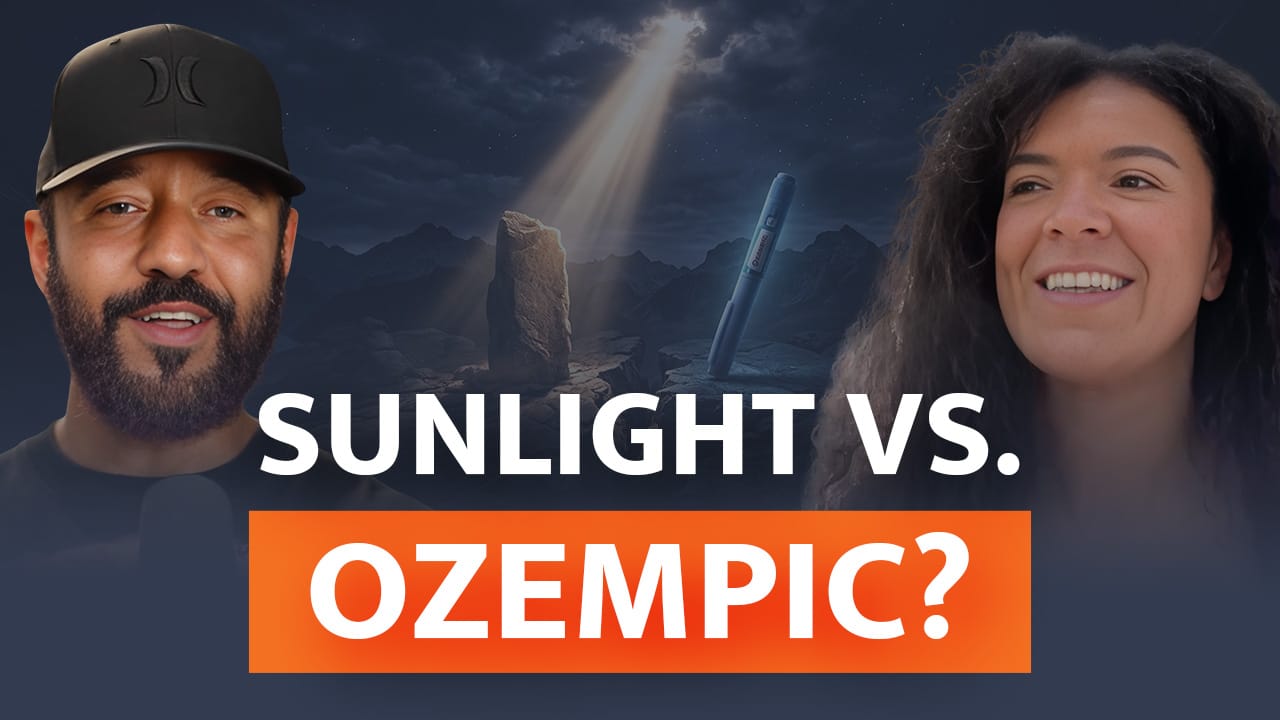
TMHS 1008: How Sunlight Supports Weight Loss, Appetite Regulation, & Disease Prevention – With Dr. Alexis Cowan
Most people know that sunlight exposure can help regulate your sleep or help boost your vitamin D levels, but did you know that a healthy dose of outdoor sun exposure can also influence your metabolism? Today you’re going to learn about the powerful impact that light has on human health and longevity.
On this episode of The Model Health Show, Dr. Alexis Cowan is back for a conversation on the role that different light spectrums play in regulating human health and behavior. Dr. Cowan is a Princeton-trained PhD from Princeton from one of the top metabolism labs in the world. Her work is centered around the intersection of light, mitochondrial health, and biophysics.
In this interview, we’re diving into the interesting science of how light sends signals to our biology. You’ll learn how different light spectrums can affect your weight and appetite, influence your susceptibility to chronic illnesses, impact your eyesight, and more. This conversation is a fascinating look at the fundamental relationship between humans and the sun. I hope you enjoy this episode of The Model Health Show!
In this episode you’ll discover:
- How our modern environment compares to ancestral conditions. (6:22)
- What different light inputs can signal to our biology. (8:53)
- The role of UV light for human health. (10:24)
- How UV light exposure impacts appetite regulation. (17:43)
- The dynamic relationship between clock genes and light inputs. (21:35)
- What the link between blue light and leptin is. (23:28)
- How sunlight exposure can affect your eye health. (32:22)
- A conversation on the link between sun exposure and skin cancer. (40:26)
- How to mitigate your risk of sunburn. (43:42)
- The role of melanin in the skin. (46:54)
- Best practices for healthy sun exposure. (52:46)
- How light exposure at night can influence your sleep quality. (1:04:31)
Items mentioned in this episode include:
- DrinkLMNT.com/model – Get a truly meaningful dose of electrolytes in a science-backed ratio. Free sample pack with any order.
- Piquelife.com/model – Doctor-approved, cutting-edge solutions for your head-to-toe health and beauty transformation. Get exclusive savings on bundles & subscriptions.
- The Incubator – Subscribe to Dr. Cowan’s book club!
This episode of The Model Health Show is brought to you by LMNT and Pique.
Most people are underhydrated—and it’s costing you energy, focus, and performance. LMNT delivers a science-backed electrolyte ratio with no sugar, no junk—just what your body actually needs. Get a free sample pack with any order at drinklmnt.com/model.
Elevate your daily ritual with cutting-edge, doctor-approved teas designed to support your metabolism, skin, and overall vitality. Unlock exclusive savings on bundles and subscriptions at piquelife.com/model.
Transcript:
SHAWN STEVENSON: Welcome to The Model Health Show. I've got some profound questions for you. Can sunlight exposure impact your metabolism in ways similar to GLP-1 drugs? And on the other side, can a lack of sun exposure be driving biological scarcity programs within ourselves that are making us gain weight, struggle with our mental health, and manifest chronic diseases?
Today we're gonna be discussing this mind-blowing new research with Princeton-trained scientist Dr. Alexis Cowan. Now, before we get to our special guest, as of this recording, we're moving into the summer months here in the United States, so more access to sun exposure, but more outdoor activities. A lot of people like to get outside and play more, but I want you to keep something in mind.
Obviously, when it's hotter, we're going to be sweating more. We're going to be activating our body's intelligent air conditioning system. And when you sweat, your body loses very significant electrolytes that help us to move, to contract our muscles, to relax, to perform, and also to manage our nervous system and our cognitive function as well.
And a study published in the Journal of Sports Science found that vigorous exercise in hot weather can result in up to seven grams of sodium loss. Now, this is profound because researchers at McGill University have detailed how sodium deficiency can deeply cause dysfunction with our cognitive health.
And just even keeping in that lane, sodium is required for our brains to maintain proper fluid balance. So this is deeper than just sweating out our sodium. You know how it feel, it's kinda like salty. It kinda tastes salty. Somebody sweat, maybe you give a little smooch and you like, on a cheek and like, "Oh, you been sweaty.
You salty." All right? We're literally sweating out these salts, and they need to be replenished because sodium is a huge driver of our movement, along with potassium, along with magnesium in particular. This combination is profound when it comes to performance and so especially during these summer months, we wanna make sure that we're eating plenty of foods rich in electrolytes and also especially if we're outside and sweating and performing and doing activities, getting our hands on some science-backed clean electrolytes like the electrolytes that I've been using for years from the incredible team at LMNT.
LMNT is the number one science-backed electrolyte drink designed to support active hydration, cognitive performance, and a healthy lifestyle. LMNT has the science-backed ratios of sodium, potassium, and magnesium to help you to feel and perform your best. No sugar, no artificial colors, and nothing dodgy. The best performers in the world use LMNT.
I'm talking about Team USA weightlifting, NBA and NFL teams, Navy SEALs, the list goes on and on. And right now you can try LMNT risk-free with their no questions asked refunds if you don't absolutely love how it makes you feel. Just go to drinkLMNT.com/model right now. That's drink L-M-N-T.com/model to take advantage.
And also, bonus alert, you get a free sample pack of their most popular electrolyte flavors with every purchase. All right? So you have nothing to lose and only better hydration and performance to gain and by the way, lemonade salt from LMNT is popping for the summer. I'm telling you, few things hit like after sweating and playing and competing and having that lemonade salt from LMNT.
Ooh, and it's cold, too ooh, it hits different. So again, head over there, check them out, drinkLMNT.com/model. And now let's get to our special guest and topic of the day.
Dr. Alexis Cowan is a Princeton-trained PhD from one of the top metabolism research labs in the world. Dr. Alexis defected from academia post-graduation after falling down the rabbit hole of quantum and circadian biology.
Now her focus and efforts lay at the intersection of light, mitochondrial biology, and biophysics. She works with and educates professional athletes and sports organizations, schools, and individuals disenfranchised with the centralized approach to facilitate the science and practice of health and performance.
Let's dive into this conversation with the incredible Dr. Alexis Cowan.
We've got round two with Dr. Alexis Cowan. I'm so happy to talk to you. How you doing today?
DR. ALEXIS COWAN: I'm doing so great. I'm so happy to be back. Like we were mentioning just before we kind of hopped on, I have been wanting to podcast with you again and get my kind of chops going again 'cause I've been off the podcast circuit for a while, and I'm really excited to chat today.
And like you said coming into this conversation, it's the perfect time to have a conversation about light and the sun given that we're about to come into the summer solstice in a couple weeks. So I'm really excited to chat about it.
SHAWN STEVENSON: Perfect timing. You already know. And last time when we had a conversation, there were a lot of mind-blown emojis.
There were a lot of just incredible insights, ahas, and, I'm so grateful because we are just tapping into something that is uber valuable and as you mentioned, as of this recording, we're heading into the sunnier summer months here in the US, and as a result, access to some profound benefits for our metabolic health.
And so let's start off by talking about how adequate sunlight can actually promote weight loss and improve our metabolic health. Let's start there.
DR. ALEXIS COWAN: Yeah, sure. I'd love to. So I guess to start the conversation, I'd like to contrast the modern environment with the, an ancestral or more evolutionarily consistent environment and how those inputs are different and what that means actually.
And so if we look at modern humans that are living indoor lifestyles and we touched on this in the last podcast as well for sure, but just as a reminder for people. If you're sitting inside, you are most likely under fluorescent bulbs, LED bulbs, you're on screens. Obviously there's windows, so the glass is also a filter for light.
And basically, the net effect of all of these inputs is, is that we are missing certain parts of the light spectrum that we would typically get if we were living a more outdoor lifestyle. And we're also getting an enhancement in other parts of the light spectrum. So in particular, the LEDs, the fluorescents, the screens, they're all enriched in the blue frequencies of light, and they are all highly deficient in infrared and UV, ultraviolet.
And so the UV and IR portions of the spectrum we get, in abundance from the sun. Over fifty percent of sunlight is red and infrared. Obviously people kind of know now about like the hype around red light therapy, not re-necessarily realizing that sunlight provides all that you could need with regards to red and infrared light.
It's literally the dominant portion of the spectrum. And then of course we get UV light from sun, though it's a smaller portion than people might imagine. Less than eight percent, depending on the time of year and your location on the planet is gonna be in the UV range. Most of that is UVA, a small portion of UVB.
UVC is in sunlight, but our ozone layer scatters it into back out into space, so it doesn't reach the planet, though UVC light is still relevant with regards to our biology, and we can circle back to that later. So if you're sitting inside all day working an indoor job, whatever people do inside, most activities, ninety percent of time that Americans spend is indoors, more than that actually and modern school children in the public school system get less outdoor time than maximum security prisoners. I love to highlight that just because it's just a shame when it comes to the health of our kids and our society. It really starts, at a young age, building healthy habits, and we kind of are doing, these kids a huge disservice.
And why is that? So when we are restricting infrared and UV and we're getting an abundance of blue, we're sending certain signals to our system that then have knock-on effects at a whole body level, at a metabolic level, at a cognitive level, and basically at every level in the system and with regards to health and disease.
And so the way that I like to think about it is that there are certain signals that the body's looking for to determine what time of year it is. Now, we know that when bears, for example, are preparing for hibernation going from fall into winter, what do they do? They eat a ton, and they put on a ton of weight.
So the food and the calories that are coming into their system are preferentially being stored as fat as an actual adaptive mechanism to be able to withstand the long winter months when there's cold temperatures, low energy availability in the form of food, like food is not abundant in the wintertime.
Now, what else does the wintertime come alongside? Low UV, right? We know that UV light basically, depending on what latitude you're at, can go away in almost entirely in the wintertime UVB in particular. For, for example, here in Jersey, we lose UVB light entirely for about six to eight weeks. If you live in Scandinavia, you could almost entirely even lose UVA light.
You still maintain a little bit of it, but needless to say, UV light goes down tremendously at high latitudes in the wintertime. So that's one signal that the body is using to determine, is this summer or is it winter? Is UV abundant? Is energy abundant? UV is a signal of bioenergetic abundance. It's a sign that there is plant foods growing, that animals are fertile
like, all of these things go alongside a high UV environment Now, if you're living an indoor lifestyle that's completely devoid of UV light, and when you go outside, you're also wearing sunscreen and sunglasses and contacts that are all blocking UV inputs into your body, your body is receiving the signal of eternal winter.
When we don't receive this UV light from the sun our biology is thinking it's time to be in scarcity mode, essentially. We have to be very thrifty around how we use our energy, how we partition nutrients. We're going to preferentially partition nutrients that are coming in into fat to allow us to withstand the winter months.
The problem being, though, that the winter months never end in the modern human lifestyle because the UV light is continuously blocked and avoided at all turns. In contrast, when we are living in accordance with the seasons and living a more outdoor lifestyle and getting those inputs into our system, when we're getting the UV light, when we're getting the carbohydrates, because carbohydrates are also a sign of spring through fall, essentially, the more summer fertile, abundant months of the year.
So when we're eating carbohydrates, we're getting UV light. Obviously, the sun also helps us to process and clear carbohydrates, metabolically speaking so they go hand in hand. When we're getting those inputs, our bodies are getting the signal of bioenergetic abundance. And actually, this is what drugs like Ozempic are mimicking.
They're mimicking the signal that we would naturally get from UVB light, which stimulates the production of something called POMC, which we talked about in our last podcast, proopiomelanocortin. It's made in the skin and in the brain in response to UV light on the skin and coming in through the eyes.
And POMC is cleaved into a variety of peptide hormones, ten different ones. But the one with regards to metabolic health and, appetite and energy expenditure that is the most important is gonna be our melanocyte-stimulating hormones, or MSHs especially alpha-MSH. So when alpha-MSH is made in response to UV light exposure onto the eyes and the skin it basically helps to inhibit appetite, increase energy expenditure, and send a signal of bioenergetic abundance to the system.
It's like we don't need to hold onto excess fat, we don't even need to eat that much because we have enough energy coming in from our environment. Like, obviously you can eat food as one way of receiving energy, but newer research, even from Dr. Arturo Solis Herrera and others, is showing that our bodies can actually directly harness UV light as well as a form of energy.
That doesn't mean that you can't ever eat again and just leverage the sun. I don't think we can run fully on human photosynthesis, and that's not what I'm arguing. But there is a contribution to energy production and bioenergetic status from UV light is what it seems, and it's probably via melanin, melanin harnessing this UV light and actually being able to use it productively to support our bioenergetic systems.
So this is like summer metabolism. These are the signals that come together to help create, lean bodies that are healthy metabolically speaking. The mitochondria are functioning well. The appetite is regulated. The dopamine system is also being regulated because another thing that is produced from POMC is beta-endorphin, which is our endogenous opioid molecules-
that make us feel really good, reduce anxiety and depression, improve overall dopamine status and critical thinking abilities, reduce compulsive behaviors and so these kind of factors come together to create a state where you essentially just feel like replenished and like you're not in need of like you don't necessarily need anything, so to speak.
Like, I think our culture really thrives, the materialist culture that we live in really thrives on people constantly feeling a sense of lack. Like, you constantly need something outside of yourself in order to feel whole. And a lot of that comes fr- at a hormonal and, like, a biochemical and biophysical level from this lack of UV light input.
And obviously you can go down the conspiracy rabbit hole when you think about that. It's like, okay, it makes perfect sense why the centralized paradigm is constantly telling you to avoid UV light at every turn. It actually makes you more easily controlled. It makes you more likely to spend money frivolously.
It makes you more likely to feel insecure so that you're gonna buy into the materialist culture that we live in. That's a little bit of an aside, but from a metabolic standpoint, we really want to be focusing on summer inputs and leveraging our natural environment if we want to be healthy in the context of that environment.
SHAWN STEVENSON: Okay. already, you blow my mind again. You blow my mind again and I've got several questions within this and so just overarching again, we have not been educated or even miseducated about the influence of sunlight on our hormones, right? There's such a huge conversation, fortunately, about hormone health going on today.
But this is the number one input that's influencing what's going on with our hormones, our circadian timing system, when certain hormones are getting produced, let alone seasonally, right but also in our daily lives and having these clock genes being influenced, right? So we understand that these circadian clocks that are controlling just about everything that our bodies are doing and when they're doing them, these are really glorified genes and proteins that control our other genes and proteins.
And so the number one input for this is light and lack thereof. And so what if we're never getting the inputs or very, very rarely getting the inputs we would frequently be getting to help to synchronize these systems so that we, again, we're, we just are healthy. That's the normal state.
Whereas today, as it is very abnormal to be metabolically healthy. One recent study found that only 12% of US citizens are metabolically healthy, and even that comes with some caveats. And so I wanna circle back really quickly because when I'm thinking about the impact, just a superficial impact of sun exposure, of UV light exposure and we think about the relationship between this UV light and cholesterol in our system and building our sex hormones, right?
Or we think about just subcutaneous fat, right? That's something we know that the sunlight is accessing, and knowing that things like leptin, right? So some of our satiety hormones literally living in our fat cells. So is there an impact? Do we know if there's a, an impact? Well, and I know the answer to this already, but I want for you to share it with everybody as far as, like, appetite regulation when it comes to UV light exposure and helping us to very much like you mentioned, like these GLP-1 drugs when we simply get light exposure
DR. ALEXIS COWAN: Yeah, there's a lot to unpack here. So in addition to the alpha MSH component of POMC being produced from UVB light also inhibiting appetite which of course is a sign that your body's like, "We're good. We don't need extra energy coming in" and that has nothing to do with willpower, by the way. Like, I want really people to understand that, like, when we're talking about this the conversation around weight loss is so largely focused on discipline and willpower, which by the way, both of those are epiphenomena of your dopamine status.
So if your dopamine is run into the ground and you're constantly on the dopamine rollercoaster from your screens and your processed foods and whatever, gambling, pornography, drugs, alcohol, whatever it is, if you're constantly on that rollercoaster, you're gonna be more likely to continue on that rollercoaster and reach for the hyper-palatable thing or whatever else.
We're not talking about that though. What we're talking about is at like the biophysical, biochemical level, appetite is being regulated, and it's being regulated centrally in the brain. Like, you don't actually have control over whether you feel hungry or not. You don't have control over how much energy your body is burning at rest or not, or even how motivated you feel to move.
That's all controlled in the brain. And so the whole conversation around, like, calories in, calories out, and, like, energy balance, while it's true, you don't have control over either end of the equation. You can't control what's coming in, like, fundamentally. You can do it for a short period of time, but over the long term you cannot control how much you eat.
You can restrict for a period of time, but then you're gonna binge later on. It's just a fact of life and so that's why it's so important to think about optimizing your environment and the inputs coming into your body and when you do that, you're setting yourself up for success in the short and the long term instead of these much more short-term strategies with regards to restricting and overworking out and all these types of things.
But with regards to light, so that's kind of the UV part of the equation relating to alpha MSH and POMC but as you brought up, leptin is a very important part of the equation when it comes to appetite, energy balance. Also leptin is one of the primary hormones involved in puberty initiation, especially in girls, but also in boys to a certain extent as well.
And so it's actually very interesting, but it seems like there are these different clocks, right, that are running in our bodies. We think about the circadian clock as like this 24-hour clock that is being set by light and dark cycles. In particular, the blue fraction of light is what's primarily setting that master clock in the brain.
The SCN, the suprachiasmatic nucleus, it's looking for blue light of a certain intensity from the environment, but also in a certain ratio with other portions of the light spectrum And that's also why I think a lot of the gadgets and stuff with regards to like, oh, 10,000 lux lights for circadian health, blah, blah, blah, it's not really considering the combinatorial effects of different parts of the sun's spectrum at different times of day.
We can only mimic so much in our technology versus the technology that nature has already provided with us with- ... is so much more advanced. We can't even begin to comprehend how we might engineer that, like in a lab or in a factory to be able to get the same effects. And what I mean by that is At every time of day as the sun moves from horizon to high noon and back down to horizon, the light spectrum, the distribution of wavelengths changes dramatically.
So there's a specific ratio of red and blue in the morning, and as the sun shifts towards high noon, the short wavelength, the blue and the UV increases. So the relative ratios are changing, and the relative ratios are encoding information about what time of day it is just makes perfect sense, right and we are yoked to that, and we're meant to be receiving that in order to allow the clocks in our bodies to be modulated and set in a coherent way because we want all of the clocks in our body to be on the same time, keeping the same time.
Right. That's what coherence is at some level. We could talk about coherence at like a quantum biological level too, but with regards to circadian biology, this is kind of what we're talking about. So with regards to leptin, it seems like there's clocks in our system that run not at the twenty-four-hour scale, not even at the month or the year scale, but maybe on like even twelve-year cycles because how on earth can you imagine that, like, leptin suddenly can surge to a point to trigger puberty, like There are so many amazing things going on in biology that, like, we're literally just scratching the surface on being able to comprehend. Like, imagine the cascade that needs to occur at the right time.
Like, puberty is happening between, like, twelve and fourteen years old typically. Like, what are the signals that were laying dormant for twelve years and then suddenly rising to the top? Like, there is a very exquisite timekeeping mechanism in our bodies that we literally can't even begin to fathom, and I think it's really exciting research, and I hope, people continue to probe it and be curious about it because it's amazing.
It's miraculous but with regards to leptin and appetite, the important wavelength of light that we're receiving from the sun with regards to leptin is actually blue light and so blue light stimulates this receptor called Melanopsin. Melanopsin is a blue light detector. It's expressed on our skin, in our subcutaneous fat, in our cardiovascular system, on our eyes, in our brains.
It's kind of everywhere and leptin essentially can be stimulated when blue light interacts with our subcutaneous fat depots, and that's also why nature put our subcutaneous fat underneath our skin. It's so the light can actually still reach to it and regulate it and allow it to understand something about the environment because light is a very reliable signal from the environment.
The sun comes up and goes down every single day and so when that signal is that high of fidelity and that reliable, of course, biology is going to take advantage of that to regulate and yoke itself to its environment because that will increase your survivability and your ability to successfully reproduce and live and thrive by using environmental cues in order to sync up your body to that environment.
So when melanopsin and subcutaneous fat gets stimulated by blue light, it helps to create leptin, liberate leptin, which can then travel to the brain and the bloodstream and stimulate something called the Leptin Melanocortin pathway. Melanocortin, when you think of melanocortin, you can again think of those MSHs that we talked about with POMC.
They are working on the same pathway through different means and so leptin also works on the MSHs and in doing so decreases appetite and increases energy expenditure and so leptin resistance, of course, is essentially when leptin gets elevated from our subcutaneous fat. It's liberated, but the brain cannot effectively sense the concentration of leptin in the bloodstream.
And so in that issue, essentially what it can't do is understand how much energy is on board because leptin is can be thought of kind of like a thermostat for total energy availability in the body and this is another problem with drugs like Ozempic, is it's sending the signal of bio-energetic abundance, but simultaneously the opposite is actually true because drugs like the GLP-1s are essentially, dramatically inhibiting appetite, so no energy is coming in. You're also not getting UV light, so that's another form of energy that's not coming in as well and so the signal being sent to the body is, "We're good. We've got plenty of energy on board.
Let's run the system as such,"when in actuality the body's being run into the ground bioenergetically because it's a false signal. It's a facade essentially. And so the ramifications of that, I think we don't even have any idea over the long term what that might mean from a metabolic, a mitochondrial perspective.
At the very least, we can surmise that when people come off these drugs, the weight is gonna come back on like that and probably even more so than whatever their starting point was. The other important thing about leptin to understand is that the blue light coming in through the skin needs to be of sufficient intensity in order to actually reach to those fat depots and stimulate that leptin production.
And so the blue light that we're getting from our LEDs, fluorescents, screens, it's not quite gonna cut it. It's not quite intense enough to penetrate and fully engage these mechanisms because of course, people might think, I mentioned blue light earlier is enriched in indoor environments. Oh, isn't that great for leptin?
No, not really because the light intensity is so much less than something like the sun. If we're talking about the sun, we're talking like a hundred thousand lux of light midday. Compared to indoor environments, we're talking a thousand lux tops usually. Maybe we can get to five to ten thousand if you're really intentional about it.
So the total intensity is just much, much lower, which is a problem for circadian health because bright light is one of the primary inputs needed to set that circadian clock. The second input being the spectrum of the light is also very important. So it's really important to get enough sunlight, the blue light from sunlight onto our skin and to, onto our subcutaneous fat depots if we want to optimize the leptin system.
And what that also means is exposing as much skin as possible to the sun when you're in the sun because the benefits and the effect that you get is larger when more skin is exposed. That's true not only from a leptin and blue light perspective but from a UV light perspective as well. The more skin that's exposed to UVB light, the more vitamin D you make, the more POMC you make.
The more skin that's exposed to UVA light, the more nitric oxide you make. UVA light is a primary stimulator of nitric oxide production within the skin. So within the cutaneous layers, nitric oxide can be produced. Its, production is catalyzed from UVA light, which can then diffuse into the bloodstream and help support vasodilation, cardiovascular health, blood pressure regulation waste removal from tissues, nutrient delivery to and oxygen delivery to tissues.
So many important things, UVA light plays a critical role in that department but of course, in the modern medical system, this is completely disregarded. We used to have sunning decks on tops of hospitals before the Flexner Report and the kind of entire overhaul that our medical system underwent in the earlier 1900s, like around 1920 There was a lot of wisdom in our medical system before we started to, I think, develop an ego and hubris, and also around the time that big pharma started to get a foothold and a lot of people don't know that big pharma is essentially rooted in big oil, so there were specific byproducts of the oil industry that they were like, basically, "How can we make money off these things?" Well, let's we can actually make some drugs and sell them and, if we then educate the doctors to make them think that they need to sell these drugs and that they're benefiting people, well then, the more the merrier.
And so that's a whole history lesson that I won't get into right now. But there's a lot of wisdom packed into reconnecting with nature, and people can experience it for themselves. For example, my father-in-law was in the hospital with a hypertensive crisis last year around this time. I remember I told this story last time.
He was on, like, three different blood pressure meds. His blood pressure would not come down. It was a beautiful day out. We're like, "Hey, you're clearly not improving where you're at. Check yourself out of there. Go home, sit in a lawn chair in the sun, and let us know what happens." And within an hour of doing that, his blood pressure was back to normal.
It's almost malpractice, this, the state of affairs, when we have such powerful and potent inputs at our disposal for free from nature, and yet they are the last things that get recommended. It's just... I could rant all day.
SHAWN STEVENSON: This is why I have you here, and I'm so grateful, and we're all so blessed to be able to talk to you and to learn from you, because it's just, again, reminding us of what's most important in these high-leverage activities.
Again, it's so incredibly simple. That's part of the genius in masking all this stuff and I really want to, today, to really spark a movement in the way that we're doing things and how we're approaching our lives day to day because, as right now humans, for the most part, you mentioned this, the 90% of time indoors statistic, which again is...
It depends on where people live also but in many instances, it's more than 90% and then add to that enclosed vehicles, that's another 5 or 6%. It's like we are barely outdoors anymore and as a result of that, modern humans are now living in a state of eternal winter, basically. And the question is, and what you're already unpacking for us, what are the ramifications of this when we evolved, like, incredibly different from this.
And what this is doing is driving biological scarcity programs within our cells, within our tissues, within our organ systems. We are perpetual hibernating bear, right? For the most part in our society. We're carrying all of this excess, and our energy is low, and that is just, that's just the, the tip of the iceberg.
There's so many downstream ramifications with this eternal winter and so thank you for, helping to open our eyes about this. And speaking of eyes, this is one of those primary inputs for light and for regulating the system and earlier you mentioned, of course, yes, obviously sunglasses are going to be, we're out, maybe we're out in the sun or we're out in the daytime, but we're wearing sunglasses.
Something we don't think about that I have never thought about until you said it today was contacts. Wearing contact lenses because that's going to distort the light that's getting in and helping to you know, regulate this system. I've never even thought about that before.
DR. ALEXIS COWAN: Yeah. At least with glasses, they're easy to pop out, on, or pop on and off rather.
With contacts, I've, obviously it's a bit more of a, a commitment. You're putting them in. You're probably not gonna pop them in and out all day. There are some brands that are better than others. So the ones that I wear are called Dailies Total1, and they're in the purple and white box, and they don't have added UV blocking.
And so you're going to get a pretty high fidelity signal of the sunlight spectrum when you're wearing those. Obviously, it's better to not wear them at all, so when I'm, like, laying out, for example, or if I'm getting morning sun or midday sun, I just go with naked eyes, and there's actually benefits to doing that as well.
So for example, in my case, over the past couple years, I've improved my prescription in both eyes by almost one entire point just by engaging with adulterated sun exposure onto my eyes regularly, every single day and blocking blue light at night is the other thing as well, reducing screen time because whenever you're focusing your eyes on something that's close to your face for extended periods of time, it's kind of like a use it or lose it thing. Like, yeah, your distance is going to suffer if all you ever do is focus on things that are close to your face. The, fine motor skills of the muscles that contract the pupil and dilate the pupil are going to be impaired if you're not using them effectively.
They're going to get weak. They're gonna get lazy and so it's important to take breaks if you're gonna be working on screens or at anything close up to your face, even reading a book to take breaks looking at a distance, like at the horizon, like, gazing. We really don't gaze as humans anymore.
Like, everything we do is kind of like hyper-focused, and it turns out when you focus your eyes on a point close to your face, it also naturally engages the sympathetic nervous system. And so it's just another way that we're kind of contributing to our nervous system dysregulation and our lack of parasympathetics, is the way that we are using our eyeballs and the kind of activities that we're engaging in.
So trying to take breaks every hour to just go outside, ideally get the natural light, and look at something in the distance for even just a couple minutes can make quite a big difference when it comes to eye health when it comes to nervous system regulation and obviously if you're getting the full spectrum sun as well, you're getting all of the benefits to circadian and quantum biology health in doing so as well.
SHAWN STEVENSON: All right. I'm about to give you the tea on longevity. There's one beverage that has been found and scientifically proven to contribute to longevity far better than anything else. A phenomenal peer-reviewed study published in The Lancet just last year found that people who regularly drink tea age slower than everyone else.
Using clinical biomarkers to determine biological age and following thousands of participants for up to four and a half years, the researchers found that, number one, transitioning from not drinking tea to tea drinking was associated with a decrease in biological aging versus people who remained non-tea drinkers.
That's the tea. Number two, even stronger associations were found in consistent tea drinkers, and number three, the research suggests that drinking around three cups of tea per day had the most anti-aging benefits. Now, there are so many varieties of teas to choose from, and they're teeming with different benefits, from green tea to herbal teas like rooibos tea
but there's one tea, if we're speaking about anti-aging, that you need to know about. It's been found to have anti-aging and anti-obesity effects. This is according to a study published in the journal Clinical Interventions in Aging that found that the renowned science-backed tea called pu'erh makes a notable difference in weight loss.
In this double-blind, randomized, placebo-controlled trial, the researchers stated, quote, "Consumption of pu'erh was associated with statistically significant weight loss when compared to a placebo. Fat loss was seen for the arms, legs, and the hip and belly regions." Unquote. The participants who utilized pu'erh lost more overall body fat, and what was especially remarkable was they maintained their muscle mass during their weight loss.
This is that major component of longevity. There's only one pu'erh that I drink, and this is my favorite tea. I've been drinking pu'erh for years, and it's from the incredible team at Pique Life. Go to piquelife.com/model right now, and you're gonna receive up to 20% off, plus some limited time free bonuses, like an electric frother to mix your favorite beverages.
Their pu'erh is made from a patented cold extraction technology. It's triple toxin screened for purity, and it's wild harvested, so it's even richer in these incredible polyphenols that lead to those amazing benefits that we talked about and right now, you get to try Pique Tea's risk-free with their 30-day money back guarantee.
You either love it or you'll receive a full refund. So you have nothing to lose and better health to gain. Head over there, check them out. It's piquelife.com/model that's P-I-Q-U-E-L-I-F-E.com/model. Take advantage. And that is the tea. Now back to the show.
This is also one of the greatest points that you've made today, and I'm leaning into more intentionally, thanks to our conversation that we had last time, is getting as many data points for sun inputs
and what I mean by that is having more of our skin exposed when we are getting sun access whenever we can. This is the value of these times of year when you could wear less and we have this moniker in our culture, sun's out, guns out, right? Or sun's out, buns out. It has and we want to upgrade that to back and chest out brings your best out.
All right?
DR. ALEXIS COWAN: Hey, let's go.
SHAWN STEVENSON: Come on.
DR. ALEXIS COWAN: Let's go.
SHAWN STEVENSON: I just did that. Come on. So
DR. ALEXIS COWAN: I see a T-shirt. Actually, no make it one of the mesh t-shirts at least so the light comes through.
SHAWN STEVENSON: Come on and those are stylish. But again, so if we can to be able to have our shirt off and/or, like a, a little, cami or whatever the case might be, something that allows more of your skin to be exposed when we have this opportunity.
And so again, this is really just helping with all of those clocks getting synchronized and giving you more metabolic, mental health, cardiovascular, the list goes on and on, benefits. But this brings us to an important part of this conversation that I still... There are so many people who are listening today don't know about because of the prevailing narrative about sun exposure causing cancer.
And if you could, can you talk a little bit about that and that concern? And also pair that up with what about the diseases that sunlight dramatically reduces the risk of those things? So is there a trade-off with this whole thing? And, number one, first and foremost, can you address our fears around sunlight?
Should we be afraid of getting skin cancer if we're out there in the sun?
DR. ALEXIS COWAN: Yeah, thanks for asking because the data on this is actually way more complex than we're led to believe in the mainstream. And if you actually look at the dermatology literature, it becomes very clear. So there are three different types of skin cancers we need to think about if we're gonna have this conversation.
So there's basal cell carcinomas, squamous cell carcinomas, and melanomas. Melanomas being by far the most lethal and problematic. The literature on this is actually pretty surprising, so let me talk about some of the trends that are seen within the data. So with regards to melanomas, which are the ones that people tend to worry the most about, low vitamin D is a risk factor for developing melanoma, and if you have a melanoma and you have high vitamin D, you're more likely to have a better outcome.
Essentially, the melanoma is less likely to be aggressive. You're more likely to fully get into remission. So that's one thing. Obviously, vitamin D is made from UVB light in the skin. When it comes to supplementation, we don't have any strong data to suggest that supplementing with vitamin D is going to give you any benefits outside of if you have rickets, essentially.
If your levels are, like, 10 nanograms per mil or less, you probably need to supplement in the short term just to get up to sufficiency from a calcium homeostasis perspective, because that's what vitamin D does at that level. Outside of that, optimizing vitamin D levels to at least 45 nanograms per mil, but ideally between 60 and 80 nanograms per mil via sun exposure is where we see the most benefits with regards to protection against things like all cause, all-cause mortality neurodegeneration, metabolic disease, obesity, diabetes autoimmune diseases, cardiovascular disease, dot dot dot.
So when you kind of introduce this conversation, the thing that really kind of grinds my gears about it is that there's never the risk-cost, the risk-benefit analysis is not ever really portrayed honestly. It's always, "Stay out of the sun. You're gonna get skin cancer," and it's never, "Get out into the sun.
You're gonna protect against all of the top 10 killers in our country." Including t- types of cancers, including colon cancer, breast cancer, prostate cancer blood cancers are all protected against with chronic daily regular sun exposure but back to s- the skin cancer conversation so there's a vitamin D kind of corollary that's interesting.
The other kind of interesting observations that have been made include that indoor workers are more likely to get melanoma diagnoses than outdoor workers, that melanomas are often on parts of the body that are not exposed to sun regularly. These are kind of two observations that are, I think, very interesting and compelling, and alongside of the vitamin D observation, really is pointing to the fact that melanomas do not seem to be caused by the sun per se.
And with regards to the dermatology literature, there could be an argument made that some basal cell carcinomas could be caused by sun exposure. However, I would make the argument that it's likely completely preventable. And what do I mean by that? So If you're going outside like never, let's say you work an office job and you're indoors all day long every day, and then you go on vacation in the summer to the Caribbean and you blast yourself for a week and you get burned to a crisp and you're blistering this is a problem.
And this is also like completely avoidable. If you are building a solar callus, as Dr. Jack Kruse would say, where you're constantly getting sun exposure every day, and if you're somebody who has a, a low fitzpatrick status, I, II, III, you're building up that base tan essentially so that you can tolerate more and more sun.
You're gonna be less likely to burn. The burning is a sign of inflammation within the skin. It's a sign that you've overwhelmed your body's capacity to assimilate the photonic energy load from the sun and so it's a sign you either did too much too fast or that you're living a lifestyle that is not congruent with your body's biophysical ability to harness that photonic load, which could include excess exposure to lots of non-native EMFs, to a lot of blue light indoors.
Essentially, both of these inputs onto the skin increase inflammation in the skin and make it more likely that you're going to burn. Eating a diet that's enriched in processed foods and a lot of linoleic acid, seed oils also likely influencing the fatty acid composition of skin cell membranes, making skin cells more vulnerable to essentially burning, to inflammation.
Eating at night. So regardless of what you're eating, if you're eating late at night, there is some evidence to suggest that eating late at night can also increase your burn risk on subsequent days because the clocks that are present within the gut are linked and yoked to the clocks that are in the skin.
All of our barrier tissues are coordinated with one another, the lungs, the skin, the gut, the blood-brain barrier. They're all essentially the same tissue in different fractal layers. All of them are essentially responsible for maintaining the boundary between the inside world and the outside world and so as a result, they are all coordinated with one another.
So when you eat late at night, you're sending the signal to your gut clocks that it's actually the daytime. It's creating a lack of coherence in the timing mechanism and the timing signal with the gut and the skin and so essentially, your skin clocks can now be thrown off as well and the skin clocks in the melanocytes are important for making sure that your body and your melanocytes can make new melanin in response to sun exposure.
So circadian health, super important if you want to mitigate burn risk. Also, just a total deficiency of red and infrared light is a problem when it comes to burning. So getting out and seeing morning sun and getting morning sun on your body is a great way to prime your skin's mitochondria to be able to make new melanin and absorb that photonic load when you go out again in midday sun
and this is especially true for people who have much fairer skin. This conversation is like almost not entirely irrelevant, but for anybody who's melanated, black and brown individuals, our bodies are meant to be receiving intense sunlight, like essentially year-round. Our skin has evolved for more equatorial solar exposure patterns.
That's why we have the melanin. It's not simply for protection. It allows your body to harness that photonic energy and use it productively like I kind of teased earlier in the conversation. That it's actually absorbing that photonic load, and I made a post about this yesterday on Instagram how melanin is a piezoelectric semiconductor that is actually harnessing photonic energy and electronic energy to not only, support your bioenergetic system, but also every single one of our sense organs, taste, sound, sight, smell deep parts of our brain, they all contain melanin, and that melanin actually plays an absolutely indisposable role for how those sense organs work.
Without melanin, you cannot have a perception of reality. It is so fundamental in how our biology works, and that's whether you have fair skin or the darkest skin in the world, it doesn't matter. Melanin plays the absolute most important role in that context. Now, the melanin that's on our skin is adaptive to the environment that our biology is expecting to receive and interface with.
And so for anybody who has melanated skin, you need more midday sun than somebody with fair skin, and that's because melanin serving as this sponge for light, essentially you need more light to overcome that kind of sponge effect to get all of the beneficial cascades from vitamin D to POMC. You need more UV light to overcome that, that that sponge barrier essentially that melanin is serving as to then make the vitamin D, to make the POMC, and get all those benefits.
And when you begin to understand this, it becomes no surprise that black and brown communities, especially at northern latitudes here in the States, suffer disproportionately with regards to certain metabolic diseases, chronic diseases, cardiovascular disease, hypertension. This is really a story about UV light and different needs for midday sun exposure across different racial populations essentially.
But this conversation is just apparently not one that's ready to be had like, highlighting any differences between races is super taboo for whatever reason, even though we have very discreet and obvious differences in how our physiology is being run at, like, a physics level. And so I'll kind of pause there and see if you have any questions.
Yeah. But I could go on forever.
SHAWN STEVENSON: Well, what you just shared, and that's okay that we have these differences. There are a ton of things obviously that unite us and that we have consistency with, but one of these things with interacting with our environment and our cells being able to pick up data, it's different depending on, the melanin in your body, and that's okay.
I'm thinking about, so this past weekend we went to we had a, a brunch In Santa Monica. And then we popped down to the beach. It was myself, my wife, and my youngest son, Brayden, who's 14 and so, this is like people are doing all the fitness stuff in Santa Monica. There's all these cool contraptions and slacklining and, some people climbing up on stuff like Spider-Man and, but we went down by the water, and where we were kinda camped out, hanging out, just chopping it up, having a good time, there were a, a couple of people who were close to us that had thongs on, all right? So, shout out to Sisqo. One of them was probably, I'm guessing, a Persian woman, and she was laying there on her stomach for probably...
we were there for, like, 45 minutes, all right? And didn't move and she didn't look like she was being impacted in any way, like, not getting, burnt or anything like that. Then maybe 20 feet from her was a guy wearing a thong, and my son pointed him out 'cause I didn't, I didn't see him.
He was like, "Hey, Dad, look at him." 'Cause he was up on his knees spraying himself with some stuff. His skin was so white it was reflecting sunlight off of him. It was just like, I can't even, I can't even describe. I wanna say, like, the movie powder, but not that white.
It was more just kinda, like, reflective and, he was hairless, all right, from head to toe, but he had this little thong on and I was wondering just like, "What is he spraying?" Because he's out here apparently trying to soak up some rays, but he might've been wearing some kind of, highfalutin sunscreen as well.
And so it just got me thinking about, and this is my question back to you, and again, shout out to Sisqo in keeping all this in context, what are some best practices? So you mentioned people with darker skin needing more midday sun. So can you give us some best practices when it comes to our sun exposure?
And I wanna ask you this because we are moving into the summer months as of this recording. Is it possible for us to kinda store up some of this sun exposure, some of this light data once the, the fall comes and we get less access to sun? Like, is this a time for us to bank intelligently bank some UV light?
DR. ALEXIS COWAN: Yeah. So great questions. With regards to best practices, I would say depending on your fitzpatrick status. So if you're super fair skin, you really want to get out in the morning. Everybody should get out in the morning from a circadian perspective anyways. But from a burn protection standpoint perspective, you're definitely gonna wanna bathe your skin in red and infrared light from sunrise, ideally.
You can also, if for whatever reason you can't make it outside for sunrise, which I highly recommend prioritizing, obviously it's quite early this time of year, but it is a really incredible way to upgrade your health in so many different ways. Really anchor in those clocks throughout the tissues of their body, supercharge your mitochondria so that you're protected against a whole host of chronic diseases that are caused by mitochondrial dysfunction, which is basically all of them.
That's one really important thing. Also, before you go outside midday, if you're somebody with fair skin, you can also use a red and infrared light panel if you want to. You can-- There's actually some research showing that it will protect against burning. So maybe ten, fifteen minutes front and back before you go and lay out can help.
And also doing it afterwards as well, there's some data that would suggest that could help as well. Catching sunset would be another way to do that, because sunset and sunrise are both highly enriched in the infrared and red components. That's why it looks red shifted in the sky when you, look at the sky at those times of day.
With regards to banking sun, I would say you absolutely can, and one of the readouts for that is your vitamin D status. So when it comes to getting enough sun for your individual biology, that's why I really like tracking vitamin D as a biomarker. If you're not supplementing with vitamin D and the vitamin D being made is purely through sun exposure, you can use that twenty-five hydroxy vitamin D, the storage form in the bloodstream, as a biomarker for whether or not you're getting enough sun for your biology.
And, and again, I mentioned forty-five minimum nanograms per mil, but ideally greater than sixty and that may sound like a lot to people, but I have many clients and dark skin, fair skin throughout the country, throughout the world, to be honest, and it is absolutely possible. Like, people are actually pushing a hundred with just the sun alone.
It can be done. The more melanated your skin, the more sun you're going to need, again, to overcome that melanin barrier to make the vitamin D and the POMC and all the other great things that you need to make from UV light, but we're talking about vitamin D as like our biomarker. That's why just focusing on it right here.
With regards to burn mitigation, again, avoiding processed foods is a big one. Avoiding late-night eating is another one. Mitigating your non-native EMF exposure, so trying to switch to Ethernet when possible. I'm doing this interview from outside. I have an Ethernet cable running out my window back there.
People might be able to see it. My internet's faster than using Wi-Fi using Ethernet, and you don't have to deal with the essentially the non-native radio frequencies that come from Wi-Fi. So switch to Ethernet when you can. At the very least, try to turn your Wi-Fi off at night. Maybe put it on a timer so that it turns off automatically between the hours of, midnight and 6:00 AM or whatever, so that you're protecting that sleeping window at the very least because that will set you up for success with regards to lower inflammation and better health in general.
The sleep is super important. Obviously, sleep is also a circadian phenomenon. So when we're talking about protecting against burning and optimizing our sleep, we're also talking about blocking blue light at night. So as soon as the sun goes down, opting for red light bulbs, ideally red incandescent bulbs.
If you're gonna be on screens, try to put a filter on the screen. So depending on what screen you're on, phones and computers, you can easily put a red filter or red shift or amber shift on the screen. For TVs, some TVs have settings where you can do an RGB mode, so you can turn the screen red. If you're somewhere where you cannot control the lights, that's when you wanna pop on a pair of blue-blocking glasses.
Nighttime ones should have a dark orange or red tinted lens. Those are the ones that are gonna be blocking roughly all of blue light between four hundred and five fifty. So five fifty is like blue-green, which still has an effect on circadian biology. So nighttime blue blockers, if you're gonna be wearing them because you can't control your light environment, they should be blocking between four hundred and five fifty.
Again, the light coming in through the eyes is very, very important from a circadian standpoint, which plays an important role in making sure that you can produce melanin effectively during the day because those melanocyte clocks are looking for signals from the master clock as well so those would be some of the main things to help mitigate burning.
If you engage in those practices and those behaviors, you're gonna be less likely to burn, more likely to develop a tan. The other thing that I'll say with regards to making melanin is that UVA light can change how melanin granules sit in the skin and basically how diffuse they are. So the immediate tanning effect that you get from laying out in midday sun is not actually new melanin being made.
It's existing melanin being pulled towards the surface. New melanin is only made from UVB light via the POMC mechanism or from UVC light that is made endogenously in the form of our biophotons from mitochondria, but also the, our nuclear DNA emits UVC biophotons as well, interestingly enough. And so that's also why cold water immersion is very powerful from a internal melanin perspective because when you get cold, it ramps up mitochondrial metabolism, and those mitochondria give off way more UVC photons, which can help to build the melanin internally because remember I mentioned all of our sense organs and the deep parts of our brain, like the substantia nigra that are jam-packed with melanin.
Those parts of the body, they can be supported and stimulated melanin-wise through things like cold water immersion and that's why in particular, I do most of my cold water immersion during the summertime. I have a Morozko Forge behind me here. I actually have to get it ready for the season but what I like to do is cold plunge midday and then lay out in the sun right afterwards because the cold stimulates all that internal UV biophoton production, and it also primes all of the semiconductors in your body, including melanin, but also including collagen, to actually work better so that when you lay out in the sun, your body's able to absorb more of that photonic load and again, be less likely to burn.
And you're just, like, essentially harnessing that energy more effectively, and it's gonna be used more productively to support how your body's working at a, a physics level. So those would be some things that I would say that people can leverage and, use to avoid burning. And with regards to people with dark skin, like, I think the colonialist brain rot pop- propaganda just goes super deep.
But there's literally, like, a brand of sunscreen called Black Girl Sunscreen, and like, I-- makes me wanna just, like, scream because your melanin is your built-in sunscreen but it's not just that, it's actually it, again, is using that UV light productively. It's allowing your body to harness it and support your physiology, your metabolism, your mitochondrial function, your bioenergetic system, and yet you need to actually be exposed to that UV light in order to receive the benefit.
The last thing that melanated individuals need in North America is sunscreen. We're already being starved of UV light just from simply being at a higher latitude than our biology is expecting to be, existing in. And so we really need to be harnessing it full force especially if you have like super dark fitzpatrick skin.
You're really meant to be living near the equator, if not on the equator. And so getting out unadulterated sun, you're not gonna burn most likely. Like, I think it's actually a very bad sign if somebody with dark skin is burning at some, in America essentially.
It's a sign of severe dysfunction within the skin, essentially, like a severe inflammatory status within the skin. And so anyway, we talked about all the ways that you can help to mitigate that and reverse that with regards to the food timing and the circadian health and the non-native EMFs, the blue light.
And so those are all things that I would recommend doing for everybody but especially if you have fair skin and you know you're super prone to burning, those are things that need to be prioritized and otherwise, get outside and enjoy it, and your body will naturally tell you if you're getting overheated or you're getting too much.
You then take breaks. Shade is nature's sunscreen. Use it, leverage it. I'm sitting in the shade right now. You're getting a lot of benefits from sitting in the shade, especially if there's green plants around. Green plants reflect a ton of near-infrared light, and so you're being bathed in very healing frequencies by simply sitting outside, even if you are in the shade.
And so if you feel like you're burning, never be afraid to like pop up an umbrella or even put a hat on or put some light linen clothing on or something like this. Those are all totally acceptable ways to mitigate your sun exposure. Sunscreen is not, because sunscreen is changing the wavelength distribution of the light that's reaching your body, and so it's changing the signal, which is changing and messing with the timing mechanism once again.
And so if we're going to block sun, we wanna do it in a way that's consistent with a more ancestral approach, which would be, again, leveraging shade, leveraging clothing
SHAWN STEVENSON: Incredible. Thank you for these insights and again, we need to change the paradigm regardless of as of today, we spend the vast majority of our time indoors, and then we suddenly, out of nowhere for as far as our biology is concerned, we go on vacation and we spend hours at the beach and wonder why problems might arise.
And so again, it's building up. It's like exercise, right? For our skin and building up, as you mentioned, like a building a tan.
DR. ALEXIS COWAN: Solar callus. Yeah.
SHAWN STEVENSON: And building that up over time so that you're not abruptly throwing yourself into these conditions to where, yeah, you might wanna slather up with whatever the case might be if you have fair skin and you haven't been in the sun all year and then you go on a two-week vacation.
It's context with that we gotta keep in mind as well and so what's more abnormal? That phenomenon or not getting access to sun exposure, especially when we have access, and building up time, right? So I was just out in the sun when I text you a couple of days ago. I was outside working out, but, again, I might have spent 30, 40, an hour in the sun each day, midday, for the last couple of months.
And so I could be out there for hours at this point, but I'm not gonna do that just overnight, even for myself, having fairer skin and so, again, it's we have to be more intelligent. We have to take back control of our own biology and understand there isn't a cookie cutter way for us to go about this.
We have to monitor ourselves, but we do know what our bodies need. We need UV exposure, and it's controlling so much of our biology And also I wanna circle back really quickly because you mentioned how this system can get really thrown off even with evening light exposure and there's a study and it's the title of the study is "Light Exposure During Sleep Impairs Cardiometabolic Function." This was conducted by researchers at UC San Francisco, and this was just published a couple years ago. There's so much emerging data on these light exposures at night disrupting our metabolism, disrupting our circadian clocks, throwing off our ability to properly metabolize sunlight, and the list goes on and on and on.
And this study was just, like, the equivalent, and you share this as well of, like, having a television on while you're sleeping or and also they looked at before bed as well, so it wasn't just during sleep, but also an hour prior to sleep, and having this artificial blue light exposure, and it really is disrupting so much leading into the next day and beyond.
This could possibly be two days of ramification. And so great you've already provided us some great, kind of safety measures when it comes to this if we can't control the environment. So before I let you go, shout out to Black Street I wanna ask you about, and just to get some confirmation on this idea about is it possible for us to store light and/or, and again, I know that this is a really interesting perspective on it, the metabolic compounds or the result of our sun exposure, is it something that we can kinda store up for those darker, shorter days and so for us to prioritize? Is that even possible?
DR. ALEXIS COWAN: So I think it's an interesting question. I'll kind of come at it from two different directions. So we talked about how important UV light is as an input. Our biology is very intelligent and has ways of dealing with winter months, let's say. And I kind of alluded to this earlier when I mentioned that when you get cold, it stimulates UV biophoton production internally.
It also stimulates infrared light production as well. That's why if you take an infrared camera, you can look at somebody on it because we're generating heat. We're endotherms, right? So we're warm-blooded. When you get cold, it stimulates the internal production of UV and infrared light. So what is that telling us?
It's essentially telling us that in nature, if there's not UV and IR light abundant from the sun, AKA if it's not summertime, and it's wintertime, and it's cold, and it's dark, and it's kind of barren, getting cold and allowing our bodies to actually feel that cold and experience that cold allows our biology to produce the light that it needs to sustain itself.
And we actually have some really cool data I believe out of-- It was somewhere in Europe, maybe Finland, showing that getting cold actually can help to buffer vitamin D status. And I don't know if it's because the UV photons can actually generate new vitamin D, like the internally made biophotons, or it could be that when you get cold regularly, it helps to increase levels of vitamin D-binding protein in the bloodstream, which helps to buffer the loss of vitamin D that happens over the wintertime.
In either case, what seems to be the case is you would certainly want to optimize your vitamin D levels during the summer when UV light is abundant. So get them over sixty nanograms per milliliter so that when it starts when that UV light starts dwindling, and you can, again, think about vitamin D as kind of this readout for UV light availability and UV light exposure.
So that as UV light starts dwindling and your vitamin D levels start coming down, number one, they're coming down from a higher point, so they're not gonna reach as much of a trough as they otherwise would have. And if you couple that with getting cold, like going for winter walks during the wintertime, I personally don't do a lot of cold water immersion in the winter.
It just it's very brutal, in my opinion. I love doing it in the summer, though. It feels great. But in the winter, I love going on, like, winter walks, even just exposing the face. The face has a lot of temperature receptors that have systemic effects on the body and so going on those winter walks can help to potentially buffer your vitamin D levels as well, perhaps through this vitamin D-binding protein mechanism or perhaps even through de novo vitamin D production in small amounts from your UV biophotons coming on coming online from the cold and, having a lot of the effects that they do internally, including making melanin internally and supporting those melanin depots.
Including they're doing a lot of work as well in, at like a quantum biologic level, and this is a kind of a very important area of interest, and that is that there's a lot of UV-absorbing metabolites in our system. So all of the aromatic amino acids absorb in the UV range and from the work of Fritz Popp and Roeland van Wijk, their research suggests that in order for metabolism to actually even function as intended, the enzymes and metabolites being worked upon, they need to be stimulated by specific frequencies of light in order for them to even do the thing that they're meant to do.
And it's a very kind of compelling and very interesting area of research. But things like tryptophan phenylalanine, tyrosine, these aromatic amino acids are all absorbing in the UV range. And presumably, they have to absorb UV photons in order to actually engage in the things that they need to do, whether it's, making proteins or making small molecules things like this.
So anyways, I don't know if that answered your question.
SHAWN STEVENSON: It does. Absolutely, it does. Again, we have all these incredibly intelligent systems that are honestly, I mean, they're beyond our comprehension but it's as simple as just going outside and being a part of our environment more frequently.
Of course, doing this intelligently and not chalking this up to something that is a like a nice little treat, but something that is required, right? Our genes expect us to do these things, and when we're not doing them, we're going to get gene expression for programs that we might not necessarily want.
And so let's make this a mandate, everybody listening, everybody watching, to proactively get outside more frequently, take advantage of all of these very, very powerful metabolic benefits. Again, we have this emerging paradigm, even more so looking at this pharmaceutical model of targeting our metabolism through these means and, as you mentioned, getting incomplete data or getting false data, and we don't know the long-term ramifications of this.
When we know that when we're deficient in the things that our genes expect, getting these natural light inputs, moving our bodies, eating real food, and then we see the side effects of those things, and then we go down that pharmaceutical model, and it just becomes this vicious circle and so it's great we have access and innovation when it comes to those things when they're needed
but for many of us, we simply need to take our ass outside. And so I appreciate you so much for coming to hang out with us today. Can you tell people where they can connect with you, follow you, and get more information?
DR. ALEXIS COWAN: Yeah. Thanks so much for having me. This was really fun. I'm mostly active on Instagram, Dr. Alexis Jazmyn, J-A-Z-M-Y-N. I'm currently teaching a course that I actually started in October and it's, I don't know how long we're gonna go, to be honest probably a full year but basically we're building a kind of like a bachelor's in biochem degree from scratch, so we started with like intro bio, gen chem, we did organic chemistry
we're in biochem now, we're doing physics, we're doing calc, we're doing all the fun stuff, and we're gonna kind of culminate in our advanced lectures in quantum circadian and mitochondrial biology, and I've just been having such a blast with it, and it's been really cool to also revisit a lot of these subjects that I learned many moons ago in undergrad with like a new set of eyes because I didn't really have the nature-based decentralized perspective at all when I was going through school.
And so it's really awesome to be able to revisit these topics and actually see everything kind of for the first time with like these new eyes and so I've just been having so much fun with it. So if people wanna come and hang out with us it's kind of open enrollment and there's like, everybody gets access to the recording, so you can go at your own pace and whatnot.
So that's where people can find me. That's what I'm working on right now. I also have a book club called The Incubator. We're currently reading A New Science of Heaven by Robert Temple. It's a book about plasma essentially and like plasma science it's actually quite interesting. And we only just started that one.
Other than that, if people want like one-on-one time with me, I have brain rentals available. You can rent my brain for an hour, and we can chat about whatever is on your heart and mind and yeah, people can find out about all that and more on my Instagram. I post a lot of free content. I've got some e-books, got a couple new e-books coming down the line as well. So that's where people can find me.
SHAWN STEVENSON: Amazing. Amazing. I'm grateful that I get to rent your brain for a little bit
DR. ALEXIS COWAN: Anytime
SHAWN STEVENSON: And to share all these incredible insights. It truly is amazing, and yeah, I just, I'm so grateful that you are here and you're doing this work and most importantly, you're about that life.
DR. ALEXIS COWAN: I am.
SHAWN STEVENSON: You truly are. You're living what you talk about, and it is just shining through you, and so I appreciate you so much.
DR. ALEXIS COWAN: Thank you so much. Let's do it again sometime.
SHAWN STEVENSON: It's already done. It's already done. All right, everybody, thank you for tuning in. The one and only Dr. Alexis Cowan, everybody.
Thank you so much for tuning into this episode today.
I hope that you got a lot of value out of this. Listen, get outside. Take advantage of the power of the very thing that allows us to have life here on planet Earth. We need sun exposure deeply on so many different profound levels and of course, we want to practice safe exposure, but we've been miseducated.
Shout out to Lauryn Hill. We've been miseducated, and the fear-mongering around sun exposure basically being out to kill us, the sun is trying to kill us, is just utterly ridiculous, and we gotta stop this nonsense. We need sunlight deeply. It is the number one regulator of our entire circadian timing system, which is determining when everything in our bodies are happening.
When this system gets dysregulated, we experience what we refer to as dysfunction or dis-ease. And so getting things synced up, getting sun exposure is like the quick way to get everything in our bodies in more alignment. And so again, this is one of those episodes where you've really got to take action and practice this because it's just silly to rob ourselves of this very powerful epigenetic controller.
I appreciate you so much for tuning in today. If you got a lot of value out of this, please share this out with somebody that you care about. Keep this conversation going. It's very, very important and we've got some incredible masterclasses and world-leading experts coming your way very, very soon, so make sure to stay tuned.
Take care. Have an amazing day, and I'll talk with you soon.
Other episodes you might be interested:

Maximize Your Energy
Get the Free Checklist: “5 Keys That Could Radically Improve Your Energy Levels and Quality of Life”
HEALTHY MEALS EVERYONE WILL LOVE
The Greatest Gift You Can Give Your Family is Health
When you gather your family around the table to share nutritious food, you’re not only spending quality time with them - you’re setting them up for success in all areas of their lives.
The Eat Smarter Family Cookbook is filled with 100 delicious recipes, plus the latest science to support the mental, physical and social health of your loved ones.



Share Your Voice
0 comments. Be the first to leave a comment.