
Subscribe to The Model Health Show:


TMHS 1009: 3 Things My Grandmother Taught Me About Health & Wellness (That Science Proves!)
Our lifestyle choices can profoundly influence our everyday health as well as our long-term outcomes. And for better or for worse, daily health habits like diet and exercise can often become normalized within families and passed down through generations. Luckily, we hold the power to create this blueprint for our own families with intentional choices and behaviors.
On this episode of The Model Health Show, I’m sharing three valuable health and wellness lessons I learned from my grandmother. You’re going to learn the science behind these valuable principles and how to put them into action for better health and connection.
We’re going to cover essential habits like eating real food, spending time outdoors, and eating with your family. These principles will inspire you to create generational health for your family with realistic, science-backed lifestyle choices. I hope you enjoy this episode of The Model Health Show!
In this episode you’ll discover:
- The importance of eating fresh, real food. (0:43)
- How your metabolism reacts to whole foods vs. processed foods. (4:03)
- The influence marketing has on our food choices. (7:19)
- What percentage of the average American child’s diet is ultra-processed foods. (9:30)
- How the rates of childhood obesity have changed in recent decades. (10:41)
- A simple ratio you can use to eat more whole foods. (13:39)
- The importance of making food fun. (15:42)
- What we can gain from being in a natural environment. (24:30)
- Why you should mandate more outdoor time. (32:03)
- How shared family meals can improve health outcomes for your children. (38:02)
- The science behind how shared family meals can lower stress. (39:27)
- How many days per week you should aim to share a meal. (41:30)
Items mentioned in this episode include:
- Wildpastures.com/model – High-quality, responsibly sourced meat—delivered right to your door. Wild Pastures makes it easy to eat clean without overpaying. Get 20% off every box + $15 off your first order.
- Peluva.com/model – Most shoes weaken your feet—these rebuild them. Peluva barefoot shoes are designed to restore natural movement, improve strength, and support long-term health. Get 15% off with code MODEL.
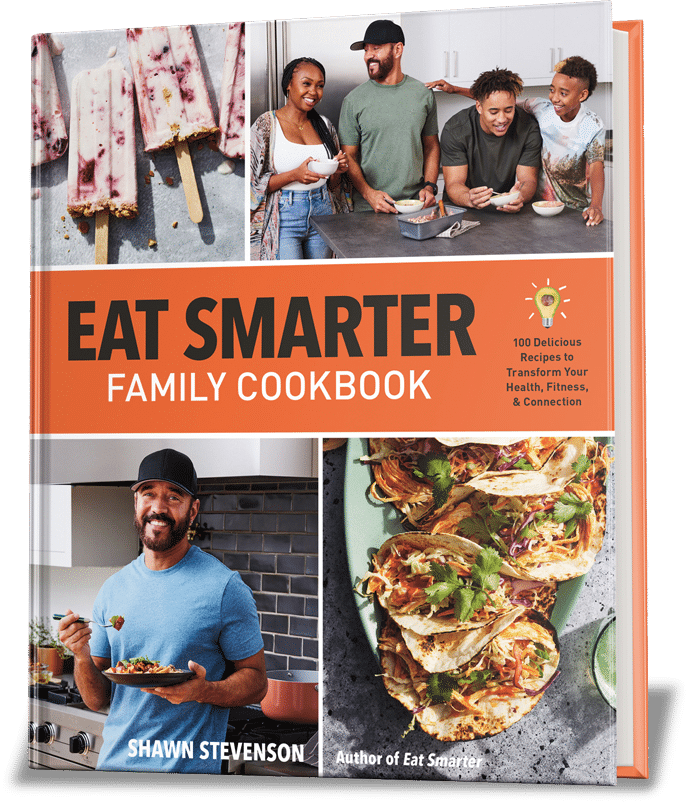
- Eat Smarter Family Cookbook – Transform the health, fitness, and connection of your entire family with the Eat Smarter Family Cookbook!
This episode of The Model Health Show is brought to you by Wild Pastures and Peluva.
High-quality, responsibly sourced meat—delivered right to your door. Wild Pastures makes it easy to eat clean without overpaying. Get 20% off every box + $15 off your first order at wildpastures.com/model.
Most shoes weaken your feet—these rebuild them. Peluva barefoot shoes are designed to restore natural movement, improve strength, and support long-term health. Get 15% off with code MODEL at peluva.com/model.
Transcript:
SHAWN STEVENSON: Welcome to the Model Health Show. Today I'm going to share with you three things that my grandmother taught me about health and wellness. My grandmother was one of a kind. She was my first love, and she was somebody who really helped to create the template for who I am today.
This very special woman created a very special environment for a little boy who had some very tough odds stacked against him. And so today I wanna share these magical inputs and experiences with you so that you will be able to add more magic, good health, and connection in your life and with the ones that you love.
And let's start off with lesson number one that I learned from my grandmother. Fresh food is the best food. I grew up in the 1980s. This was the golden age of fast food, after school cartoons, the WWF, and fast food being taken to another level. It was a time. As a matter of fact, I had one of my earliest birthday parties, my eighth birthday party, at McDonald's.
All right? This was just a normal thing. You get your friends together, you get the little crown on your head, and you lose a friend in the ball pit. All right? This was just a big part of our culture, and this was changing during this time. But my grandmother stayed anchored in certain principles, and I'm so grateful for these things.
Now, I might have fought against them, but she helped instill this blueprint for what was possible, for what was real, for what was sustainable, and creating a normalcy around that. She had a garden at our house, and she canned and jarred a bunch of stuff. We had a cellar in the basement, which was low-key creepy.
I still might pop into a bad dream with that cellar and also trying to run up those stairs, you know how dreams be. But she would create all these incredible meals, and so many of the foods that we ate were things that she grew in a garden. And she was also very adventurous with creating things from scratch.
So of course, we had these amazing family dinners, but also she would come up with ideas from the books that she would read and magazines, regarding recipes. And one time when it snowed, she made ice cream or, like, these glorified snow cones with real snow. And so just making it magical, making it relevant, and also making it sticky.
It was very sticky for me because it was just a normal part of my life. My grandfather also regularly hunted, and he fished, and so we would have these fresh foods very frequently. But again, with the emerging paradigm of ultra-processed foods making its way into our culture's households in such a profound way, of course, I wanted the mac and cheese.
Of course, I wanted the fish sticks. And I ate copious amounts of ketchup in my childhood. My blood was, like, five cc's ketchup at least, all right? And I even joked with, when people that asked me, like, "So, what are you?" Being a mixed kid, I would say, "I'm Black and white and orange because I eat a lot of cheese."
This is true story. And it wasn't real cheddar. We were eating those Kraft slices, which we've run multiple tests now to see just how profound it is with years of this cheese being out, not degrading from natural means as far as like obviously cheese will get moldy relatively quickly. But you could see a Kraft, a quote, "Kraft cheese single" not even break down.
Of course it looks gross, but it's not breaking down and degrading like something natural because it's not natural. And so today we know the ramifications of eating foods like that. There's a profound study that was published in the journal Food and Nutrition Research that sought out to see what would happen with our metabolism when we eat a meal of what they consider to be a whole food sandwich versus a processed food sandwich.
And the whole food sandwich consisted of whole grain bread and cheddar cheese, real cheese, while the processed food sandwich consisted of white bread and cheese product or what would be equivalent to a Kraft single. And what they found was that when test subjects would eat those respective sandwiches, when they ate the processed version of that sandwich, keeping in mind it is the same amount of calories and also very consistent amount as far as the macronutrients.
They tried to get those as close as they could, but it's more difficult with an ultra-processed version. Even though the calories were the same, when people ate the ultra-processed version of the sandwich, they had a 50% reduction in calorie burn after eating that meal. Something happened with their metabolism, creating what was effectively some metabolic clogs to where their bodies simply could not process those foods efficiently.
And what you find, and now again, your body's gonna get it sorted out in the short term, but what if you're eating like that day after day, week after week, month after month, year after year, and your body is constantly dealing with this conglomeration of newly invented chemical complexes, and it's suppressing the overall function of your metabolism.
And this is again, one of those underlying reasons why we see these epidemic rises in all manner of chronic diseases, but included within that obesity and overweight. And so again, I understand, I deeply understand after school cartoons, one of the best things of our reality as a human being here on planet Earth that our kids, most kids today will never understand.
The reason they were so valuable was that's the only time you get them. You get a little cartoon hitter after school for about an hour and a half, and if you miss them, that's it. You got Saturday morning cartoons and after school cartoons, and that's it. Today, they've got multiple 24/7 cartoon networks, of course.
But for us, like this was like, you better be there. You don't wanna miss He-Man. You don't wanna miss ThunderCats. You don't wanna miss G.I. Joe. You don't wanna miss none of it. And if you had cable, of course, you got the Cartoon Network, the USA Cartoon train. But that's if you had cable. And depending on where I was living at the time, whether I was living with my grandmother or my mom, when I was with my mom, no mas on the cable.
Grandma, we did have that Cartoon Network after a while, which was pretty dope. Then you got all these like weird eclectic... You got the Mon Chichis, the Fraggle Rocks, but also the classics The Flintstones and things like that. And so within that, and the reason I'm bringing this up with network television, cable TV, during those times was when I was getting fed those advertisements for ultra-processed foods.
I wanted the Lucky Charms. I wanted the Doritos. I wanted the sodas that I would see on these commercials that were literally targeting me as a small child. And multiple studies have now confirmed that this marketing does in fact deeply influence our food choices and even our perceived satisfaction from the foods that we eat.
In fact, a report published in Archives of Pediatric & Adolescent Medicine detailed an eye-opening study that sought to find out if placing a cartoon character on the side of a box of cereal influenced children's taste preferences. The children were asked to taste test what they believed to be different cereals and rate them on a five-point smiley face scale.
Some of the cereal boxes had cartoon mascots, some did not. Even though the cereal was actually all the same, kids consistently rated the taste of the cartoon-featured cereals better. All right? I loved my Mr. T cereal. I loved my Smurfs cereal. If we're gonna be honest about the drug epidemics, New Jack City, Pookie, we need to talk about that Smurf cereal.
All right? I'm glad that it came off the market because it had me hooked. All right? Just to put it bluntly, I was definitely fiending for those, that Smurf berry crunch. All right? Now, again, just keeping in mind that this is setting the template and this moniker the unsaid principle of getting us while we're young and you have a lifetime customer.
And so this principle that my grandmother instilled for me with fresh food being the best food, our culture has moved further and further away from this principle, and as a result, yes, it has deeply impacted us as adults, but our children today are carrying a heavy burden because of it. According to an analysis published in the Journal of the American Medical Association, the percentage of the diet for US children today that's made up of ultra-processed foods continues to rise and it is now nearing 70% of the average US child's diet being made of ultra-processed foods.
And when I say ultra-processed, I'm not talking about traditional processing of food. I'm talking about taking a bunch of corn and chemicals and somehow, some way, creating Lucky Charms. Right? So the foods that we're eating are so far removed from anything natural or recognizable that they fall into this category of being ultra-processed, and within that- Within this transformation and it being a nonexistent part of the human diet to maybe 10% of our children's diet, 20%, 30%, 50%.
Now it's currently 67, as of this report, 67.5% of the average US child's diet being made up of these foods. And concurrently, according to the World Health Organization, we've seen a tenfold increase in childhood and adolescent obesity in just four decades. Not to mention the shocking increase in type 2 diabetes, autoimmune diseases, and other chronic conditions in children in the same time span.
We've got to make a change, and the power truly is in our hands. It starts with awareness because this transformation in our culture was insidious, and it started off with good intentions because even though my grandmother leaned towards fresh food is the best food, the convenience piece really started to pop up its head in addition to the marketing.
This is providing all the vitamins and minerals that your kid needs to thrive. This sugary breakfast cereal is part of a healthy diet to give your kid everything that they need to go out there and win the day. And so again, the convenience piece, the well-intentioned drive for parents to make sure that their kids are eating, first of all, eating something, but also getting the things that they were being marketed towards, that these are the things that are really gonna help your kid to thrive.
They're filled with... They're fortified, they're enriched with vitamins and minerals. And so how do we take advantage of this very powerful principle, this thing that my grandmother taught me about health and wellness, fresh food is the best food? Well, some simple tips to employ this is to simply make it an intention.
Prioritize real food. Sometimes, and I, again, I'm saying this to make it an intention because I didn't know the difference. I didn't know the difference. Once I moved out of my grandmother's environment and moved in with my mom, which I'll talk about in a moment. My culture completely changed to where ultra-processed foods was the bulk of my diet.
And so growing up with that, it starts to just fade away into the background, and the discernment between fish sticks and wild-caught salmon, it started to become blurred lines. Shout out to Pharrell and Robin Thicke. But keeping this in mind, once I became aware or once I remembered, to put it more bluntly, once I remembered I made it a priority to have the bulk of my diet to be real food.
Now, of course, we could take those real foods and create wonderful meals out of them, but whole food-based. The ratio that is most attainable for a lot of people and also providing that wiggle room to have some ultra-processed stuff in the mix because, again, we live in this reality. There's stuff out here, the accessibility, the cost, all those things.
80/20. The 80/20 rule when it comes to our prioritizing real food, eating a minimum of 80% real foods that our ancestors ate. All right? So make it a mandate, prioritize real food. And tip number two here is to educate our children. Educate our children. Along with these food choices comes an education and an opportunity, and not to harp on them and hammer down, "You can't have this, can't have that."
It's simply to provide the information because our kids are growing up in this environment where there's... They're inundated, they're surrounded by ultra-processed foods. In high probability, they're gonna dabble, if not dive face first into ultra-processed foods when they are out of the house.
And I'm imagining one of those after-school cartoons, DuckTales, ooh, okay. He dove into the money. We're diving into ultra-processed foods. All right, Scrooge McDuck. But this is happening to our children. If they're not aware, like they could start to make a more conscious choice not to villainize anything, but to have some education around it, and also them having the opportunity to be educated on how they feel, paying attention to what's going on in their bodies when they have some Skittles or a soda or whatever the case might be versus when they're eating real food.
So they can have that discernment like, "Okay, I had this thing, but I don't feel the best, so let me get back on those things that make me feel good." But this leads to the other point, which is it's much easier to make those choices when we make food fun. Many of us grew up in the paradigm of don't play with your food.
All right? So I'm not saying necessarily to play with the food, but I am saying to make the food fun, make it enjoyable Real food, creating real healthy meals from scratch, or of course, there are more and more companies that have this mandate to provide real healthy foods for families, but we can make some incredible meal experiences with real food.
And it just makes the whole thing a lot easier when you're having joy attached to it, right? So, recently my wife made some protein pancakes, right? And we love to make like sweet potato protein pancakes, and this is in my book, Eat Smarter, by the way, the Eat Smarter Family Cookbook. And we have all these wonderful meal experiences that are based on real food.
And so finding ways to make it fun, finding ways to get our kids involved, right? So maybe this is making some frozen yogurt pops, for the summertime. Get yourself a popsicle mold and, or maybe some fruit pops or whatever the case might be, and just inviting our kids into the experience, providing an education, and just so that they know why you're doing the things that you're doing.
And creating that template, that blueprint that will hopefully guide them throughout their lives. And by the way, feeding your family high quality food does not have to break the bank. Wild Pastures delivers 100% grass-fed and grass-finished beef, pasture-raised pork, pasture-raised chicken, and wild-caught seafood right to your door.
Born, raised, and harvested entirely in the US, raised on regenerative family farms, and raised on pastures free from pesticides and other chemicals. No antibiotics, no added hormones, no added steroids, no feedlots, and absolutely no GMOs. Fast delivery from their farms right to your door. And right now with a Wild Pastures subscription, you're gonna receive 20% off for life.
20% off for life, plus free shipping and $15 off your first order. Just go to wildpastures.com/model to take advantage. That's W-I-L-D-P-A-S-T-U-R-E-S.com/model to take advantage. In addition to utilizing Wild Pastures, we could save a ton of money by going to farmers markets, and now it's easier than ever to just go do a Google search or ask Chat where are the local farmers markets in my area and take advantage, get closer to our food.
And also this is a great opportunity and experience and environment for our kids to be around so they could see closer where their food is coming from. So there's also community driven, CSAs and things like that. There's so many great ways to save on our food when ultra-processed foods, again, even though they're very cost intensive to make, they come at this extremely low price oftentimes.
They're operating under the premise of quantity, getting you to buy a lot, and definitely have moved away from the quality of that food. And so we have some decisions to make, and the power is in our hands, but sometimes we just need to slow down, create a plan. Maybe we go to the farmers market once a week or maybe once a month, but, like, put it on your calendar and take advantage of these other resources and make it a priority, most importantly, to know and to teach our kids that fresh food is the best food.
Now, moving on to number two on this list of the things that my grandmother taught me about health and wellness. Number two was to go outside and play. I lived with my grandmother from kindergarten through second grade, and after some health challenges with my grandfather, they decided to move back to where he grew up in the country.
So they called it the, quote, "country" down in southern Missouri. And so again, I grew up in St. Louis, Missouri, but they moved to the country, and they had a decision to make. And it was well involving my mom, who I also had two younger siblings, my brother and sister, who were about five and seven years younger than me, living with my mom.
And was I going to now move back with my mother or go and live in Piedmont, Missouri, where there was very few people who look like me, and grow up in that environment? And so coming from a biracial background, the fact that my grandmother even loved me like she did under those conditions, like, there were not many.
Now, of course. All right? We're out here. But at the time, the schools that I went to, there might be one or two mixed kids. And so having this, like, difficulty with identity and also just dealing with some of the things that people would say, obviously, and, being with this, my white side, my white grandmother, and this little boy with the little curly Afro, and, her navigating those terrains.
And I remember incidents happening, like at Ventures. Not Adventures, but at Ventures. So this was a, like a, Target. Before Target came along and, and Kmart, that kind of stuff, there was Ventures. And somebody said something to her, about me at this store, like, in, close to the checkout line.
And so just... And she loved me so much. She really made me feel like I was important, like my life mattered, like I was going to do great things in this life, and really instilled this in me, and also protected me. She protected me with her life. So I'm so grateful. And so with this paradigm, we spent a lot of...
And when I lived in St. Louis, I was outside all the time with my cousin Candy and just outside playing. Definitely in the backyard heavy with the bucket and the, little handheld shovel digging up. I was about the bug life, all right? Lift you know how you lift up that rock and it go... It's crazy.
It's crazy town. Ah. All the stuff, the the worms and the roly-polies and the centipedes and all that stuff. But, and also just playing with my friends in the neighborhood. But moving from the big city to the country was a huge adjustment for me. Moving back with my mom and now I'm in this inner-city life, where now it's more difficult in ways to navigate the terrain of being outside.
We are now exposed to drug use in the environment. We're exposed to violence. We're exposed to you, you just kinda gotta watch your back more when you're outside. But this is not to take away from the beauty and the value and the joy that's experienced in these environments as well. But here's the thing and why number two is so powerful for me, and I wanna extend this to you, go outside and play.
When my grandmother and my grandfather moved to Piedmont, to the country, I got to spend entire summers in that environment, for years. And so I would spend those summers fishing with my grandfather on riverbanks and in tiny motorboats, and also swimming in the rivers and the creeks and riding bikes on gravel roads.
To get to my grandmother's house, it was like literally gravel roads very close, like it's difficult for two cars to be on the road at the same time, and just that crunchy sound. And this is actually on a gravel road where I learned how to ride a bike in the first place, which I don't recommend for children, okay?
But you better believe I learned fast. I fell once. I didn't fall again. My grandfather, shout out to my grandfather, he taught me how to ride a bike on a gravel road going downhill. It was a... It wasn't super steep, but it was steep, all right? I scratched up my knees once, and had weepiness. He's like, "Get back on that.
Get back on there." And, then I rode that bike and, been doing it ever since. It's like riding a bike. But these are the experiences that I had. And, she had the tire swing outside, and there was just so many adventures in this environment. And what's so often overlooked is that those inputs were giving me very powerful epigenetic inputs that were creating a level of health despite the other negative things that I might have been exposed to.
So those inputs of sunlight, of fresh air, of natural terrains. There are multiple studies on just how natural terrains, like my grandmother basically lived in a forest, all right? And so being able to see these natural terrains every day, these, the rivers and the things that we would do and the cold water.
Like I was cold plunging. Little did I know, and so these inputs were creating these epigenetic changes that were creating more and more health for me, and also creating this template, this psychological blueprint that I wasn't even aware of, to the degree that when I became an adult, I somehow, some way, despite growing up and even going to college, living in the inner city, I found myself living in essentially a cabin-like house out in the woods and exposed to wildlife every day.
The wild turkeys, which you don't wanna mess with them, all right? Fox. Is that plural? Foxes? The deer in my backyard every day, and just seeing all this wildlife, the natural terrain and the quiet. That's such a powerful thing we rarely understand today, the value of quiet.
Something that we evolved having access to, and more so, I mean having access to a quiet mind Even when it's quiet in the room, in the city, there's still this electrical buzz. There's still the Wi-Fi networks and the cellular and the radio and all the things that are creating this noise. And so it takes more of a mighty decision to create quiet.
And so this was just natural for me. This was just something that I was experiencing, and the easiest way to get access to this today in some capacity is simply to go outside and play. I was just talking with my neighbor, Stan, and I see Stan just about every day when I'm out walking and he's walking his puppy, Bruno.
All right? Bruno's walking around like this, little, but he's a little dog. Bruno loves me. Apparently, I'm his favorite person. As soon as he sees me, show me the belly. All right? And Stan was sharing some insights with me about the neighborhood. He's been there for decades, and also Stan has been married for 53 years, and I could see the love in his eyes that he has for his wife, and these are the people that I wanna learn from, I just wanna know, like, what made you so successful. He was an entrepreneur. He had his own business for decades, and he worked with people, and he helped people, and he loves his puppies, so he's had Bruno for about a year and a half, but he had a, a, two dogs previously and, they passed away, and just when he talks about it, you could see the love in his eyes for his pups.
And so talking with Stan, he was like, "The neighborhood that we live in used to be ripe with, like, activity and kids outside playing." There are lots of kids that live in the neighborhood, by the way. There are plenty of kids, but they spend most of their time indoors, and if they're outside, what I've noticed, if they're, if they are outside, they're outside with their parents.
All right? So they're not just going outside and playing. Now, of course, we wanna think about the safety construct, but also the pendulum has swung so much to where, again, when I was, Eight, nine, 10 years old. Again, we lived in this time where in the '80s you just go outside and you just gotta be back before the streetlights come on.
You just go outside and play. You get on your bikes and you go. We were living that Stranger Things life, all right? And we see that and we have that nostalgia. This was just normal, but of course, we keep this in context. We wanna make sure that our kids are safe. We live on a very, like a little cul-de-sac, you know what I mean?
Like, there's not a lot... And just being able to maybe even keep your eye on your kids out the but people are less apt to have their kids outside, and also our kids just proactively doing that. And so for my son, it's been several years now, because this doesn't mean that we don't enjoy some quality time indoors.
I definitely did. After long days outside at my grandmother's house when she moved to the country sometimes we'd go by the local video store. There was no name brand stuff, though. There was no name brand video store, all right? It was like Earl's or something like that. I don't know. And then me being me, I would get a scary movie that I had no business watching, all right?
It was kinda like a weird addiction because I would have nightmares and I just, I don't know, maybe it was the thrill of it. And she, where she lived, when it's nighttime, it is nighttime. You look out that patio window, there's nothing. It's nothing, all right? But sheer darkness. And so watching the TV was right by there.
It was creepy AF. But watching movies playing Nintendo. My grandmother had the Nintendo before we did at my mom's house, so I would that's another reason I loved going to her house. She had the Nintendo. She had the gun, so we were playing Duck Hunt with that crappy gun. She also had the Power Pad.
So the Power Pad was like something you lay out on the ground and supposedly, theoretically it's supposed to have that response time. Like we do the track and field and you run in place or whatever. Never, it never kept up. It never did. And I remember then you do a hurdle, it's crazy, man.
She had all that stuff, and so we had good times indoors, but we craved being outside. And so today I've built a culture to where my son might be gaming, right? He might be gaming with his friends, maybe playing 2K or Fortnite or whatever the case might be. But after a certain amount of time he has programmed himself to go outside and shoot around, do some basketball drills.
Like, he doesn't feel right if he just stays in the house all day, and I'm so grateful for that, to see this human experiment come to fruition, and it's just based off of the things that I learned from the environment that my grandmother created for me. And so for kids and adults alike, spending so much time indoors, we're missing on key natural inputs that control our gene expression.
We are sort of devolving into building dwellers who mostly receive processed light, processed air, and restricted movement. And so we want to free ourselves, want to go outside and play. And so what are some tips to take advantage of this? Tip number one is to simply make it a mandate to spend a target amount of time outdoors each day.
If you're doing sporadic right now, where it might be several days, you're actually, like, going outside and, like, doing stuff, maybe you just, like, 10 minutes a day. You make it a mandate, 10 minutes a day I'm going outside and spending some time outdoors. But the easiest psychological way to do this and to make it more consistent is to use a psychological strategy of stacking.
And so doing the things that you're already going to be doing anyways, but doing it outside. And so this could be your time on the phone or voice texting. This could be doing your workouts, adding in some workouts outside. This could be your meditation. This could be your work if you are able to work from a laptop and just spending some time outdoors.
And so stacking is a very powerful thing to leverage, but it's just being intentional and making it something that's consistent. And also indoor time can be balanced with time outside. Like I mentioned, my son during the summer and spending some time gaming, but also spending time outside and hanging out with his friends doing stuff.
Now, another thing for us to keep in mind is that when we were kids, we spent a lot more time without shoes on and getting all of that very valuable biological data in because there are so many different nerve endings on our feet that help to determine our movement. Your foot has twenty-six bones, thirty-three joints, nineteen muscles, and a hundred and seven ligaments.
Each foot has around two hundred thousand nerve endings that are there for collecting data to determine our movement. And modern shoes essentially mute or disrupt thousands of data signals that would normally be transmitted from our feet and feed throughout our body to modulate appropriate movement.
The result, we have epidemics of foot dysfunction, foot and ankle injuries, knee injuries, hip injuries, and more that can be rooted back to modern footwear. Now, don't get me wrong. I love modern styles of shoes. It's this is not a all or nothing thing, but it's being more intentional about this. And having a shoe with a wide toe box with five-toe functionality that's also stylish can be an absolute game changer.
And I call it rehab and prehab for your feet, for your movement, and for your athleticism and the shoes that I wear every single day. When I leave the studio, I immediately throw on my Peluvas. Go to peluva.com/model and use the code model at checkout for 10% off. Their footwear is in a league of its own. So many incredible styles, and also driven towards the things that you wanna do, whether this is just everyday usage, whether this is training, cross-training, whether this is spending time on the court and playing pickleball and things like that, hiking.
They've got options for all of these activities and styles for everybody to enjoy. So again, go to peluva.com/model. That's P-E-L-U-V-A .com/model. Use the code model at checkout for 10% off. Take care of your feet. This reminds me of back in the '80s and '90s and the emergence of the one and only Eddie Murphy in his iconic film Boomerang, and he was the marketing exec and that kind of thing.
It was just, like, so stylish. But also he had this thing about women not having messed up feet. He couldn't do it if they had what he called hammer time in their shoe. All right? We can start to diminish the hammer time in the shoe, develop the health of our feet, and also the functionality. So it's a both/and because having a wide toe box, and specifically with toe separation, has been found to dramatically reduce and even reverse the incidence of things like bunions.
So really cool stuff. Just something for us to be mindful of when we're looking at getting outside and playing. We can also stack conditions by taking care of the health of our feet. So that's number two on this list of these three powerful things that my grandmother taught me about health and wellness.
And now we're at our final one on this list, and number three is for our families, for our health, for our longevity, is to sit down and eat together. When I lived with my grandmother or when I went to visit, every night, every in bold, every night we sat down and ate dinner together. So whether it was my grandmother, my grandfather, and me, or my grandmother, my grandfather, my little brother, my grandfather and me while my grandmother is still tinkering around in the kitchen and eventually sitting down, and this was just a normal part of my childhood, and it again left this very powerful imprint on me.
Now again, moving into another environment, I strayed away from that because the environment was changed. I can count on my hands how many times I sat down and ate with my mother and stepfather at the same time, literally, unless it was a holiday. I ate with my mom sometimes, yes, but a lot of times we get food and we just kinda scatter and just go different places.
Somebody's watching TV or playing a video game or going outside, whatever the case might be. But this culture of sitting down and eating together, when that's been removed from our culture, does that impact our health? Well, children and adolescents are at a very vulnerable stage for the development of environment-fostered obesity.
And a profound study cited in the journal Pediatrics uncovered that family meals provide protection against that. The researchers found when children ate with their parents or caregivers a minimum of three times a week, there was a significant decrease in obesity development in those children and a significant decrease in disordered eating with those children.
While another study published in the Journal of Nutrition Education and Behavior found that children who ate breakfast with their families at least four times a week were more likely to consume adequate amounts of fruits and vegetables. And the question is why? Why does this impact health outcomes and food choices?
In part because of the structure, maybe the intentional meal planning, maybe the elimination of distractions. As noted in the study that I just mentioned, this was when the TV was never or rarely on during these family meals makes such a huge impact, being more present with your food, having a full sensory experience to where the digestive enzymes, whether it's in your mouth or what's going on with your microbiome, everything is synced up in that food experience, and we're not distracted.
And also, we tend to slow down when we are engaged with other people. And so we know about this for kids. What about for adults? What about for us big adult babies? A study cited in the journal Family and Consumer Sciences revealed that sitting down to family meals helped working parents to metabolize stress and improve work, personal, and family outcomes.
This is something that our genes expect us to do, and yet this practice of sitting down and eating together is now on the endangered list. Despite all of the psychological and biological benefits, according to data cited by researchers at Harvard University, only about 30% of families manage to eat together regularly today.
It's just devolving over time And the impact? A peer-reviewed study published in Nutrition Journal found that people who eat alone more frequently have poor diet quality and lower intake of essential nutrients than people who frequently eat with others. This is something we've gotta change. I'm so grateful.
She might have saved me from even worse outcomes, and sometimes having that blueprint, having that template, having that imprint in a child's life might manifest years later. We might go astray, but these imprints that my grandmother provided me with really brought me home. Brought me home to myself, home to my body, home to my relationships, and it's creating a new reality, a new precedent and experience for my family in the generations to come.
So what do we do to take advantage of this and turn this around? Well, today more than ever, we got a lot of stuff going on, a lot of distractions, and if you don't schedule it, it's probably not going to happen. We could take the principle, if it's not scheduled, it's not real. We have so many things on our schedules to do, but isn't this time eating with the people that we love and spending that time together more important than all of it?
So why not put it on your calendar? Choose those days. According to the research, three days a week is that minimum effective dose for incredible health benefits. So pick what those three days are for you. Schedule them. Maybe it's Monday, Wednesday, and brunch on Sunday. All right? That's pretty similar to what we do currently.
All right? Or maybe it's Monday, Wednesday, Saturday breakfast together and Sunday after church service. Whatever it looks like for you and your family, make it a must, because it truly does provide some health benefits that are beyond our comprehension. And also, make it more intentional.
The way that we can really anchor this in and not have to force ourselves or force our kids, especially if you haven't had this to be a part of your culture frequently, is to really lean into those things that create that deep psychological connection and joy and looking forward to it. So this could be rooted in things like game nights, right?
During or after dinner. Conversations, conversation prompts. Depending on where your kids are in their growth and their particular age brackets and interests, this could be, what... If you could have any superpower, what would it be and why? To, conversations about the meaning of life, whatever the case might be, and some of the stoic ideas, right?
So we can also add in music. We can add in creativity. We could do different aspects of art together, right? Whether that's, like, making music, singing, freestyling, doing poetry, whatever that looks like. There's, you know, painting. There's countless ways to engage in artistic endeavors while enjoying a family meal or afterwards as well to make it a real event, make it something special that you look forward to.
So I hope that this was helpful for you I love my grandmother very much. She's still, even though she's not here in the physical form, she's still with me, and I still want to make her proud. That imprint that she left on me, and these principles, and these experiences really helped to create the template for who I am today and how I'm being of service, and I'm so grateful for that.
And I want to be that for future generations, and I know that you do, too. And so it's dependent upon the choices that we're making right now. We've got to write a new story for our families, for our communities, and the time is now. If you enjoyed this, please share your voice. If you're watching on YouTube, leave a comment below, share your favorite insight, or what's something that maybe your grandparent imprinted that is really serving you today?
And also, no matter where you're listening or watching, please hit the like, leave a comment, share your voice, share this episode out with the people that you care about. Let's keep this conversation going and elevating, and I truly do appreciate you so much. We've got some epic masterclasses and world-leading experts coming your way very soon, so make sure to stay tuned.
Take care, have an amazing day, and I'll talk with you soon.
Other episodes you might be interested:

Maximize Your Energy
Get the Free Checklist: “5 Keys That Could Radically Improve Your Energy Levels and Quality of Life”
HEALTHY MEALS EVERYONE WILL LOVE
The Greatest Gift You Can Give Your Family is Health
When you gather your family around the table to share nutritious food, you’re not only spending quality time with them - you’re setting them up for success in all areas of their lives.
The Eat Smarter Family Cookbook is filled with 100 delicious recipes, plus the latest science to support the mental, physical and social health of your loved ones.


Share Your Voice
0 comments. Be the first to leave a comment.