Subscribe to The Model Health Show:


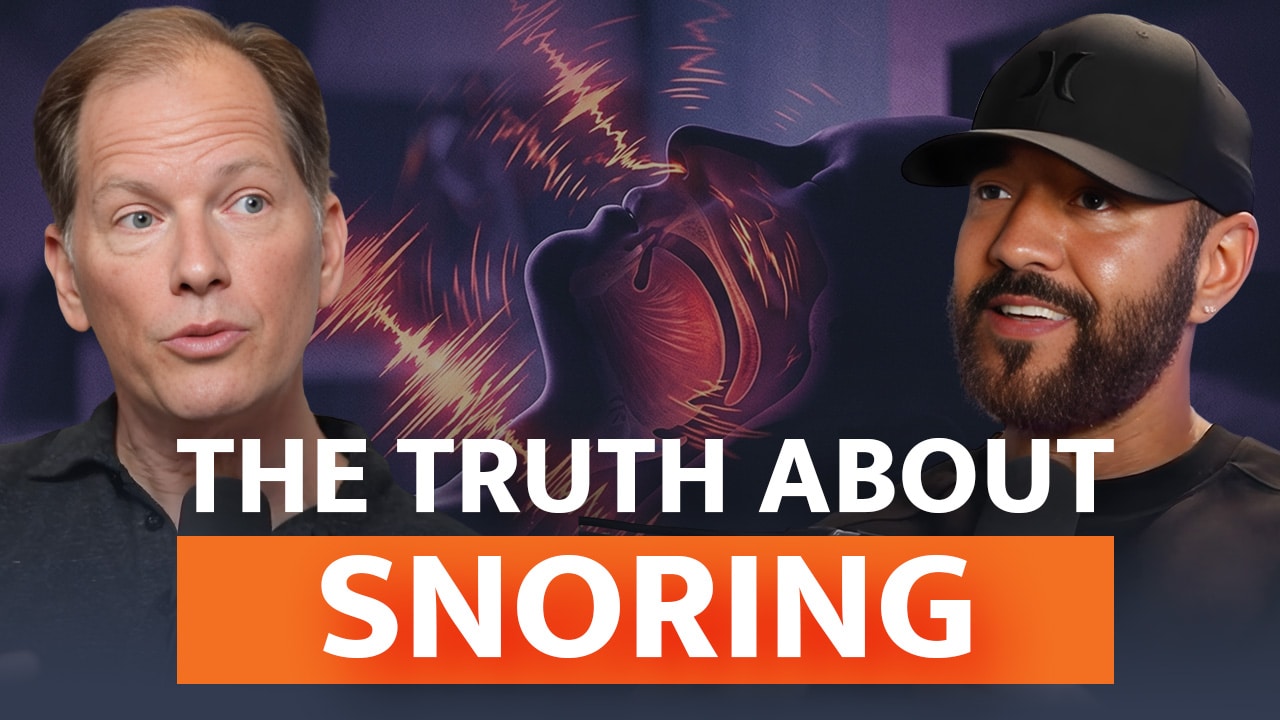
TMHS 993: The Truth About Snoring, the Science of Dreams, & the Connection Between Sleep & Fat Loss – With Dr. Michael Breus
Sleep is an essential human function that affects every aspect of your health and well-being. Whether it’s your mental health, metabolism, or risk of disease, getting better quality sleep can make a positive impact. Today, you’re going to learn about the critical role of sleep for your health and how to improve your sleep quality.
Dr. Michael Breus, also widely known as “The Sleep Doctor,” is a double board-certified Clinical Psychologist and Clinical Sleep Specialist. In his newest book, Sleep Drink Breathe, Dr. Breus shares the most recent science on how sleep, hydration, and breathing can transform your health. Today, he’s back on The Model Health Show for an in-depth conversation on the transformative power of sleep.
You’re going to learn about how sleep-deprivation impairs your metabolism, the different sleep chronotypes and how they behave, and what you can learn from your dreams. We’re also diving into the topics of mouth tape, supplementation for better sleep, and the best ways to deal with snoring. Dr. Michael Breus is an absolute expert when it comes to optimizing your sleep, and I know you’re going to love this conversation.
In this episode you’ll discover:
- What happens to your metabolism when you’re sleep deprived. (4:06)
- How your hunger hormones respond to sleep deprivation. (4:34)
- What sleep quality is and how to measure it. (8:44)
- The different sleep chronotypes. (9:52)
- What percentage of the population has chronic insomnia. (13:33)
- Different things you can learn about yourself by understanding your chronotype. (15:15)
- How your circadian rhythm can shift as you age. (22:16)
- The problem with Daylight Saving Time. (23:38)
- What you need to know about mouth taping. (28:51)
- Strategies for calming your mind so you can fall asleep. (34:49)
- Why your dreams are your emotional metabolism. (39:32)
- What causes one of the most common dreams. (43:33)
- Supplements for better sleep quality. (52:37)
- The truth about taking melatonin for sleep. (57:03)
- Solutions for snoring. (1:01:16)
Items mentioned in this episode include:
- Paleovalley.com/model – Use code MODEL for 15% off!
- Piquelife.com/model – Get exclusive savings on bundles & subscriptions!
- Sleep Drink Breathe by Dr. Michael Breus – Get your copy here!
- The Sleep Doctor’s Diet by Dr. Michael Breus – Read about sleep and weight loss!
- SleepDoctor.com/modelhealth – Take the chronoquiz & start improving your sleep!
This episode of The Model Health Show is brought to you by Paleovalley and Pique.
Use my code MODEL at Paleovalley.com/model to save 15% sitewide on nutrient dense snacks, superfood supplements, and more.
Go to Piquelife.com/model for exclusive savings on bundles & subscriptions on cutting-edge solutions for your head-to-toe health and beauty transformation.
Transcript:
SHAWN STEVENSON: Today we're talking about something that unites us as human beings. We're talking about something that all of us do and is super weird and we don't often talk about it. Today we're gonna be discussing the phenomenon of sleep. We're gonna be looking at how sleep impacts our metabolism and our ability to lose weight. We're gonna be looking at the different sleep chronotypes because everybody is not the same when it comes to our required amount of sleep and even the times that we're sleeping. And what about the major things that impact our sleep quality, namely. The big guns, the people that we are sleeping with, nobody impacts our sleep quality more than our significant other, or our kids or our roommates, or our brothers and sisters or our pets.
And so how do we optimize, or even in some cases, deal with some of the curve balls that our sleep relationships can bring to the table? What about phenomenon like snoring? What do we do when we have a partner that snores? What do we do if we are snoring and causing problems for the people around us? What are some science backed solutions when it comes to snoring? We're gonna be talking about this and so much more. We're gonna be talking about sleep related supplements. Is there anything that really works and has a science to affirm it? And also, our special guest is gonna be talking about. The most popular sleep supplement in the world and why he thinks it's actually a crime to give it to certain people.
So this is filled to the brim with incredible insights. And without further ado, let's dive into this incredible segment with our special guest and our topic of the day. Dr. Michael Breus is a double board certified clinical psychologist and clinical sleep specialist. He's the author of four bestselling books and has pioneered the science around chronotypes in relationship to sleep and optimal performance. His work has been featured all over major media, including the Oprah Winfrey Show, the Doctors, the New York Times, wall Street Journal, and much more. Dr. Breus has been in private practice for over 25 years and was recently named the Top Sleep Doctor of Los Angeles by Reader's Digest. Let's dive in this conversation with the one and only Dr. Michael Breus. Alright. This is special. This is a special occasion.
DR. MICHAEL BREUS: I'm excited.
SHAWN STEVENSON: We have a living legend here at the studio.
DR. MICHAEL BREUS: I don't know about that.
SHAWN STEVENSON: I'm so happy to see you.
DR. MICHAEL BREUS: Yeah.
SHAWN STEVENSON: We've been hanging out, we've been chopping up. We just talked about Hot Wheels.
DR. MICHAEL BREUS: Yes, indeed.
SHAWN STEVENSON: You know, in the eighties, cartoons and everything is coming back.
DR. MICHAEL BREUS: Absolutely.
SHAWN STEVENSON: And you know, speaking of coming back.
DR. MICHAEL BREUS: mm-hmm.
SHAWN STEVENSON: Recently we've had this change, this kind of cultural shift. As you know. Yeah. Just even growing up in a previous generation. Our fitness was very different, you know, our health and fitness.
DR. MICHAEL BREUS: Very different.
SHAWN STEVENSON: And things changed pretty dramatically in the eighties and obviously continue through the nineties.
DR. MICHAEL BREUS: Right.
SHAWN STEVENSON: But now people are really starting to focus again on metabolic health.
DR. MICHAEL BREUS: Yes.
SHAWN STEVENSON: Obviously people have been trying for a while of course, but it's just like more science-based affirmation and strategies with this.
DR. MICHAEL BREUS: Yeah.
SHAWN STEVENSON: And I'm setting all this up to say that. Most people are shocked to find out how much sleep impacts their metabolism.
DR. MICHAEL BREUS: It's ridiculous. I, my second book was called The Sleep Doctor's Diet, lose Weight Through Better Sleep. And it's all about how does sleep affect metabolism in particular? And the data on, it's pretty, pretty interesting. So as an example, if you become sleep deprived, right? And, and by the way, that definition is different for everybody. It's not just a quantity game, it's also a quality game, right? And so if you become sleep deprived, several things happen to you metabolically speaking. So number one, your metabolism slows down. People always say, why? Well, your body's wondering, why am I awake? I need to conserve the resources that are in me because I'm up for extended periods of time, or I'm getting really shitty sleep.
So that's one thing that happens. The second thing that happens is appetite increases. Why to forage for more food, right? So your brain says, all right, neurochemicals, let's get going. Let's go find some food because I'm up, I'm gonna need the energy. Two things also happen internally, hormonally. One is something called ghrelin, which is the hormone for hunger that increases by 20%, which is different by the way, than appetite. And then leptin, which is the feelings of satiety or fullness that decreases by 15%. So let me back up for a second. When you're sleep deprived, you're more hungry. You have a bigger appetite, you feel full less, and your metabolism is slower.
SHAWN STEVENSON: Mm.
DR. MICHAEL BREUS: Like tell me if, I mean, if sleep doesn't affect that, I know it is.
SHAWN STEVENSON: You're stacking conditions against you.
DR. MICHAEL BREUS: Yeah, a hundred percent.
SHAWN STEVENSON: And I think, and well, you know, this, that it's this psychological, it's kind of counterintuitive in a way.
DR. MICHAEL BREUS: Very much so.
SHAWN STEVENSON: That doing nothing.
DR. MICHAEL BREUS: Right.
SHAWN STEVENSON: Would result in a better metabolism because we attribute fat loss, weight loss, doing stuff. You know, I'm up, I'm sweating it out.
DR. MICHAEL BREUS: Yep.
SHAWN STEVENSON: But we negate how much sleep literally can change. What your metabolism is doing.
DR. MICHAEL BREUS: Yeah, and I think people, a lot of times they kind of brush sleep off. It's like, oh, that's that thing that I do, you know, for maybe five, six hours a night. You know, in that room, in the back of the house. Hopefully it's a little bit dark. What people need to get into their heads is sleep is recovery. Right? It's not just, it's recovery. It's recovery from all the different things that you were doing in a day. And by the way, it's not just a physical recovery, it's also an emotional recovery and a cognitive recovery.
Sleep affects every organ system in every disease state. Literally everything you do, you do better with a good night's sleep. Name, the name video games. I can show you the data, right? You know, memory, I can show you the data. Physicality. I can show you the data. Like it's remarkable how ubiquitous sleep is.
SHAWN STEVENSON: You mentioned something earlier that it's not necessarily about the quantity.
DR. MICHAEL BREUS: Exactly.
SHAWN STEVENSON: That's what we focus on. This is a good parallel to food.
DR. MICHAEL BREUS: Absolutely.
SHAWN STEVENSON: Right. It's not just the quantity of the the calories.
DR. MICHAEL BREUS: Exactly.
SHAWN STEVENSON: It's also the quality of those calories. Can you talk a little bit more about that when it comes to sleep?
DR. MICHAEL BREUS: Absolutely. So when we think about sleep quality, first of all, a lot of people are like, well, how do I measure that? Right? So a lot of times people will come to me and they'll say, well, Michael, I'm killing myself to get eight hours. I would rather I have a patient or a friend or a comrade who gets six and a half hours of high quality sleep than eight hours of crappy sleep. Right? So the first question is, well, how do I measure quality? How? How do I know what the quality of my sleep is? To be clear, you are your best doctor. Okay? When you wake up in the morning, how you feel, it's probably a pretty good indication of how well you slept. Like that is kind of bottom line. Like you wake up and you feel like crap, you probably slept like crap.
But let's get a little deeper. Let's get a little bit more objective, right? So there are these trackers that are out there in the world. There's on your wrist, there's on your finger, there's on your head. There's all kinds of trackers out there. Pros and cons when it comes to all of these trackers, specifically when it comes to sleep, right? With sleep, one of the biggest issues is that depth of sleep is measured by brainwaves or EEG. So when we look at sleep, we look at it from how, what, how much of each stage of sleep do you get? Here's the problem. It's hard to measure brainwaves from your finger, right? It's hard to prevent your brainwaves from your wrist.
So these are a proxy. These gather a piece of information, and then they use algorithms to kind of get you there. And so I want everybody out there to understand, like, I can't count the number of people who are like, you know, I woke up this morning and my sleep score was a 37. It's. Okay. You know, am I gonna die, Dr. Breus? Well, you're probably gonna die, but I don't think it's gonna be from, from that, right? All of these things measure, and there's a lot of variability in the measurement, but I still think they can be valuable. Okay? Look, trackers are ubiquitous. I honestly, I, you can't, you can't talk to somebody, you know, especially in a town like LA, right?
Who's not tracking something, but you don't wanna look at the immediate data. You wanna look at trends over time, right? So what I tell people all the time is like, look, don't look at your sleep data until Sunday. Okay? One day a week. And then all I want to know is, hey, people say to me, I got 14 minutes of deep sleep, Michael, is that okay? Well, number one, that's not accurate because if you only got 14 minutes of deep sleep, you'd probably be dead. That's number one, but number two, what did you get the night before? And they say, oh, 16 minutes. And I say, what about the night before? They say 13 minutes. And I said, you're fine. So what are you talking about?
I said, well, it's being consistently inaccurate. I said, if it says you got 14 minutes that I don't think I care. But if it says you got 407 one night, I wanna know what happened that night. Right? I'm looking for the delta here. I'm looking for the difference or the change in what's been going on with your sleep. That's one of the ways I think we can measure sleep quality. Now, a lot of people will say, okay, well I've measured some sleep quality, but what if I want to improve my sleep quality? Like how, how do I, how do I go about doing that? Right? So there's, I think there's a couple of ways that you can go about doing that.
And that comes into a couple of different thought patterns behind sleep. So the thing that I'm probably most famous for is I came up with this idea of chronotypes, right? So chronotypes are this, and by the way, I didn't come up with chronotypes. I actually discovered a type of chronotype. But chronotypes for folks who may not know what the word is, but want to hear what the vernacular is, if you've ever been called an early bird or a night owl, those are chronotypes. Okay? Now, to be fair, when I was writing my book, and you know what, it's like writing a book. It's always an interesting process when I'm sitting there in the editor's office, you know, they were like, well, we want to come up with a different system, Michael. And so somebody said, it should be crystal.
Somebody said it should be colors. I'm like, no, no, no, no. It should be animals. I said, I'm a mammal, not a bird. Right? So I want to, I want mammals. And by the way, I want animals that actually represent the chronotypes that I've kind of been working with. So early birds turn into lions 'cause who wouldn't wanna be the king or queen of the jungle, right? Right. But by the way, that only makes up 15, one five% of the population actually gets up early. You know how many people tell me that they're early birds? It's amazing.
SHAWN STEVENSON: Hmm.
DR. MICHAEL BREUS: It's amazing. I'll never forget, I got interviewed by the Wall Street Journal, maybe two, three months ago, and they said, what do you think of the 5:00 AM club? I said, I think it's the second stupidest idea I've ever heard other than mouth tape. Right? Okay. And here's why.
SHAWN STEVENSON: Shots fired.
DR. MICHAEL BREUS: Right? And here's why. And by the way, I love Robin Sharma, and he's one of the guys that came up with that. And Robin and I have had many a conversation about it. Here's the deal. If you're telling people to wake up at 5:00 AM and only 15% of the population can do that on the regular, naturally you got 85% of people that are gonna fail. Yeah, that's not the business I want to be in, right? So lions are my early birds. They make up, again, about 15% of the population. People in the middle. For some reason, we used to call them hummingbirds, I call them bears, right? So bears make up 55 0%. So one in two people turns out to be a bear. Right? Now what's interesting about bears is these are a very different group of people.
They like to get up around 7:30, like to go to bed around 10:30, right? They're, they're kind of the most fun group. They're the people invite you to their house for dinner, buy you a drink at the bar, you know, they're people that get the work done right in society. Society's whole schedule of nine to five works perfect for a bear. The night people, the night owls, we call them wolves, right? We know that wolves are nocturnal creatures. They hunt it, you know, late in the evening time, even towards midnight. And so night owls are my creatives, right? So lions back to the early birds. Those are the COOs of a company, by the way, you know, if you have a lion in your life, if you get an email that says 6:00 AM.
Okay. You know, that person's an early riser, but the wolves, these are my creatives. These are my artists, my actors, right? My, my musicians, right? These are the people, like if you've talked to a creative, they don't get their best idea at two o'clock in the afternoon. It's usually two o'clock in the morning, right? So, so far I haven't told anybody, quite frankly, anything they didn't already know, right? We know about, you know, early birds and night owls. We know about lion, we know about wolves. What I'm famous for is I discovered a fourth chronotype. By the way, these are genetic. I can look at. If you get your genome sequenced, I can go to a section of your human genome called the PER three area, and what we look for is called a single nucleotide polymorphism or a snip.
So what that means is building blocks flip one way. You're an early bird, they flip another way. You're a NightOwl. They don't flip, you're, you're in the middle, right? What I discovered was, is there was an irregular pattern for one, I call them dolphins. Now, people always say, Michael, why? Why'd you choose dolphins? So it turns out dolphins sleep, uni hemispherically. So half of their brain is asleep while the other half is awake looking for predators. And I felt like this represents my insomniacs, right? Did you know that 10% of the entire population has chronic insomnia?
10%. That's more people than have diabetes. Like holy crap, right? And so we have to understand that group of people. And look, I'm a clinical psychologist, I'm a sleep specialist. My area, one of my areas of specialty is insomnia. And so I was trying to figure out and understand more about this group of people. Now getting back to the question of what is sleep quality? If you can sleep within your chronotype, you don't need as much sleep. That's where your body genetically wants to sleep. Honestly, I can look at your 23 and Me or your ancestry.com. They have reports. It's right, it's right there. The data's right there.
You can figure this out. Good news for everybody out there is you don't have to go and do all that. I created a quiz called the Krono Quiz. You know all about it. You people can go to krono quiz.com or go to my swing by my website and be able to fill out the quiz. It takes a grand total of like four minutes and it's free. And what we do is we discovered, hey, we can pretty much shake out what one of these four chronotypes you are. And here's the crazy part, Shawn, is it becomes a huge unlock, and let me tell you why. Because once you know your chronotype, you actually know when all your other hormones go because hormones follow a very distinct pattern, right?
But if you're an early bird, your hormones kick off like melatonin kicks off, turns off at about 4 30, 5 o'clock. You wake up about five 30, the cortisol kicks on, and then all the other hormones go in a very predictable pattern. But if you're a bear, that doesn't happen till about seven. And if you're a wolf like I am, that doesn't happen till about eight. So what we've got is we've got people who are running around who have similar hormones, but they're moving at a different schedule. What I'm talking about here are circadian rhythms. Okay. And that's one of the big, big kind of unlocks with sleep. Now people are like, well, that's cool for sleep. And like, I, I get it, Michael, but can I use it in anything else?
Dude, I can tell you the perfect time of day to have sex. Eat a cheeseburger, ask your boss for a raise, write a book, drink coffee, drink alcohol, all based on your chronotype, because it's all about just following your biology. And following your hormones. You know, we were having a great discussion before about evidence-based medicine.
Right. Where are the studies? How does it work? There are probably 200 labs out there that are studying chronotypes at any given time. There are thousands of papers, you know, that are out there about chronotypes. It's pretty amazing. And so when I talk to people about how do you improve the quality of your sleep, one of the very first things I say is, let's figure out what your chronotype is and let's get you into your chrono typical swim lane, because I can almost guarantee you we're gonna improve your sleep quality.
SHAWN STEVENSON: Amazing.
DR. MICHAEL BREUS: Yeah, it's awesome.
SHAWN STEVENSON: Why is it that we can actually sleep less when we are sleeping within what our chronotype is actually desiring and looking for?
DR. MICHAEL BREUS: Yep. So here's what I think is, this is my theory. I've got a little bit of data to support it, but here's what I've discovered is when people are stretching it out to eight hours, what ends up happening is they're not sleeping within their chronotypes. They're only probably getting six and a half to seven of the actual sleep within that chronotype. And so the other is kind of fluff. And so what happens is if you have on the regular, you sleep within your chronotype, and I wanna be clear, consistency matters. Okay. If people get one thing from me talking today besides, Hey, I'm, I'm kind of curious about my chronotype.
It's wake up based on your chronotype the same time, seven days a week. Let me tell you the biology as to why. Okay? When you wake up in the morning, sunlight hits your eye, and you have a special cell in your eye called a melanopsin cell, which sends a signal to the back of your brain to turn off the melatonin faucet in your head, right? It keeps that melatonin faucet turned off, but it sets a timer for almost exactly 14 hours later. It's called the melatonin phase response curve. So what happens is, is melatonin turns off. Let's say that you're a lion and you wake up at, let's say five 30. Let's make the math simple. Six o'clock, right? 14 hours later is 8:00 PM which means melatonin turns back on, takes about an hour and a half for it to get up and in.
You get tired around 9, 9 30, you're in bed, right? But if on Saturday you sleep in until eight. Guess what happens? Melatonin doesn't turn on until 10, so the time at which you wake up directly affects when the hormone melatonin clicks back on in your head. Consistency is king when it comes to this. And if you really want to dial it in, if you know your chronotype, wake up at your chrono, typical wake up time. And I can assure you, all of a sudden sleep begins to compact.
SHAWN STEVENSON: It makes so much sense.
DR. MICHAEL BREUS: It's crazy.
SHAWN STEVENSON: So much sense. But unfortunately, our society is structured in a certain way.
DR. MICHAEL BREUS: I get it.
SHAWN STEVENSON: That everybody's supposed to be on the same clock. Right. And you know, just thinking about this, you know, you just mentioned it's, it's attractive. Everybody wants to be a lion.
DR. MICHAEL BREUS: Yeah, yeah. Yeah.
SHAWN STEVENSON: My friend Eric Thomas says that everybody wants to be a lion until it's time to do what lions do.
DR. MICHAEL BREUS: Right.
SHAWN STEVENSON: Right. And so today, true story. I woke up without an alarm. It was like I went to my, which I don't sleep on my phone by the way.
DR. MICHAEL BREUS: Good.
SHAWN STEVENSON: But I went and checked the time.
DR. MICHAEL BREUS: Yeah.
SHAWN STEVENSON: It was five 50.
DR. MICHAEL BREUS: Yeah.
SHAWN STEVENSON: And then I started my day. I didn't see my wife until about seven. Yeah. You know, because I think we live in the same environment. Would be insulted Yes. If I tried to wake her up, like, Hey, come do, come read with me, whatever it, and she's not against the reading and the meditation, whatever. But she wants to be on her bare time.
DR. MICHAEL BREUS: Absolutely.
SHAWN STEVENSON: You know, and so being in a relationship and you know how much sleep impacts our relationships and vice versa.
DR. MICHAEL BREUS: Absolutely.
SHAWN STEVENSON: It's understanding each other's chronotype and not attributing it to like, this person's erotic or this person's lazy.
DR. MICHAEL BREUS: Absolutely.
SHAWN STEVENSON: Or this person's this or that.
DR. MICHAEL BREUS: You got it.
SHAWN STEVENSON: It's just honoring your biology. Yeah. Finding how to leverage it.
DR. MICHAEL BREUS: Right.
SHAWN STEVENSON: Dare I say? By sleeping within those parameters and, but, you know, full transparency within a relationship, there's gonna be some overlap that we can find.
DR. MICHAEL BREUS: For sure.
SHAWN STEVENSON: And that's what we've tended to do over the years is find where that overlap is.
DR. MICHAEL BREUS: Yeah. And that is the mark of a healthy relationship. And I'm gonna tell you something right now, dude. I've saved more marriages as a sleep doctor than I ever would've as a marital therapist.
SHAWN STEVENSON: Come on. Come on.
DR. MICHAEL BREUS: Right. I believe it. I believe it. Just by, and, and it has to do with really two areas. One is this kind of scheduling, but the other is snoring. Right? Snoring is a killer. It beats the shit out of relationships on the regular. Right. And here's the problem is snoring can sometimes be a sign of something called sleep apnea. Right. And so sleep apnea for folks who don't realize it, this is where you sucking air in so hard that your throat closes up and you actually stop breathing in your sleep.
So now, by the way, this is what most sleep doctors out there treat. When I was seeing patients on the regular and I was in a sleep clinic, 80% of my patients, I was treating them for sleep apnea. Now, a lot of people think sleep apnea is a big person's disease. I'm here to tell you it's not. By the way, full disclosure, I have sleep apnea. I stop breathing in my sleep 24 times an hour. Right? That's only moderate, believe it or not, right? I sleep at the sleep C-Pap machine every single night. It's not the sexiest thing in the world, okay? But it allows me to be sexy.
SHAWN STEVENSON: Mm.
DR. MICHAEL BREUS: Right? You know what I'm saying?
SHAWN STEVENSON: Come on.
DR. MICHAEL BREUS: Right? Because at the end of the day, if it's no longer, not tonight, I have a headache. It's not tonight. I'm too damn tired.
SHAWN STEVENSON: Yeah.
DR. MICHAEL BREUS: Right. And so being able to understand your biology becomes very, very important. And that's a lot of importance within a relationship, intimacy. But also, my daughter said this when she was eight, she was like, daddy, I know when people aren't sleeping well, they become grumpy fish. I'm like, that's the perfect term. I, that's the best term I've ever heard. Right. It makes perfect sense. Yeah. Right. You are not you. When you're sleep deprived.
SHAWN STEVENSON: Yeah.
DR. MICHAEL BREUS: And for a lot of people, if I can maneuver them closer to their chronotype or get them to a better bedtime, you'd be shocked at how well it works. And also, let's be fair, society has moved away from that nine to five absolutism of work. Yeah. A lot of people can work from home, a lot of people can call in. Like there's a whole host of different ways that we can kind of manage our work in society today. And so I feel like a lot of people have got a little bit more flexibility than they might imagine. Now, one question I will admit that I get asked all the time is, well, I wanna wake up at 5:00 AM so that way I can get to the gym. And that way I can, I've got all this list of things that I want to do. I got news for you. If you're a night owl, you're gonna hate it. You're not part of the reason that exercise works is because it brings you joy.
Okay. And if it is not a joyful experience because your melatonin is still going while you're trying to work out, dude, it isn't gonna work very well, right? You have to find what your body type is. Also, by the way, it changes over time. So I was telling you before, I'm 58 years old and I've been a night owl person wolf all my life, and right around age 50 things started to change, right? All of a sudden I started waking up earlier and earlier. Like if you, if your grandparents are alive, if your parents are alive and you say, Hey, mom or grandma want to go out to dinner, what time do they say?
SHAWN STEVENSON: Six o'clock.
DR. MICHAEL BREUS: Right? 4 30, 5 o'clock, six o'clock. They, they're early eaters. Why? Because one of the things we know is as we get older, their circadian rhythm begins to shift a little bit earlier. There are a couple of reasons we think that happens. Some of it has to do with hormones. One was kind of amazing. I learned about this not too long ago. They were doing lens transplants in people's eyes, and when they would put in a new lens, they would sleep longer and better. And so when we started to look at that, try to understand why it's because the lens would cloud or get yellow and not as much light would come in.
SHAWN STEVENSON: Come on.
DR. MICHAEL BREUS: Remember, light affects your ability to produce melatonin. We call it the vampire hormone because it only comes out in darkness, right? And so if you're not getting light in, it doesn't turn off. So there's a lot of things that you can do in your environment to make sure that you get light at the right times, darkness at the right times, and, and you can start to manipulate that cycle for the good.
SHAWN STEVENSON: This is so powerful. What is your perspective about daylight savings time.
DR. MICHAEL BREUS: I think it's a terrible idea.
SHAWN STEVENSON: Come on.
DR. MICHAEL BREUS: Okay. And, and, and so first of all, look back, when we were in agrarian society, it made a lot of sense, right? We needed to be in the fields longer so we could, you know, till the fields and do all this other kind of good stuff. But the American Academy of Sleep Medicine, which I'm a member of, has got a very specific stance on it, which is standard time is better. The bottom line is nobody should wake up in the dark. It's not healthy, okay? You should wake up as the sun is coming up, or maybe a little bit after if you're a night person, right?
And be able to get that sunlight. Sunlight is critical, critical, critical for your just being alive, right? A lot of people don't know it, but 15 minutes of sunlight helps produce vitamin D in your system, which is a circadian pacemaker, an anti-inflammatory. Like there's a lot of good things about having vitamin D. You need that sunshine in order to do it.
SHAWN STEVENSON: Yeah.
DR. MICHAEL BREUS: Right. Wake up with the sun. Don't wake up in the dark if you can help it. Now, if you do have to wake up in the dark, because let's say you know you've got your bicoastal or whatever, there's artificial lighting that you can have. There are alarm clocks that will produce a sunrise and sunset, and I love those. I think those are great.
SHAWN STEVENSON: Whether it's from injury, age related wear and tear, or even chronic diseases and infections, our stem cells have to kick into action to help us heal. There's a specific compound that's been identified in turmeric that's getting a lot of attention right now for its impact on our stem cells. This compound is called our turon in a study site. In the journal, Stem Cell Research and therapy details how our neural stem cells proliferate 50 to 80% faster when exposed to varying levels of rone. The study concluded that " our Turon thus constitutes a promising candidate to support regeneration and neurologic disease."
How powerful is that? In addition to the remarkable power of our turon, turmeric has many other phytonutrients that support stem cell function. A little known realities that stem cells act upon inflammation, and many people are experiencing a chronic state of systemic inflammation that's literally draining their body's supply of stem cells. One of the most notable anti-inflammatory compounds ever discovered comes from turmeric too. That nutrient is called curcumin. And curcumin is shown in numerous studies to reduce inflammation, including in a meta-analysis cited in the Journal, frontiers and Pharmacology, plus a randomized placebo controlled trial conducted by scientists at UCLA.
Found that curcumin appears to reduce inflammation in the brain and even improve memory and attention span. And of course, we could take this advice and start adding more turmeric to a variety of dishes, including curries to scrambled eggs or whatever the case might be. But keep in mind that the results seen in these studies are from therapeutic amounts of turmeric that would only come in supplement form. And the turmeric supplement that I've been using for years is certified organic with no binders, no fillers, and has an outstanding money back guarantee. It's the turmeric complex from Paleo Valley, and right now you're gonna get 15% off of their incredible turmeric complex when you go to paleo valley.com/model.
That's P-A-L-E-O-V-A-L-L-E y.com/model for 15% off. I absolutely love their turmeric complex. It's always there on my superfood shelf for whenever I need it. So definitely head over there, check them out, support reducing inflammation, support your stem cells, and even support your cognitive health with the turmeric complex. Go to paleo valley.com/model 15% off and now back to the show.
SHAWN STEVENSON: And the idea of abruptly making an entire civilization change their circadian clocks.
DR. MICHAEL BREUS: It's so stupid, dude. It's so stupid.
SHAWN STEVENSON: And you see the data, you know, we see this uptake in car accidents.
DR. MICHAEL BREUS: Car accidents and heart attacks.
SHAWN STEVENSON: Heart attacks.
DR. MICHAEL BREUS: It's terrible. It's a terrible idea.
SHAWN STEVENSON: Yeah.
DR. MICHAEL BREUS: Yeah. Standard time. Let's stick to it.
SHAWN STEVENSON: Yeah, we gotta stop. This is a advocation right now.
DR. MICHAEL BREUS: Yeah.
SHAWN STEVENSON: From the one and only Dr. Michael Breus, stop the madness. Stop changing the damn clocks twice a year. It is stupid.
DR. MICHAEL BREUS: It's really stupid.
SHAWN STEVENSON: We don't gotta do that. We've got, we've got AI now, right? We've got, you know, we have lights, we have indoor lighting. We have indoor plumbing. Yeah. We don't need, we're not working in factories.
DR. MICHAEL BREUS: No.
SHAWN STEVENSON: Or on the F, whatever it is.
DR. MICHAEL BREUS: Yeah.
SHAWN STEVENSON: Whatever the reason was back in the day.
DR. MICHAEL BREUS: Right.
SHAWN STEVENSON: And by the way, there are a lot of countries that don't do this.
DR. MICHAEL BREUS: Right.
SHAWN STEVENSON: Alright.
DR. MICHAEL BREUS: There are some states that don't do this.
SHAWN STEVENSON: There's some states that.
DR. MICHAEL BREUS: Arizona doesn't do it.
SHAWN STEVENSON: Hawaii.
DR. MICHAEL BREUS: I think it's Hawaii doesn't do it like.
SHAWN STEVENSON: They got the Mana Hawaii.
DR. MICHAEL BREUS: Right. They figured it out.
SHAWN STEVENSON: We're keeping our mana you're not changing our clocks. Alright, I want to ask you about, and again, shots were fired early. You said the mouth tape.
DR. MICHAEL BREUS: Terrible, terrible idea. Yeah. Let's talk about it for a second. So there's a meta-analysis that was done within the last six months. I'll send it to you. We can put it in the show notes if people are interested. People have died using mouth tape. Sure enough. Yeah, absolutely. So what happens is when you tape somebody's mouth shut and they, they have undiagnosed sleep apnea, they stop breathing in their sleep, you can have a problem there not only from asphyxiation, but you can end up with a heart attack.
Right? So what I tell people all the time is 'cause people are like, well, if I tape my mouth shut, my ring says that I get more deep sleep and I wake up and I feel better. You know why people sleep with their mouth open congestion in their nose. That's the number one reason. Something like 90 something percent of people will naturally close their mouth when they're asleep, if they don't have nasal congestion or some kind of deviation, like a deviated septum or inflamed terminates or something along those lines.
And so what I tell people all the time is, this is a terrible, terrible idea. Unless you've had a sleep study. If you've had a sleep study and it says, Hey, you ain't got no apnea and you have no congestion, I think I'm okay with it, but nobody says that. I've never seen on, and I've, look, I've looked at all the mouth tapes out there. None of them say, Hey, by the way, you need to go get a sleep study done before you use this product. None of them do. I'd love it if they did, but none of them do.
SHAWN STEVENSON: Wow. That is a perspective today. You know, of course we've heard the stories, many people listening, many people are utilizing this. That is transformative for them to use mouth tape. But the other side of the equation, again.
DR. MICHAEL BREUS: Stupid.
SHAWN STEVENSON: Is the risk of like why? Why are you mouth breathing in the first place?
DR. MICHAEL BREUS: Exactly. What's the.
SHAWN STEVENSON: And also like, let's take another step here to make sure that this is safe for you to do.
DR. MICHAEL BREUS: Exactly.
SHAWN STEVENSON: In the first place.
DR. MICHAEL BREUS: I like to do what I call the mom test. The mom test is simple. Call your mother and say, Hey mom, I'm thinking about taping my mouth shut while I sleep. If she says it's a good idea, feel free to go ahead. What she'll turn to you and say is, I'd love it if you did it during the day so I don't have to listen to you. But that sounds like a stupid idea at night.
SHAWN STEVENSON: Okay. Let's move on from mouth tape and let's go into the realm of some more practical things that we can do to get more value from the minutes of sleep that we are getting.
DR. MICHAEL BREUS: Oh yeah.
SHAWN STEVENSON: And I want to ask you about what I feel is in, in our current society as it stands today.
DR. MICHAEL BREUS: Mm-hmm.
SHAWN STEVENSON: It's new.
DR. MICHAEL BREUS: Okay.
SHAWN STEVENSON: And I feel that it is the number one culprit or obstacle to getting a good night's sleep and that this is our relationship with our technology.
DR. MICHAEL BREUS: Yeah, yeah, yeah. For sure. For sure, for sure.
SHAWN STEVENSON: And you've already set the tone with understanding. The value of knowing our circadian rhythms, you know, our chronotype.
DR. MICHAEL BREUS: Yep.
SHAWN STEVENSON: With our technology, we can throw a monkey wrench into the whole thing.
DR. MICHAEL BREUS: Super easy. Super easy. So there's a couple of different things about technology that I think are important that people need to understand. Right. And so, one of them is, is that a lot of technology proximately is very close to our face, got our phone, and it's close to our face if a TV's across the room. I don't think I have as big a problem with that. Also, the level of engagement is different. When you're watching tv, right? The content is just kind of flowing over you. But if you're trying to get your high score on Candy Crush, I'm pretty sure you ain't trying to go to bed, right? And when you start to doom scroll with the shorts and the tiktoks and the thiss and the that's, and don't get me wrong, I've got a TikTok channel.
I teach people shit on TikTok about sleep. The problem is, is that your arousal level increases, right? So when you start to look at things and you get an a response, whether that's a dopamine hit or a, or an elevation in heart rate, it makes it harder to fall asleep. If people wanna understand one metric, you need a heart rate of about 60 or below to enter into a state of unconsciousness. It's really hard to do that when you're scrolling through shorts on YouTube, right? Again, nothing against YouTube, but at the end of the day, there's a time and a place when that's important. And a lot of people will say to me, well, I just want to catch up with what's going on. That takes five minutes.
That doesn't take three hours. You get pulled in and you go down rabbit holes that you would never, ever go down and again, your heart rate ticks up and that's the real problem with technology and sleep.
SHAWN STEVENSON: So really quickly to take a step back.
DR. MICHAEL BREUS: Mm-hmm.
SHAWN STEVENSON: I had an experience where I had to wait for a family member to get home and I was already my chronotype, I wanna go to bed.
DR. MICHAEL BREUS: Yeah.
SHAWN STEVENSON: And so I was watching television to try to stay out.
DR. MICHAEL BREUS: Sure.
SHAWN STEVENSON: But I was dozing off. Oh yeah. Right. I'm with you. And so literally I had the thought of, let me get on social media to keep myself up and it worked.
DR. MICHAEL BREUS: I mean, you just proved my point.
SHAWN STEVENSON: Yeah.
DR. MICHAEL BREUS: Right. Because what does it do? It raises your heart rate. Right. It gives you more dopamine, it does all these different things to you. And by the way, they know it. Okay. The people who have introduced social media into society, they understand what it does to your human physiology, not to mention your mental health. Right. I mean, landmark case just came out against a lot of these social, some of these social media places, right? About how it's hurting kids and things like that. Like, I mean, back in our day, right, it was video games, right? People play video games until four o'clock in the morning. But when you're 13 years old, your entire circadian rhythm is shifted into a wolf. So you wanna stay up until two and sleep until 12 when you're an adult.
Your circadian rhythm kind of sets for about 30 years, and so you really want to avoid that kind of, you know, use of technology. Also, by the way, you need runway to land the plane, okay? It sleep is not an on off switch. It's like slowly pulling your foot off the gas and slowly putting your foot on the brake. There's a process that should occur there. If you fall asleep this fast, that probably means you're sleep deprived. It's probably not a good sign. It should take you 10, 15 minutes to fall asleep. Now, a lot of ways to fall asleep. You can listen to music, you can read a book, you can, you know, talk with your partner.
By the way, you can watch tv. I think I'm the only sleep doctor in the universe that says it's okay to fall asleep watching television. By the way, isn't there a timer in like 99% of the televisions out there that you can set? That'll turn it off in the middle of the night, but in my house, lemme tell you what, lemme tell you how it works in my house, okay? We have a big screen tv. It's on all night long. We have two French bulldogs in the bed with us, okay? And, and I'll tell you the story of how it all happened. So, when my wife and I were dating, we've been married for 26 years, when my wife and I were dating, she said, Michael, if we ever have a sleepover, I need to let you know that I sleep with the television on.
I said, I said, don't you worry about that, honey. I said, I'm gonna be become a sleep doctor. I'm gonna fix that. Have you ever tried to fix something in your partner, because I've got news for you, it doesn't go well. So I pulled the TV out and she said, Michael, if you ever wanna be let back in the bedroom again, I suggest you put that tv. I put the TV right back in there and I studied her. And now, to be honest with you, I studied my kids, I studied my dogs, I studied my wife, I studied sleep. I mean, that's kind of my thing. And what I discovered is that she wasn't even watching it. She was listening to it out of what I call the corner of her ear, right?
Because she wants to avoid monkey mind. Right. I don't even know if I have to give a definition of monkey mind. I think everybody out there kind of knows what it is. But monkey mind is where you can't stop thinking because here's what's the problematic, is when you get in bed and the lights are off and the, and there's no noise, all the thoughts from the day come flooding in. 'cause it's the only time of day that people aren't talking to you and asking, Hey mom, I need this. Or, you know, hey, all that kind of stuff happens. And so all of those thoughts come flying in, flying in, flying in and you have to do something to distract yourself from being able to do that. Television works well, but I'll be honest with you, I don't think it's the best way to do it.
My favorite way is to do something called 4 7 8 breathing. So this is a technique developed by Dr. Andrew Wild, Harvard trained naturalist, super smart dude. And it's very simple. You slowly breathe in for a count of four, you hold for a count of seven and you lightly push for a count of eight. Right.
It's very simple. It's very thoughtful, right? You need about 20 cycles of this and your heart rate dumps below 60, which is our magic number for entering into a state of unconsciousness. Now, when I started doing this technique, I'm gonna be honest with you, as I was telling you outside, I'm not a great meditator. I didn't understand breath work. I'm one of those guys. Like, am I doing it right? Like, what's going on To get to 20 cycles? I would lose count, and then I'd get anxious and my heart rate would go straight up. So I came up with the technique. So, well, you're doing this, 4, 7, 8, breathing. Take your hands, make light fists, and put 'em down by your side.
And when you go through one cycle, stick outta finger and stick. When you get to 10, then wrap it back. Guess what? You've hit 20 most of the time. I don't even make it back to 20, if I'm honest with you. Two other things that I think are important. Number one, when I started doing this, I couldn't hold my breath to seven and I certainly couldn't push to eight. So you can start out with 4, 5, 6, breathing, and then after two weeks, move to 4, 6, 7 breathing. And then after two weeks, get to 4, 7, 8 breathing. So you know, ramp yourself up nice and slow. And then the final one is you want to picture the number in your mind's eye. So when I'm breathing in, I'm thinking the number four.
I see the number three. I see the number two. I see the number one. Same with the seven and the eight. You can't count and think about problems at the same time. It's actually impossible to do. And if you follow this breathing and you're doing this tactilely, you've distracted yourself so well. The natural sleep process comes in, you're out like a light.
SHAWN STEVENSON: Out like a light, out like a light. This is phenomenal. Thank you so much. So once we drift off and we enter this magical realm of sleep, a lot of stuff happens.
DR. MICHAEL BREUS: Indeed.
SHAWN STEVENSON: And one of the things that. We are just marveling with is this phenomenon of dreaming. Do we have any insight onto what's going on with that?
DR. MICHAEL BREUS: I'm so glad you asked me about this topic. So I've spent the last two years, becoming a dream therapist. Okay, so lemme explain to you what that is. 'cause it's not dream interpretation. This is where we use dreams in the therapeutic context. So dreams can happen, by the way, in all stages of sleep.
Doesn't matter if it's REM sleep or not. But the, the most dreams happen in REM sleep in particular. And one of the things we know about REM sleep is this is where you move information from your short-term memory to your long-term memory. You kind of create this organizational substructure, like a filing cabinet to put data into. I call dreams emotional metabolism, right? So it takes the emotions from the day, it pulls out the bs, keeps the important stuff, and then locks and loads it into your hard drive. Okay? Now, that's what dreams generally speaking do. There's a problem when somebody has a nightmare, okay? They're dreaming, dreaming, dreaming.
They get scared. They wake up, they stop processing, go back to the beginning of the dream. When they fall asleep, get to the scary point. Wake up, stop processing. Also, by the way, guess what happens in a scary dream? Your heart rate goes up. Remember, heart rate needs to be below 60 in order to sleep. Sleep is a heart rate game, like that's very, very important for people to understand. Dreams in and of themselves are fascinating, fascinating, fascinating to me. So the way you can use dreams in the therapeutic context is you can't give people therapy while they're asleep, but they can daydream during the day. So what we do is we bring people in for a therapeutic session. I can do it one-on-one, I can do it in a group or I can do it on Zoom, put them into a mild hypnotic state.
Not like walking around clucking like a chicken or anything like that. Just relaxing people, making them feel safe. Have a good, safe environment. Then I have them go through the dream with me in as much detail as they possibly, possibly can, can get to. Now this is, this come, so I studied under a woman by the name of, Dr. Leslie Ellis. She's amazing. I highly recommend if people have interest in her, she should, they should look her up. And what she's taught me is that when they get to the point of the dream where they're scared or they wake up, we were specifically looking at nightmares in particular. She turns to the person, and again, they're awake in a very mild hypnotic state.
You turn to them and you say, let's drop into the dream together. So we do. Again, this is all being done in the dreamer's head. It's not like inception. I'm not like zooming into your brain or anything like that. But we use daydreaming to make progress inside the dream. So I'll give you an example of one of the dreams that I worked with, with the client. And to be clear, this is not this. You'll not, you'll not get any information about who this person was or anything like that from the dream. But uh, this person was being chased in a jungle, right? And we got to this point where. It got super duper scary and she would wake up. And so we got to that point and I said, great, let's drop into the dream together.
So we drop into the dream together, and I'm there to be a curious Sherpa. I'm not there to analyze, I'm just there to ask questions. So we're asking questions, and I turned around and I said, you know, we're in a, we're in a jungle. Can you describe it to me? She said, oh, it's really green. There's lots of beautiful flowers. And I say, oh, can we, can we walk over and can we smell one of the flowers? And she thinks about it. And she says, yes we can. We've just actually made progress in the dream. We've actually had her start processing something inside of her dream. Remember, we're conscious now. I'm not inside her head. So we go over and we sniff the flower and I ask her to describe what it smells like to me.
And she describes it to me. And I said, okay. I said, well, we're in a jungle. Are there animals? And she looks around. Yeah, her eyes are closed. Yeah, there are animals. Oh, great. What kind of animals around? She said There's a lion. I said, wow. I said, is the lion friendly? She spins it up for a second. Yeah. Lion's friendly. I said, great. Can we walk over to the lion and see it? Yeah. So we walk over to the lion again. This is all in her head. Uh, and I said, does the lion talk? She stops for a second. She says, yeah, it does. I said, does the lion have a name? She says, yeah, the lion has his name. His name is Jack.
I said, does Jack mean anything to you? And then boom, Jack was my step uncle who saved me from my stepfather, who tried to rape me. Boom. Now we're getting somewhere in the dream. Make sense?
SHAWN STEVENSON: Mm-hmm.
DR. MICHAEL BREUS: Dreams can be used in a lot of different ways, but it's hard for me to have a lot. I mean, don't get me wrong, young and Freud all looked at symbols and dreams and things like that, but it's very difficult to say, you know, you're swimming in water and you hate your mother, type of thing. Right. But there are some dream themes that we know are out there. One in particular that I've always found interesting when I've been giving a lot of lectures lately, and I really enjoy giving lectures, and now half of my lecture is all about dreams. And I ask people about different dreams that they might have experienced, and one of the ones, it, it's unbelievable.
I was given a lecture in Johannesburg, South Africa. I was in Edinburg, Scotland. I've been doing in Dallas, you know, all over the world. I say, has anybody out there had the dream where their teeth fall out? Then invariably the room lights up. People are like, holy crap, Michael, I've had that dream. What does it mean? Blah, blah, blah. So we started to kind of look at, here's, there's a couple things that are interesting to me. Number one, it's fascinating to me that every culture has that dream. Doesn't matter what country you're in. Doesn't matter what race, what religion, yeah, it doesn't matter. People have this interesting dream of their teeth falling out.
So I started to look into it and this is where Dr. Ellis was, was very valuable. She explained some things to me. A lot of it has to do with physically what could be going on with you. So, as an example, if you've grind your teeth, you could easily have the dream where your teeth fall out. If you have sleep apnea, you could have the dream where your teeth fall out. If you produce a lot of saliva, you could have the dream where your teeth fall out, but it can also be a stress dream for people as well. So you start to combine emotionality with physicality. And sometimes these dream themes kind of bubble to the surface and there are a lot of negative dream themes, but to be fair, there's a lot of positive ones as well. People have very positive dreams. I'll tell you what my favorite positive dream is, I get to meet my grandmother.
SHAWN STEVENSON: Mm. Yeah.
DR. MICHAEL BREUS: And I get to ask her questions. I still have a relationship with her. Yeah. I get emotional about it, but it's like, it's, it's cool because I can go in there and I can talk to her and I can, you know, get her wisdom.
SHAWN STEVENSON: Yeah.
DR. MICHAEL BREUS: Like dreams are a special, special place for people. And, but to be clear, dreams mean something to the dreamer.
SHAWN STEVENSON: Yeah.
DR. MICHAEL BREUS: More so than they do to anybody else.
SHAWN STEVENSON: Yeah. Wow. Thank you for sharing that, man. I'm just, I'm, I'm blown away. You know, our, we are so incredible. We're so amazing. And.
DR. MICHAEL BREUS: It's nuts, right?
SHAWN STEVENSON: Yeah. You know, our, our, our, our minds, you know, we make these full length motion pictures with all these meanings. And the thing is like, you know, sometimes like, oh, I had this dream is that the dream is happening to us.
DR. MICHAEL BREUS: Right?
SHAWN STEVENSON: But we're creating this and we're processing. And so thank you for sharing that. And you know, I have a huge, um, connection to that phenomenon. You know, being able to.
DR. MICHAEL BREUS: Are you a lucid dreamer?
SHAWN STEVENSON: I was just about to say.
DR. MICHAEL BREUS: Tell me
SHAWN STEVENSON: a couple times a week.
DR. MICHAEL BREUS: Yeah.
SHAWN STEVENSON: I realize that I'm dreaming and then I immediately fly.
DR. MICHAEL BREUS: Yeah.
SHAWN STEVENSON: Like whenever I realize it's so funny, I just take off.
DR. MICHAEL BREUS: Let's go. I'm Superman. Right.
SHAWN STEVENSON: And then, but now it's, it gets to the point where I'm just, because I wake up
DR. MICHAEL BREUS: mm-hmm.
SHAWN STEVENSON: A lot of times when I start flying and I'm just like, I'm trying to stay in the dream and keep flying and
DR. MICHAEL BREUS: yeah. So that's a skill, believe it or not, that's a skill I can teach people how to do.
SHAWN STEVENSON: Mm-hmm.
DR. MICHAEL BREUS: And there's even, uh, products out there now that can teach people how to become lucid dreamers. I work with a company, I'm their Chief Sleep Officer, that's called Next Sense and their earbuds that you sleep with. But they measure EEG from your ear all night long so they know when you're in a dream state. And what's interesting about them, not on the dreaming side, but on the sleep side, is when you start to move out of the deeper stages of sleep, it can send in a signal to push you back down into deep sleep, which is kind of cool.
But they can also help you with training about being a lucid dreamer. So we're lucid dreaming. What a lot of people used to do is they'd, they'd put an X on their hand, right? And then they'd look every, you know, couple of 20, 30 minutes and they look down, okay, I can see the x, I can see that. And they get into a habit of it. And then one all of a sudden, one time they look down and there's no X, then they're in the dream.
SHAWN STEVENSON: Mm-hmm.
DR. MICHAEL BREUS: Right? And there's different ways that you can go about doing, there's more formal ways. Believe it or not, you can go, there's a weekend course that you can take. The most famous person, the person who really, I think really did the most seminal research was a guy named Dr. Steven Laberge. I got a chance to meet him. He did a little too much acid in the sixties, I have to tell you. But man, is he a fascinating dude. And I worked on a project where we had a headset where we could reliably put people into a lucid state almost every night.
SHAWN STEVENSON: This is incredible, incredible.
DR. MICHAEL BREUS: It's cool stuff.
SHAWN STEVENSON: Alright. I'm about to give you the tea on longevity. There's one beverage that has been found and scientifically proven to contribute to longevity far better than anything else. A phenomenal peer-reviewed study published in The Lancet just last year found that people who regularly drink tea age slower than everyone else, using clinical biomarkers to determine biological age and following thousands of participants for up to four and a half years.
The researchers found that number one, transitioning from not drinking tea to tea drinking was associated with a decrease in biological aging versus people who remained non tea drinkers. That's the tea. Number two, even stronger associations were found in consistent tea drinkers. And number three, the research suggests that drinking around three cups of tea per day had the most anti-aging benefits.
Now there are so many varieties of teas to choose from, and they're teaming with different benefits from green tea to herbal teas like robo tea, but there's one tea. We're speaking about anti-aging that you need to know about. It's been found to have anti-aging and anti-obesity effects. This is according to a study published in the Journal Clinical Interventions in Aging that found that the renowned science back tea called Pu'erh makes a notable difference in weight loss and this double blind, randomized placebo controlled trial.
The researcher stated quote, consumption of pu'erh was associated with statistically significant weight loss when compared to a placebo. Fat loss was seen for the arms, legs, and the hip and belly regions, unquote. The participants who utilized pu'erh loss more overall body fat. And what was especially remarkable was they maintained their muscle mastering their weight loss. This is that major component of longevity. There's only one pu'erh that I drink, and this is my favorite tea. I've been drinking pu'erh for years, and it's from the incredible team at Pique Life. Go to Pique life.com/model. Right now you're gonna receive up to 20% off plus some limited time free bonuses, like an electric frother to mix your favorite beverages.
Their purer is made from a patented cold extraction technology. It's triple toxin screen for purity and it's wild harvested. So it's even richer in these incredible polyphenols that lead to those amazing benefits that we talked about. And right now, you get to try PTs risk-free with their 30 day money back guarantee. You either love it or you'll receive a full refund. So you have nothing to lose and better health to gain. Head over there, check 'em out. It's Pique life.com/model. That's P-I-Q-U-E-L-I-F e.com/model. Take advantage. And that is the T. Now, back to the show.
SHAWN STEVENSON: You know, the last year in particular, you know, I've had, I've, I've very similar to you, I've, I've. Woke up and I've been in tears a lot more this past year. Mm. Because of being able to talk to my, to my stepfather to hug him.
DR. MICHAEL BREUS: Yeah.
SHAWN STEVENSON: To talk to my grandmother. And just to feel that love and that connection and just to see them because I, I see them at these special places that they're like frozen in, in my mind, in this way. And also because sometimes this is a trigger for me to realize like, oh, you're, you're not, you're not here. Yeah. Or you're not, like, you don't look like this. Or whatever the case might be. And then I'm just like, you know, I'm awake and I wanna spend time with them.
DR. MICHAEL BREUS: Right.
SHAWN STEVENSON: Because I'm aware that I'm in the dream. And, you know, but also in my head I'm like, oh, I gotta fly soon too. Yeah. You know, so, you know, this is incredible and it's, thank you for helping to direct us inward Yeah. A little bit more. Yeah. Because you just said that the, the dreamer is where central, all this magic is really happening central. And so even our ability to communicate this to somebody else, nobody can really understand our experience. And so.
DR. MICHAEL BREUS: They can't.
SHAWN STEVENSON: It's, it's one of the most valuable things is it is a part of our lexicon.
DR. MICHAEL BREUS: Absolutely.
SHAWN STEVENSON: To dream big, to be a dreamer. You know, but truly this is something powerful and it's a powerful part about being human. And I want to ask you about, there are certain things also I, you, you just mentioned some strategies to be able to influence what's happening in that state.
DR. MICHAEL BREUS: Mm-hmm. Yep.
SHAWN STEVENSON: Some people, this is a result of something they might eat or something they might do before bed. Absolutely. Or a certain supplement.
DR. MICHAEL BREUS: Absolutely.
SHAWN STEVENSON: And having you here, I, I have the ability to ask you about.
DR. MICHAEL BREUS: Sure.
SHAWN STEVENSON: Supplements when it comes. Yeah, yeah, yeah. To supporting sleep quality, obviously.
DR. MICHAEL BREUS: Absolutely.
SHAWN STEVENSON: You know, there's so much stuff now. There's so much stuff. Break it down for me.
DR. MICHAEL BREUS: Sure.
SHAWN STEVENSON: It's easy. What's real? What Easy works. What is a, a bunch of hot wash.
DR. MICHAEL BREUS: Yep. Crap. Absolutely.
SHAWN STEVENSON: Break it down.
DR. MICHAEL BREUS: So I'm very staunch on my stance on supplements as you'd be, you know, not surprised. I have opinions. And here's what I'll tell you is, everybody should go do blood work. That's number one, because supplementation in general is because you're not getting something from your diet, so you supplement it, right? So historically we would look at supplementation as vitamins, minerals, right? Because we weren't getting them from our diet. I can assure you no one has a deficiency in ashwagandha.
Okay? They may have a deficiency in vitamin D or magnesium or iron, but ashwagandha's probably not on the list, right? Do blood work and figure out where your deficiencies are first, then fix those deficiencies. Dude, I prop 25% of the patients that I treat, we do blood work on, and if we see that they've got a deficiency and we fix that deficiency most of the time, a lot of 25% of the time, the sleep problem just goes away.
Right now, what do you wanna look for? Iron is huge, specific. There's a special type of iron called ferritin that looks at things like restless leg syndrome and things like that. So I always want people to look at ferritin and then just general iron. A lot of women have iron, poor blood, or anemic, and that can have big, big effects on your sleep. Magnesium turns out to be a big one. Now, magnesium's got some controversy surrounding it. Believe it or not, there are 13 different types of magnesium out there, so people are like, which one? How much? Blah, blah, blah. Number one, do your blood work please. Let's figure out if you're deficient in it first or not.
If you are deficient in it. There's a couple things to understand. I like magnesium glycinate to start first, because glycine has a temperature control issue and it helps lower your core body temperature, which can be helpful. Magnesium helps to calm the nerve, so those two together seem to work quite well. But if I'm super duper honest with you, I didn't believe any of it. And so I had a, I was at a, I was at a lecture and some guy stood up and he said, I make magnesium supplement and it pits people to sleep better than any other one out there. And so I went up to him afterwards and I was like, you wanna put your money where your mouth is?
Gimme a check for 75 grand and I'll run a double blind placebo controlled study on it and we'll see if yours works or not. He was right. It's called upgraded formulas, magnesium. Right? And, I get no money from him for telling you about this. I ran the clinical trial. My family, my whole family takes, it's the one that I recommend. It works very, very well for people when they have, especially have a magnesium deficiency. It has something to do with the absorption rate. I, he's like a fluid chemical engineer or some kind of engineer like that. So he really understands how you can get stuff into you. The biggest problem with supplements in general, you usually piss it out, right?
The absorption rate is not really all that good. Now, let's say that you don't have a vitamin D deficiency, not magnesium poor. Your iron looks good, but you still sleep kind of like crap. Are there supplements that can be helpful? I believe that there are. But here's the thing I want people to understand is insomnia and, and poor quality sleep.
That's a hardware problem, not a software problem. Supplements are software. Okay. It's between your ears that we need to work on it. That's why things like cognitive behavioral therapy have a much greater track record than supplementation do. Right? Again, if ashwagandha calms you down, or Valerian root works well for you, I don't have a problem with it, but you're really not getting to the root of the problem, right, which is heart rate and anxiety 90% of the time. Right. And so for supplements, I, again, I don't have a problem if people want to take supplements. And supplements can be good. Like I, I can tell you what my stack is. I only have three supplements. I take vitamin D, omegas, and magnesium. That's it. It's the only three that I take. It's the only ones that my body really needs.
I found that that's worked out well for me. I do take electrolytes on days where I work out 'cause I'm a real heavy sweater. And that's the other reason I take magnesium. You have to eat magnesium, your body doesn't produce it. And you could eat a bushel of kale and still not get enough magnesium. 'cause you know, the soil's been so over tilled, it doesn't come up through the root stalks the way it used to. So it's good to have some magnesium on board. That's kinda my stance on supplementation.
SHAWN STEVENSON: And also magnesium deals a lot with stress and we are.
DR. MICHAEL BREUS: A lot with stress.
SHAWN STEVENSON: More stressed out and just unaware of the stress and.
DR. MICHAEL BREUS: Completely, completely,\.
SHAWN STEVENSON: You know, so your body's going to make adaptations. And so, you know, but I wanna ask you specifically about what popular culture turns to, melatonin.
DR. MICHAEL BREUS: Yeah, yeah, yeah. Oh, this is, this is one of my favorite topics. I'm so glad you brought this up. So, to be clear, melatonin's a hormone. Okay? Like, you don't, you can't go to the local CVS and buy testosterone and estrogen, and there's a reason hormones affect every single system in your body.
A lot of people don't know this, but, melatonin is by prescription only in most, most areas outside the United States prescription only. You go to Australia, you can't get melatonin without a prescription. Here's something else that's really interesting at high dosages.
It's a contraceptive, it, it's birth control. Look it up. It's unbelievable. And here's where I get really kind of jazzed about it and get kind of upset, is because there's so many pediatricians that are telling parents to give their kids melatonin. Okay. I can't think of anything worse for a young female developing body than an introduction of a contraceptive when it's not necessary. But more importantly, you just taught your kid they need a pill to sleep. That's not an association that you need to do. Okay. Melatonin is good in three situations. It's good for jet lag, it's good for shift work. It's good if you have a melatonin deficiency. That's really about it. So many people take melatonin, honestly, dude, you walk into the CVS, there's a section.
SHAWN STEVENSON: Yep.
DR. MICHAEL BREUS: Right? With me. And by the way, it's all overdosed. The appropriate dose of melatonin is between a half and one and a half milligrams. You can't find it in anything less than three, five or 10 milligram gummies. And people turn to me all the time. They're like, oh, I pop a melatonin with a glass of wine. I smoke some weed, and I'm out like alike. I'm like, no shit. You're poisoning yourself like you're anesthetizing yourself at this point. Right. Like I, I can, I promise you, promise, you promise you I can get you to sleep without any of that, assuming you don't have any major deficiencies. The only big things that are hard for me to overcome without getting some outside help are pain and mental health issues.
Those are the two big ones where we have to be thoughtful. In some cases, a pharmaceutical could be necessary. Okay? Look, to be fair, if you're a paranoid schizophrenic, you get your Ambien. It's, it's very simple, right? When you've got a major mental health issue, you've got major depression, you've got a major anxiety disorder. I don't have a problem with you using medications appropriately, right? Don't escalate in dosage. Work with your doctor, be thoughtful about what you're doing. You know, if one is good, two is not better 'cause that's what happens with a lot of people.
SHAWN STEVENSON: I wanna circle back really quickly.
DR. MICHAEL BREUS: Mm-hmm.
SHAWN STEVENSON: Because, you know, to tie all this together, nobody influences our sleep and our sleep quality then our significant other.
DR. MICHAEL BREUS: Oh yeah.
SHAWN STEVENSON: Than our kids, than our pets. Then it's our relationships.
DR. MICHAEL BREUS: Yeah, of course.
SHAWN STEVENSON: And with that being said, as you mentioned, you know, a lot of people today, a lot of couples, it's a emerging phenomenon of a quote, sleep, divorce.
DR. MICHAEL BREUS: Yep, yep, yep.
SHAWN STEVENSON: Right. And outside of that, outside of that phenomenon, which is an availability to sleep in different spaces. Do you have any insight or advice.
DR. MICHAEL BREUS: I do.
SHAWN STEVENSON: When it comes to this issue of snoring.
DR. MICHAEL BREUS: Oh, okay. Snoring. I thought we were gonna talk about sleep, divorce, but we can talk about both. So first of all, I wanna be very, very clear to people, the strength of your relationship does not matter which bedroom you sleep. Okay. You can have an incredibly strong relationship and sleep in completely separate bedrooms. People always ask me about intimacy, like, Hey, when, when are we gonna be intimate? Here's the thing. I tell people all the time, look, if you can't, if you've got a snoring bed partner, which we're gonna get to snoring now, and they keep you up, it's okay to sleep in the, in the guest room for Monday through Thursday.
And then on the weekends you get, by the way, you end up having more intimacy when you do that, then less because it's kinda like, Hey, I'm here for the weekend, you know, let's go, let's have some fun. And that's a great connection point as well. So I don't think there's anything wrong. I hate the term sleep divorce though, if I'm honest with you, because I don't kind of participate in that.
I think sleep separation makes a lot more sense, just again, based on environmental conditions or, hey, somebody has to get up at five o'clock in the morning because they're trading in the market. And the other, you know, I, that, that's okay with me. Snoring in and of itself is fascinating, fascinating topic. So the way I like to educate people about snoring is if you've ever been out in the garden, right, and, and you water in the flowers, right? And you put your thumb over the end of the hose, the water squirts faster, right? Your nose is the hose in this analogy. And so as this, anywhere that the aperture gets smaller, the air moves faster, which causes a vibration, which causes a cadence, which causes a snore.
Okay? Not all snoring leads to sleep apnea, however, it's pretty rare to have sleep apnea without snoring. So a couple of caveats here. So number one, there's some great products on the marketplace that I really like, but the key factor, the thing that people have to understand is you've gotta open up the pipe. That's how you get rid of snoring because when it's small, the air moves fast. When it's wide, the air moves a lot slower 'cause there's more physical room to move the air. So a lot of people are like, okay, well how do I do that, Michael? Well, snoring occurs in one of three places and sometimes more than one.
Nasopharynx, oropharynx or hypopharynx. Okay. I can show you different things to use for the nasopharynx and the oropharynx. Hypopharynx is a lot more difficult, but nasopharynx, sometimes people like those breathe right strips. Now, I'm gonna be honest with you, I tried those for years and I have kind of oily skin and so they kind of migrate. And before, you know, it's crossed my I and I'm working up like, what the fuck is going on? You know, it's kind of a mess. So I like internal nasal dilators. There's one called mute, MUT, like hit the mute button. And I like that a lot because I like bourbon every once in a while and my wife's like, you've had a bourbon?
Can you go put your nose thingy in? Because I don't wanna listen to you all night long. This is before we realized I had sleep apnea. Now I don't drink at all anymore because it doesn't work for me. But you can put something up in your nose there, you feel it for about 30 seconds and then it's gone. Believe it or not, I actually used to use this when I worked out. 'cause you can get more air in when you're working out. Like you see like a lot of the athletes who have like, trust me, this one up in here works much, much better. It's called an internal nasal dilator. The one I've I've used is mute. I have no association with them whatsoever.
That's one thing you do, but irrigation saline spray works wonders for reducing all of the tissue up there or even, what used to be prescription, but it's now over the counter Flonase nas aort. You can, you can go into the local drugstore and you can get those two shots in either side in the morning and at night shrinks those tissues down. It's, while it's called a steroid, it's stays local. It's not systemic, so it's not like er steroids. And it really can help shrink all that tissue, again, opening up the pipe, right? The second is the oropharynx and the way we work with snoring. There is mouth guards usually. Now, I want to be clear, it's probably not the best thing to get the boiling bite ones that you see on the internet or you see, you know, advertised on television.
There are a couple that aren't bad, but generally speaking. It's not the way you go. You want to talk to a dentist. And I'll tell you why. Because when you, when you wear one of these things and it's not well-fitted, you can get jaw pain or you can get tooth movement and that's a whole different pathway that you just don't want to go down. So I don't think I have a problem with people use as long as you've been tested for sleep apnea, because that's what a lot of people do is they'll do something for the snoring and then they'll say, oh, my snoring stopped. I don't have sleep apnea. Bullshit. Let's test you and let's figure out if you've got it or if you don't first, because that also is gonna, you don't wanna mask the symptom of sleep apnea.
Why? By using a snoring technique, and this is one of the problems I have with mouth tape, right, is we don't wanna mask the symptomatology of what could potentially be the root cause.
SHAWN STEVENSON: Wow, we've covered so much ground. This is amazing. I mean, this is such a big topic and it's a big deal. I'm so grateful to talk to you because we can.
DR. MICHAEL BREUS: Dude, we've been friends forever.
SHAWN STEVENSON: Analyze so many points.
DR. MICHAEL BREUS: Why different have we've done this sooner?
SHAWN STEVENSON: I don't know. And we both live here, you know, so, but everything on, on good time and, yeah. I'm just grateful man to be able to share this information with everybody, to get us thinking differently.
DR. MICHAEL BREUS: Yeah.
SHAWN STEVENSON: And to start to implement, most importantly, implement. If something really spoke to you today, take action on it. And again, just talking to you, it's like, it's the host. Analogy, you know? Right. It's like there's so much and to be able to, to drink it all in.
DR. MICHAEL BREUS: Yes.
SHAWN STEVENSON: You know, this is where we do a deeper dive. And to check out one of your books. Your books are phenomenal.
DR. MICHAEL BREUS: Thanks.
SHAWN STEVENSON: Really, again, pushing this idea, this really important understanding about chronotypes into popular culture. I attribute that to you. That was our last conversation that we had as far as like a podcast.
DR. MICHAEL BREUS: Yeah.
SHAWN STEVENSON: Yeah. Yeah. Years ago. And that book is one of those that is standing the test of time because it's so relevant.
DR. MICHAEL BREUS: Thank you.
SHAWN STEVENSON: And you also have a newer book. Can you tell people about that?
DR. MICHAEL BREUS: Yeah. I have a new book out. It's called Sleep Drink. Breathe. Wellness is too complicated because it is fundamentally speaking, if you know how to breathe by doing breath work, clearing out the nose like we were talking, if you know how to hydrate. 'cause that's what the drink part is. And if you know how to sleep, that's the basis of wellness. There's, there's no getting around it. If you can't do those three things, don't do anything, right. Diets don't work if you're not breathing, hydrating and sleeping. Exercise routines don't work. If you're not hydrating, breathing, sleeping.
These are the fun, dumb mentals of health, right? And they're free. Right? A lot of people say like, why'd you write a book about things where our body automatically does? I'll tell you why. Because we don't do 'em right most of the time. You know, my body can naturally walk, but if I go for a run and I've got bad form, I'm gonna blow out my knees, my ankles are gonna hurt my back, you know? So what I try to do is give people very practical advice in the book, and we can put a link in the show notes for all that kind of good stuff. I think people will really get a lot out of the book. I created a 20. I think it's either 21 or 28 day plan where like, I think it's 21. 'cause the first week you talk about breath work or sleep.
The second week you talk about hydration. The third week you talk about breath work and I give you assignments that you can go through. Again, it doesn't cost you a dime. I mean, I guess the book does, but you know, it doesn't cost you a dime and you can get through these things and it's super simple stuff to do to really think through these ideas. I mean, hopefully today I've given people some really practical advice. That's how all my books are. So if you get a chance to swing through that, I think, I think you'd enjoy it. And then there is one other topic I thought I'd throw out there if I can. It's about thermo regulation.
SHAWN STEVENSON: Mm.
DR. MICHAEL BREUS: So temperature matters when it comes to sleep. A lot of people don't think about it, but the your body sleep follows the core body temperature cycle. And so that's, by the way, one of the reasons that people wake up in the middle of the night. Would you believe, Shawn? The number one question that I get asked is, what do I do if I fall asleep? Fine. But I wake up somewhere between one and three o'clock in the morning. Right? And so, first of all, that's a natural occurrence. So your core body temperature rises, rises, rises till it hits a peak, and then it drops. That drop is a signal to your brain to release melatonin, and then it keeps dropping, dropping, dropping.
But at some point in time, the internal furnace has to kick on, right? Otherwise you go hypothermic and die, right? That happens between one and three o'clock in the morning, depending upon your chronotype, right? So what I try to explain to people is every human on earth wakes up in that period of time. Now a lot of people will burp, fart, roll over and go back to sleep. That's great, but a lot of people, the monkey mind starts. That's where the 4 7 8 breathing works really well. I've got a good bunch of good videos on my YouTube channel if people wanna swing over and check it out about that particular area. But when we start to think about thermo regulation, we're now starting to see products in the marketplace that can be very helpful with this.
Full disclosure, I am the chief sleep officer of a company called Orion Sleep. So what we have is we have a topper that you put underneath the sheet. So here's what's interesting is a lot of people say, well, why do I need anything else? I can just turn the AC on and make my room like a meat locker. Right? Here's the problem is the ambient temperature is different because once you go under the covers, this unit that we're in for 80, 90 years, it runs about 98.6 degrees, and as soon as you cover it, you, you create a little mini sauna. Underneath the covers, it's like a microclimate. And so by having something that can cool you from beneath does a whole lot of good.
And so what this product does is it's a topper. It's got a tube that runs through it on either side. So you can change the temperature for different folks, and you can make it cool or warm depending upon what you want. Right. And so here's what's fascinating about this. Now there are other people out there that have products like this. I wanna be clear, this is not the only one that's got it. But the reason that I joined this company, and the reason I think it was so important is we do a sleep disruption test first. So it's a little patch that you wear underneath your arm here. You sleep with it for one night, then you pull it off and you scan it with your phone and the data hops to the cloud.
And we give you a report that says, Hey, you woke up. Based on this many number of times that your core body temperature was changing, and you might say, well, why would my core body temperature change? If you're a woman in menopause, I got news for you. Your core body temperature changes all the time, right? If you're a guy in andropause, which men have that, your core body temperature changes all the time. But what's fascinating about is we take that data and we can actually punch it into the product. We can mimic. Exactly what you should be doing versus these disruptions that you have. So what I wanna tell people is, technology isn't bad.
Probably shouldn't watch it while you're falling asleep if you can avoid it. But there's some really cool stuff happening out there in sleep and sleep medicine. So I'm, I'm excited to be able to do this kind of stuff. Thanks for having me, by the way.
SHAWN STEVENSON: Of course, of course. You know, life finds a way, right. You know, like we have emerging issues and you know, we find solutions and that's just the name, name of the game.
DR. MICHAEL BREUS: Absolutely.
SHAWN STEVENSON: It's a circle of life. Absolutely. Shout out to Lion King. Shout out to the Lions and the Bears and the.
DR. MICHAEL BREUS: Absolutely.
SHAWN STEVENSON: And wolves.
DR. MICHAEL BREUS: And the Dolphins. Exactly.
SHAWN STEVENSON: This has been phenomenal. So again, we'll link everything in the show notes. I appreciate you so much. Truly. Thank you for making the trip to come and hang out.
DR. MICHAEL BREUS: Yeah, yeah, yeah.
SHAWN STEVENSON: And
DR. MICHAEL BREUS: And you know, what we'll do is I can have on, on my website, which we'll have in the show notes, I'll have a special page just for Model Health show so that what people can see, some of the highlights, you know, and some of the products that I've talked about so they can be able to find stuff if they want.
SHAWN STEVENSON: Easy peasy.
DR. MICHAEL BREUS: You bet.
SHAWN STEVENSON: I appreciate you so much.
DR. MICHAEL BREUS: Thanks brother.
SHAWN STEVENSON: The one and only, Dr. Michael Breus, everybody
DR. MICHAEL BREUS: Sweet Dreams.
SHAWN STEVENSON: Thank you so much for tuning into this episode today. I hope that you got a lot of value outta this. This is one of the most important aspects of our health, of our performance. When we're up, we want to be full of vitality and good cognitive health and a healthy metabolism, and so much of that is dependent on what we're doing when we are asleep. And so this is incredibly valuable. If you found some value in this, please share this out with somebody that you care about. Let's get this conversation going. Let's get this information into more people's hands. Now, of course, there are some controversial topics. Shots were fired on the phenomenon of mouth taping, for example, that is just caught fire in the biohacking community in particular.
But there is no one size fits all when it comes to any of this stuff. Dr. Breus and I talked about the importance of the end of one. If something is working for you, nobody can take that from you. And so also, adding the important caveat, like making sure that you are able to breathe efficiently through your nose when you embark in something like mouth taping, and also the way that you're mouth taping.
There's all kinds of mouth tape out there. You could just do a little slit of the mouth tape just right on the little purse of the lips right there. A lot of people have figured out that that works great for them. So if need be, you could still breathe through the corners of your mouth. And also there's mouth tape with little holes in it. There's all kinds of bridges to be able to utilize something like that. But let's zoom out, take a meta perspective and understand this is not for everybody and you don't want to do certain things haphazardly. And also paying attention to the big movers when it comes to our sleep quality. Minding our circadian rhythms, mining our chronotype.
And also one of the most important things that really stood out in this episode is the importance of consistency rather than quantity. This is what the data affirms as well. It's finding that consistent time that we're going to bed and that we're waking up because what we see is a greater benefit when it comes to recovery, when it comes to hormone function, when it comes to our cognitive performance the next day.
Our brains and our biology are always looking for a consistency. So making that more of a priority to find that consistent schedule that works for us. Again, if you've got a lot of value outta this, share this out with somebody that you care about and listen, we've got some incredible masterclasses and world leading experts coming your way very, very soon, so make sure to stay tuned. Take care, have an amazing day, and I'll talk with you soon.
Other episodes you might be interested:
Maximize Your Energy
Get the Free Checklist: “5 Keys That Could Radically Improve Your Energy Levels and Quality of Life”
HEALTHY MEALS EVERYONE WILL LOVE
The Greatest Gift You Can Give Your Family is Health
When you gather your family around the table to share nutritious food, you’re not only spending quality time with them - you’re setting them up for success in all areas of their lives.
The Eat Smarter Family Cookbook is filled with 100 delicious recipes, plus the latest science to support the mental, physical and social health of your loved ones.



Share Your Voice
0 comments. Be the first to leave a comment.