
Subscribe to The Model Health Show:


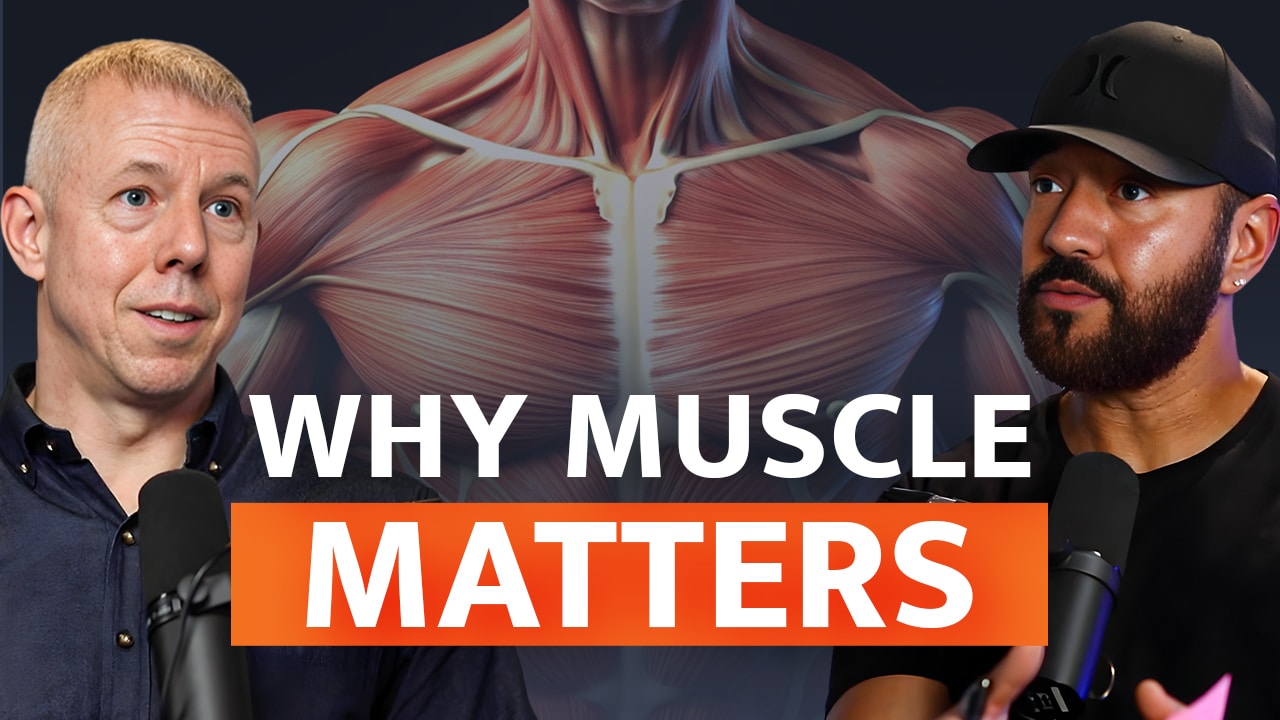
TMHS 954: The Mind-Blowing History of Muscle & How to Become Stronger – With Michael Joseph Gross
As humans, we have an innate ability to create change in all aspects of our lives. And one of the most vital things we can influence is the health and strength of our bodies. On today’s show, you’re going to learn about how building muscle can influence everything from your mood and mental health to your risk for diseases and longevity.
Today’s guest is author and journalist, Michael Joseph Gross. His influential work has been featured across many national media outlets and mediums. His newest project, the book Stronger, brings light to the central role of muscle for human health, happiness, and longevity. On this episode of The Model Health Show, Michael is sharing the fascinating ancient history, science, and role of muscle.
You’ll learn about Stronger’s three central figures and their inspirational stories of how muscle improves the human experience. We’re also going to discuss muscle’s incredible ability to reduce painful symptoms and increase your overall survivability. Michael’s insights will reframe the way you think about exercise and muscle—and why we need them to live our best, healthiest lives. So click play and enjoy the show!
In this episode you’ll discover:
- The essential role of the gluteus maximus. (2:29)
- How learning a new sport changed everything for Michael. (7:53)
- The importance of making exercise as routine as brushing your teeth. (8:33)
- How the culture of strength is driven by example. (10:57)
- What percentage of the population strength trains. (12:09)
- Why we need to respect muscles and the mind as an integrated whole. (19:30)
- A story of the power of progressive overload. (20:50)
- Why rest as essential as building strength. (23:14)
- What supercompensation is. (27:41)
- The interesting history and etymology of gym. (33:16)
- How the Spartans trained. (37:11)
- Why strength training is transformative for overweight adolescents. (47:54)
- The role of muscle for young developing girls. (54:11)
- How strength training can improve the symptoms of depression. (1:03:37)
- Why strength training can reduce your risk of dying from cancer. (1:06:30)
Items mentioned in this episode include:
- WildPastures.com/model – Get 20% off every box plus an additional $15 off!
- DrinkLMNT.com/model – Get a FREE sample pack of electrolytes with any order!
- Stronger by Michael Joseph Gross Get your copy of the book here!
This episode of The Model Health Show is brought to you by Wild Pastures and LMNT.
Get 100% grassfed and finished beef, pasture raised chicken, and other nutrient dense, regenerative meats. Sign up with my link to get 20% of for life, plus an additional $15 off your first box at wildpastures.com/model.
Head to DrinkLMNT.com/model to claim a FREE sample pack of electrolytes with any purchase.
Transcript:
SHAWN STEVENSON: Welcome to the Model Health Show. This is fitness and nutrition expert Shawn Stevenson, and I'm so grateful for you tuning in with me today. What if I was to say that your muscle is a matter of life and death? Would you believe me that's such a strong and profound statement to say, no pun intended, with the strength. But what you're going to discover today is not only historical references to muscle being a matter of life and death. But the overwhelming amount of new science that we have today, affirming how powerful muscle and specifically being stronger is arguably the most powerful protective mechanism that we have, that we can proactively grow, that we can protect.
Whether this is from our beginning here on planet Earth, all the way up into our late, late senior years. You're gonna hear today some signs affirming that people in their nineties are building crazy amounts of muscle with the right inputs, and it's having transformative impacts on their health. And so today, again, this episode is so special for me because it helped to uplevel my thinking regarding muscle because it tapped into something that I'm deeply passionate about, which is where did this stuff come from? The ideas that we have as a culture, the things that we accept as normal, like where did this start?
Is there any historical reference to our fascination and focus on building muscle? And the book that this information comes from is so masterfully written. I actually wanna share a quick portion for you here today because we covered so much ground in this amazing interview with the author that we didn't even get to talk about. One of my favorite parts that relates to something that's incredibly powerful in our society today, that's normalized in our society today, but it has some very deep biological roots and historical roots as well. And what am I talking about? I'm talking about our culture's obsession with the booty. All right.
Now in the book, it states that the biggest muscle in the butt, the gluteus maximus, is a priority because it's the biggest, thickest, most powerful muscle in the body. The muscles enormous size makes it a striking anomaly of human muscular anatomy compared to all other animals, " being endowed with prominent rounded buttocks is the unique privilege of humans." Wrote the evolutionary biologists, Francois Kay Joffrey. And this was in a study, published a published study on the glutes, " A hallmark of humankind", no other mammal even has a gluteus maximus. Alright, so looking at even human biology, why are we so obsessed with booties? You got one, you could be popular.
Is it some kind of primal programming that's looking at, oh, this is a, that demonstration of potential. All right. Not potential, whatever, but a potential in strength in capability, right? This isn't just reserved for the ladies, by the way. Okay? There's guys out here that are doing their hip bridges. They're doing their RDLs. They know that this muscle, the gluteus maximus, the glutes, have this remarkable potential for muscular growth and development and all the benefits that come along with that, which you're going to discover today specifically. I'll just throw one part out here for you.
Preventing and reversing symptoms of depression in regards to muscle booty prevents depression. All right? That's the headline, let alone reducing the risk of cardiovascular disease. The list goes on and on. Now, of course, this is not relegated solely to the booty. But this is a function of our musculature overall. But there is a lot of potential with that bias. So, but, but no pun intended, in reality, this episode and this book is one of the most remarkable books that I've ever read on human health, on functionality and weaving together masterfully the history of muscle and cultures that really valued muscle and physical culture like the ancient Greeks and Romans, that we might picture the Spartans.
Right? And we're gonna talk about that. And you're gonna hear about the exclusion of women in a lot of these cultures except for the culture of the Spartans and how remarkable it was at that time for women to be encouraged as a culture, to get stronger, to train. And you're gonna understand why they were doing that because there was a very specific driving force behind that intention as well. And so, of course things have changed over time, but knowing where we come from can often help us to better decide where we're going. And so, again, I'm very excited about this episode. Not only we're gonna look at some of the history, but also we're gonna look at progressive overload, periodization, super compensation, and these new terms for many people that are emerging in fitness and strength training and muscle development today.
Been around for decades, been around since the beginning, alright. But the terminology and the science has been around for decades, but now they're emerging in popular culture as ways to more efficiently and effectively build and sustain our muscles. So again, so much incredible information. Without further do lists, get to our special guest and topic of the day. Michael Joseph Gross, graduated from Williams College and studied at Princeton Theological Seminary. After working as a political speech writer, he began writing for newspapers and magazines. As a long time contributing editor at Vanity Fair, he wrote about culture, he politics, religion, crime, business, technology, and even national security.
And his investigative reporting has been featured on countless national television and radio shows. His new book Stronger. The Untold Story of Muscle in Our Lives is about the central role of muscle in human life and is probably the only book to ever be excerpt in both Men's Health and the American Scholar, and featured by a wide range of media outlets from the peer-reviewed journal Nature to People Magazine. This book and this message are a masterful blend of history and practical science to help you to get stronger. Now let's dive in this conversation with the incredible Michael Joseph Gross. Alright, I'm so excited. As I said, Michael, so good to see you. Thank you for coming to hang out with us.
MICHAEL JOSEPH GROSS: Thank you for having me, Shawn.
SHAWN STEVENSON: All right. Let's start off by asking this big question. How do you think we can use revelations of muscle and strength from the past to inform our decisions about the future? What made you take that approach to looking back in time?
MICHAEL JOSEPH GROSS: Around the time that I turned 40, I decided that I wanted to learn a sport that scared me. I wanted to learn whitewater kayaking, but I knew I had to be a lot stronger than I was before I got on the river. So I started working out more seriously than I had before in a gym, and it changed me head to toe. I was calmer. I was just generally more useful and I actually came to see my workouts as one of the most useful things I was doing for other people in my life too. The reason for that was that even though I had gone to the gym before and a lot of people I knew went to the gym, but you know, in a sort of on and off way, maybe train for a race every few years. I didn't, and the people I knew didn't work out the way we brush our teeth. And when I did start to work out the way that I brushed my teeth, it made my friends, my family, curious about that for themselves.
And they tried it and it changed them too. And it made me really curious about that whole set of changes, not just what was going on in my body, but what was going on socially. So the Science of Strength training and the Culture of Strength training, these questions about the culture of strength training really get to the heart of your question about history. Why is it that only certain people and certain kinds of people have really taken up strength training in a serious way? Now that goes way back to the whole story of how athletics and medicine developed, even in ancient Greece and ancient Rome. But we can get into some of that in a few minutes. The point I'm really driving at is that I saw that we need to blow the doors open on the gym and really invite everybody in, all kinds of people.
I mean, what would the world look like if the first person you thought of every time you heard the word muscle was not some big guy but your grandmother. Now your grandmother in particular, I wanted to ask about, because, you know, she changed your life. She's how you first got strong, right? She's who set the model of health for you. And these models of health through history were what I ended up becoming most fascinated by, that turns out that the culture of strength is driven by the force of example. It's driven by some people who get strong, other people who see it and want to emulate that and start to create a new story for themselves.
SHAWN STEVENSON: Yeah. Oh, this is so true. So true. It's, for me, I always. Kind of just put this placeholder in my mind, and this is why I'm part of the reason I'm so excited to talk to you today about this very physical culture that we look at and we marvel at, you know, we look at these statues and these paintings and we wonder like, was this the, was this just the norm? Versus today, right? Like, what are we doing so differently? Do we not have the same kind of physical culture or admiration or respect, or like how is it integrated into culture at one point and how it's integrated into culture today because it is integrated in our culture. But one of the things I was shocked to find out was how few people, because we have our bubbles are actually strength training.
MICHAEL JOSEPH GROSS: Yeah.
SHAWN STEVENSON: Right?
MICHAEL JOSEPH GROSS: Yeah.
SHAWN STEVENSON: Was it around three, 4% of the population?
MICHAEL JOSEPH GROSS: Yes. So if you look at Instagram, it looks like everybody is lifting weights because the people who get their pictures taken most often are lifting weights. More of those people are lifting weights and lifting weights really has been the fastest growing of all of the types of exercise that the government collects data on over the past 30 years or so, it has grown in popularity by about 34%. But when you look at the absolute numbers of people who do it, it's much, much lower. It's really grown from just about 3% of the population to 4% of the population.
And the people who are doing it are heavily weighted toward highly educated and people who already believe themselves to be in really good health. And also young people, the percentage of people who are lifting weights drops precipitously with every decade of life. And by the time we get down to by the time we get into our eighties, it's really a fraction of 1%, and it's the oldest people who probably need weight training the most.
SHAWN STEVENSON: Right. We have a huge opportunity to shift culture so that it's more normalized.
MICHAEL JOSEPH GROSS: Yes.
SHAWN STEVENSON: And this book is incredibly special in helping to get this message out here. And I don't say that lightly because prior to me even meeting you, two of my biggest muscle mentors and friends and colleagues reached out to me about you. Dr. Gabrielle Lyon, in her perspective, muscle centric medicine and Nsima Inyang, which is he's just a master of muscle and movement like nobody else I've ever seen before.
And so for them to be like, this book is transformative, like you don't, this is the best book I've ever read on the subject of strength and muscle. And a part of that, a big part of that is because something that we have in common that I haven't seen very often, which is I'm curious about where it came from.
Right. And so in my book, eat Smarter, having this conversation about a calorie, I was like, where did this idea come from? Where did, what was the, what was the foundation of this? And how did this evolve over time? Right. I was so excited and entrenched in that discovery that it became something very special and connected for other people. And that's what you've done with this.
MICHAEL JOSEPH GROSS: Now, why is the history of physical culture interesting to you? Like what, what does it do for you? How is that useful to you? I'm curious. Yeah.
SHAWN STEVENSON: The first thing that comes up for me is seeing what's possible like that really stood out for me and having these superhero figures. You know, in my childhood and wanting to be strong and capable and to overcome obstacles. And I attribute that psychologically to being physically strong, and muscular. Right. And so having an ability to move the world.
MICHAEL JOSEPH GROSS: Hmm.
SHAWN STEVENSON: In essence.
MICHAEL JOSEPH GROSS: Hmm. I remember when I first got serious about lifting and started working with a trainer, he would say things to me like, listen to your body. You know, I would ask how much pain is too much pain? Things like that. He would say, listen to your body. And I had no idea what that meant. Like, none whatsoever, because I had lived my whole life, mainly in my brain up to that point. I tell you that story as a kind of preamble to introducing the first of three central figures in Stronger. Once I decided that I wanted to write a book about exercise, I knew that I wanted to tell interesting stories, and I knew that I wanted those stories to have embedded in them, the best research that people need to know about if they want to get stronger. I started traveling around all around the world, interviewing elite athletes and coaches, and doctors and scientists.
And, over time I came to see that there were really two main frameworks in which we understand and experience muscle, and it's maybe a big obvious thing to say, but let's say it, we understand and experience muscle through the frameworks of athletics and medicine and athletics and medicine as we experience them in this society. Go back to ancient Greece and Rome. Now, the person who helped me understand that is a guy named Charles Stocking. Charles Stocking is probably the only Homeric scholar who also holds a California junior state powerlifting record in the squat. When he was in his early twenties, he squatted almost triple his body weight and he's kept up with the training.
He's 45 now. He's even stronger now than he was then. He is almost certainly the only person in any university anywhere who both teaches ancient Greek classics and kinesiology, your specialty. The study of human bodily movement, one of your specialties, I should say. But Charles stocking teaches courses on ancient Greek athletics that always start with him saying The one thing all of us have in common with ancient Greeks is that we all have bodies. The question is, are they the same bodies? Now that was another observation that didn't make any sense to me when I first heard it, but I'm gonna loop back and connect these things here now. Over time I came to see that when you look at those statues of ancient Greek athletes, and you are amazed by the mus.
You're seeing them in a completely different way than ancient Greeks saw them. Ancient Greeks didn't understand that the fleshy part of mussel had anything to do with movement. They thought it was the lines of articulation around the muscles, that bespoke strength. They thought that it was actually tendons and not muscles that moved us, but they thought that tendons moved us because of a portion of hot air that was caught in the body that circulated and caused those tendons to increase in size, which pulled on the bones in our arm and moved us like a marionette. So what the body is the very physical, physical reality of who we are changes over time. It's changed through history and it also changes over the course of our personal history. You know, I didn't know myself as a muscular being 15 years ago. I have had to learn how to take muscle as seriously as I take the mind. I've had to learn that the muscles and the mind are an integrated whole, and that the only way we can come close to living a really thriving life is to respect them on par with one another.
SHAWN STEVENSON: I love this so much. I want to ask about a specific story. Got, oh, I'm trying to hold my excitement. This first story, Milo in the bull.
MICHAEL JOSEPH GROSS: Yeah.
SHAWN STEVENSON: I want to ask about this because it's a concept. As soon as I started reading the story, I'm like, oh my goodness, he's going to get stronger in alignment with the growth of this bull and this concept of progressive overload. Right? So can you share that story?
MICHAEL JOSEPH GROSS: So there was a young man who was in a field, in the fifth century BC and he looked across the field and he saw a little calf, and he walked over to that calf and he picked it up and then set it back down. And the next day he did exactly the same thing, and he kept doing the same thing until that calf became a bull, or so the story goes. Now this is the story that was told about Milo of Croton, who was the Arnold Schwarzenegger of the ancient world. He was the preeminent figure in physical culture, really in athletics. He was a wrestler, and he won more Olympic wrestling titles than anybody ever did. I think the number of Olympic wrestling titles Milo won was the same number of Mr. Olympia titles that Schwarzenegger won, actually.
But this story has become a symbol of the principle of progressive overload. The idea that you need to lift progressively heavier weights in order to get stronger. Now, the limitation of that story, of course, is that if you, is that the Milo story is false. You know, nobody can improve their strength on an endless upward course. Strength is cyclical. We have to take a rest after we have exerted ourselves so that our bodies can replenish their, can repair and so that our strength can be replenished. So the Milo story is both really useful and also a cautionary tale not to get too carried away with any particular idea about strength. Because even this most basic truth that we have to lift progressively heavier loads is limited. We have to rest as much as it is as important for us to rest as it is for us to exert ourselves if we want to get stronger.
SHAWN STEVENSON: Yeah.
The overall nutrition in our food has taken a nose dive in recent decades. In fact, an analysis published by scientists at the University of Texas made an alarming discovery. 43 foods, mostly vegetables, showed a marked decrease in nutrients. From the 1950s to 1999, according to that research, everything from vitamin A to calcium to iron and more has significantly declined. Again, if it's not in the soil, it's not in the food. It's the unsustainable farming practices that have obliterated our soil quality. But this is changing thanks to farmers who are dedicated to regenerative farming practices. And this is not easy to do in a market that is slanted towards quantity over quality, but select farms are stepping up to do the right thing.
And this is especially seen in the domain of animal foods. Research published in the British Journal of Nutrition found that beef from animals fed an abnormal diet of conventional pesticide laden grains that decimate the soil quality contain up to five times less Omega-3 fatty acids than what's found in grass fed beef. And research from the College of Agriculture at California State University has found that grass fed beef contains elevated precursors of vitamin A and E, as well as increased disease fighting antioxidants like glutathione and superoxide dismutase activity compared to conventionally raised grain fed beef with unsustainable farming practices. Whether you're eating plant foods or animal foods.
You'd better know the difference when it comes to organic practices and regenerative farming. And this is what I truly love about Wild pastures. Wild Pastures delivers 100% grass fed and grass finished beef pasture raised, pork pasture raised chicken and wild, caught seafood directly to your door. All born, raised and harvested entirely in the US and raised on regenerative family farms. These pastures are free from synthetic pesticides and other chemicals. There's no antibiotics, no added hormones. And right now with the Wild Pasture subscription, you're going to get 20% off for life, plus free shipping and $15 off of your first order. Absolutely incredible. Go to wild pastures.com/model. That's W-I-L-D-P-A-S-T-U-R-E s.com/model. 20% off for life free shipping and $15 off your first order. Head over there, check them out. Wild pastures.com/model. Now, back to the show.
SHAWN STEVENSON: I love this historical reference to something that so many people who are invested in the culture of bodybuilding, for example, they know about this. Yeah. Right. And as you just mentioned, it's so mind blowing because somebody who's uneducated in this subject might even think, of course, like it's just strength is linear. Like I just keep doing this thing. But to make this affirmation it's cyclical.
MICHAEL JOSEPH GROSS: Yes.
SHAWN STEVENSON: You know, is very, it's such a important thing for us to remember. Because it keeps our mind in the right place. You know? And you mentioned how even that mind muscle connection or like how, paying attention to how you feel. Right. It's a huge part of this whole equation is like integrating this stuff and doing this in a more intelligent way, because of course we wanna get the results we're looking for.
MICHAEL JOSEPH GROSS: Right.
SHAWN STEVENSON: And you know, it's so wonderful because we have this aspirational part of the story and also a cautionary part of the story. And for us to be aware of, when you say cyclical, we can see a phenomenon that happens whether this is, you know, sprinting, whether this is kayaking, whatever the case might be. We see this amazing transformation happen occasionally. We, I don't know even based on what, what I've learned from you, if it's something that we can predict, maybe we could stack conditions. But this concept of super compensation. Right. So can you talk about that and also just share that, that bridge to what? To what I'm talking about?
MICHAEL JOSEPH GROSS: I wanna answer that with a story. Charles Stocking has translated and written a lot about the only long piece of writing that survived all of antiquity that's focused solely on athletics. It's called the gymnastic, and it is not exactly a training manual. It is a defense of athletic training. A representation of athletic training as a form of wisdom.
The oldest piece of writing, we have the oldest long piece of writing we have about athletic training begins like this. Let us consider athletic training, a form of wisdom inferior to no other. It goes on to compare athletic training, to put it in the same class with music, mathematics, philosophy, navigation, all of these skills and arts that we recognize habitually as being the essence of culture where we often think about athletics as existing in a different realm.
But one of my favorite stories in the gymnastics is about a wrestler named Garran Os. Now Garran Os was an Olympic champion. He was a great wrestler. He when after he won at Olympia, he went out and he decided to celebrate by going on a massive bender. He just got drunk and stayed drunk for days, and then he showed up for training and his coach was angry. He's thought, you know, I'm gonna teach this kid a lesson, and he forced him to go through his workout just like normal. But it didn't work. Garron Os just wasn't up to it. He did his best, but he worked himself so hard in this workout that he died. And the gymnastic tells this story as an example of the wrong kind of training.
The coach was following a form of training called the tetrads. The tetrads were basically an early form of periodized training. Like anybody who's ever looked at the work of Charles Quin knows about periodized training is organizing your training in blocks of time that adjust intensity and other variables. And super compensation can be one result of a periodized training program. You build up the intensity, you then take a break, and while you're taking a break, your body repairs itself. Back, not only back to where you were, but to a higher level of strength so that you can exceed your previous performance.
And a lot of people use this strategy to break records. Charles Stocking used it to set his squat record. So the coach in the gymnastics was forcing the wrestler through a periodized training program, and he was doing simply the wrong thing. The gymnastic is says that good coaches only. Provide exercises improvised for the right time. They're not wedded to a cookie cutter prescription. They're always paying attention to the reality of the body on any given day. And when the gymnastic has says that exercises should always be improvised for the right time, the word they use for time is kairos. That's transliterated, K-A-I-R-O-S. And what Kairos means is basically doing the right thing at the right time. So our oldest record of what training actually looked like in a formulaic way, is actually an argument against training formulas. It's an argument that the formulas have to work for us. We don't work for them.
SHAWN STEVENSON: Yeah. I love this. I mean, again, just affirmation for the coaches that are just at the most elite levels, they're paying attention to their athlete or their client on that day. Right. And what's appropriate. Of course, you have your plan, but having flexibility within that plan, right. To adapt for the person that is there before you that day. Right. And for us to do this ourselves as well, that takes wisdom.
MICHAEL JOSEPH GROSS: Right.
SHAWN STEVENSON: You know, that takes that experience and growth to be able to go within and to find out what's appropriate to keep you moving forward.
MICHAEL JOSEPH GROSS: Right.
SHAWN STEVENSON: I wanna ask you about gym gymnastic a little bit more. Is there a meaning even in the word itself?
MICHAEL JOSEPH GROSS: Oh, well, all. Variations on the word root that starts with gym. GYM, go back to the Greek Ginos, G-Y-M-N-O-S, and Ginos meant naked. So gymnasium literally meant the naked place. There was a sign over the entry to the gym in Sparta that said, strip or go away.
SHAWN STEVENSON: Well, damn.
MICHAEL JOSEPH GROSS: When gymnastics came to the United States in the 19th century, gymnastic training after ancient Greece and Rome was, so far as we know, from the historical record, it really was almost entirely forgotten until the 18th and 19th centuries. And when it came to the us, it actually first came to a girls' school around Boston in 1825. The first P.E. class in the United States was a girls PE class, and the head of this school in 1825 wrote a report on gymnastic training for females. He said that most of the girls strength had more than doubled. Once he'd introduced this form of exercises. He said that the only drawback was that their hands had some calluses on them.
And the other drawback was this word gymnastics, which he thought was so coarse that it shouldn't even be breathed in the vicinity of young women because everybody at that time knew their Greek well enough to know that Ginos meant naked. But despite that, he said that he hoped that gymnastics classes for girls would soon be as common as churches in Boston.
SHAWN STEVENSON: There was, of course there's been different iterations from there proceeding towards modern day. And it was not an easy fight to get this physical culture popular with female population. As a matter of fact, you know, cultures kind of fought against that. But there is, again, as we go back to the past, probably the greatest example of physical culture with women was the people of Sparta.
MICHAEL JOSEPH GROSS: That's right.
SHAWN STEVENSON: And of course that this was one of the things I was super excited to talk about earlier and I was just trying to, withhold my excitement. You know, it's been really glorified, obviously with the movies 300 and that got a lot of guys to go to the gym or step things up as well. But one of the things that really stood out to me was the relationship with his queen. And of course there was a part two, which wasn't as good of course, but you know, just like seeing how strong she was as well. Right. And can you talk about that? Because during this time it was wildly unacceptable for women to be participating in athletics to that degree, except for the people of Sparta.
MICHAEL JOSEPH GROSS: That's right now, gymnasium education in Greece started. Well, gymnasium education in Greece was really at its height was thriving by the third or fourth century BC but it was exclusively for men. The only place where we have any evidence that women, young women were also allowed to learn gymnastics training is in Sparta. We don't know a lot about what forms of exercise they did, but the earliest records suggest that both wrestling and running were part of their training. And also, group dancing, choral dancing, which would've involved a lot of jumping, a lot of plyometrics, a lot of things like lunges.
And most of the writing that we have about Sparta was written by people who lived in Sparta's enemy territory, Athens. So when they would write about Spartan women training, they would make fun of them. They would try to make them sound loose and loose. They would call them thigh flashers.
SHAWN STEVENSON: Those freaky thigh flashers over there, Sparta.
MICHAEL JOSEPH GROSS: But there are some records, some artifacts I should say, that come pretty close to showing us what Spartan women thought about Spartan Women's athletic training. There are about 40 small bronze figurines. Many of them were actually mirror handles. So, imagine you're a Spartan woman in like the fifth century BC and you reach for your mirror and the handle of that mirror is actually a sculpture of you or of somebody who looks just like you. They are, they're wearing the basic accoutrements of athletes. The two symbols of an athlete were something called a rigel, which was a piece of bronze shaped, kind of like a banana. Athletes would cover themselves with olive oil before they trained or competed, and then they'd take the rigel and scrape the olive oil off.
And there was also a little, but they would, they would also, it would be valuable. When they scrape that off, when they, when you scrape it off, it's called, it has a different name. It's called Gloss. So it like gloopy, gloppy stuff and it's combination of sweat and oil and dust. And they would save that because they could sell it because people believed that it had medicinal purposes. It seems that people believed that it actually carried some of the strength of the athlete. And if you took that and you put it on yourself, it might rub off on you.
SHAWN STEVENSON: Literally.
MICHAEL JOSEPH GROSS: Yeah. Yeah.
SHAWN STEVENSON: So the second thing was?
MICHAEL JOSEPH GROSS: The second thing is in ribose, and that was a little vessel about the size of an apple that they would keep the olive oil in. So pour the olive oil from those in your hand, cover yourself, get your skin nice and smooth and glistening, and then take the rigel and scrape it off, and then you're ready to take on the world.
SHAWN STEVENSON: Amazing. Shout out to olive oil, by the way. It's been around a long time. Lots of different purposes. It's so fascinating, you know, and to put, and even more powerful emphasis on this physical culture. This wasn't just because they were very intentional about this. Talk about that.
MICHAEL JOSEPH GROSS: Yeah. This was really about creating the main goal of Spartan society was to create strong soldiers to protect the city state of Sparta. Now, there's a caveat here, which is that when I talk about Spartans, I'm really talking about just the elite, very top level of society, which is held up by a whole structure of slavery and exploitation. So, you know, when we're, when we're talking about ancient Sparta, we have to remember that there was kind of a 1% or a 5%, and then a 99, 90 5%. But, in that top level. When you weren't doing your job, when you weren't doing military training, you were basically expected to be at the gym. And they believed that strong women would produce strong children. For that reason, women's training really stopped once they got married or had children. This was not a, an egalitarian practice in, a modern sense, not at all. This was done for eugenic purposes, and it was all done in a way that was controlled by men.
SHAWN STEVENSON: Hmm. That's fascinating. You know, it's so interesting because. We would say, they don't necessarily have any "science" on this. It was just kind of maybe, maybe it was just logical to them, like, stronger mother will produce a stronger child today. We know that there's actually something to that, you know, and the strength, physical strength of the mother and being able to make these gene expression alterations and what's getting passed off. But it also goes into the negative as well. You know, and so, we see under stress and, you know, these conditions and passing off genes that are more susceptible to stress and this just puts the power back into our hands, a little bit of shining a light into, in a reminder that we have the capacity to influence future generations.
It's not just purely, you know, genes getting passed down. We are making changes in this kind of coding and what's getting passed down and the potential. One of the things that we've talked about a couple of times over the years is, you know, there are thousands of possibilities of what a gene can do, how it can be read or expressed. Right. We tend to see it. Unfor, when I was in school, actually in the, you know, the, the genome project. And everything shifted to, you know, genes are blaming, we're blaming genes for everything. Your potential is specifically based on your genes, and we went too far.
MICHAEL JOSEPH GROSS: Right.
SHAWN STEVENSON: You know, it obviously plays a part, but there's so much more to the equation. A big part of that is environment. A big part of that is what we are passing down based on our choices that we're making right now. But then even still, our child still has the opportunity and we have the opportunity to, because I'm saying that to say, because sometimes we can feel guilt about certain things, or maybe we should have did this, should have did that. There's no better time than now to start and to help to push this culture forward, to create a culture where we are taking advantage of getting stronger.
MICHAEL JOSEPH GROSS: There's no better time than now to get stronger, and it's never too late to get stronger. Maria Fiatarone Singh is a geriatrician, a medical doctor at the University of Sydney Medical School. And I think of her when you talk about the potential to alter our physiological fates, even if we're not genetically blessed, because that is a fundamental principle of the almost 40 year research career that I tell the story of in stronger. Maria Fiatarone Sing in 1989 got the idea of teaching a group of frail 90 year olds to lift weights at high intensity. I'm talking about 80% of one RM. Now, their relative strength was so low that in some cases, 80% of one RM for a knee extension, a leg extension was like five pounds or even less.
But they did a very simple program, just a classic, three sets of 10, two or three times a week for something like eight, 10 weeks. And the results were astonishing. The minimum strength gain among this group of people was 67%. The average strength gain was almost 200%, and the maximum strength gain was almost 400% incredible. So this, these people were suffering from a syndrome that was just then being named. It's called sarcopenia. Sarcopenia is age related muscle loss. And at that time, doctors believed that becoming frail, losing very significant amounts of muscle and strength was an inevitable part of aging.
These experiments that Maria Fiatarone Singh did, showed that that wasn't true and also opened the door to a whole line of research that has now shown sarcopenia in many cases, begins in early life. So kids who aren't exposed to muscle strengthening exercise don't develop muscles to a high enough level that they're gonna be able to, that they have any chance of aging successfully, you know. And all this research on strength at the end of life has really changed many scientists view of how strength needs to be handled early in life. And Maria Fiatarone Singh has done some amazing studies of weight training for adolescents too, especially overweight and obese adolescents found that it increases metabolic health.
It can just stop the expansion of the waistline. It can just stop it. And, for kids who are overweight, who maybe feel self-conscious about doing aerobic exercise. Self-conscious about running weightlifting is something that they can be really good at. You know, they can sit in a seat and lift heavy weights and it gives them a real sense of accomplishment too.
SHAWN STEVENSON: Hmm. And it's definitely changing their biology.
MICHAEL JOSEPH GROSS: Yeah.
SHAWN STEVENSON: When it comes to energy and performance, it all starts with the powerhouse power plants of ourselves called the mitochondria. Our mitochondria are so abundant, they actually make up about 10% of our overall weight as adult human beings. We got a lot of mitochondria to run a lot of processes. Now we wanna make sure that we're not gumming up that process of energy creation. And not only that, how can we add to it to create more mitochondria and more energy efficiency? Well, one of the most important components nutritionally has to do with these incredible minerals that carry an electric charge called electrolytes. In particular, something like magnesium, for example, is required to make new mitochondria. It's a process called mitochondria biogenesis.
The creation of new mitochondria depends on magnesium to be present. Pretty amazing. Plus, we've got this remarkable sodium potassium pump that has a lot to do with the energy exchange going on throughout all of ourselves. It isn't just about the mitochondria. Of course, there's a huge data network that runs this amazing human entity. But again, it all works together and those three electrolytes in particular are an important place for us to focus. And so we wanna make sure that we're getting plenty of electrolytes from our diet.
Today more than ever, whether it's high performance athletes, top CEOs, or just everyday folks looking to fuel their days and fuel their performance. Supplemental electrolytes are one of the most popular things in the world, but for decades, that medium has also been a source that has been rampant with artificial colors, artificial flavors, and ridiculously high amounts of refined sugars. And to that, we've said no more. Enter the age of LMNT. It has no artificial colors, no added sugars, and no dodgy ingredients, and it has science-backed ratios of those three key electrolytes based on hundreds of thousands of data points with real people. When people utilize LMNT, they truly notice the difference, whether it's in their stamina, their cognitive performance, helping to manage hunger and cravings.
There really isn't a metabolic process in the body that an electrolyte supplement like this cannot support. And right now, when you go to drinkL,NT.com/model with every electrolyte purchase, you're going to get a free sample pack with two. Servings, each of their four most popular flavors. Incredible. Go to drinkLMNT.com/model right now to take advantage of this incredible offer. This very special gift element is a big part of my life, my team's life, my family, friends. It's really an incredible supplement. Super easy to travel with. I always have their little packets on the go with me when I'm traveling. Also, when I'm working out as just in my water bottle today, during my workout. Truly love LMNT. Head over, check them out. It's drinkLMNT.com/model to take full advantage of this very special offer in this special gift. And now back to the show.
SHAWN STEVENSON: This is one of the big goals, you know, I I see from your work is to shift the culture and the perception around strength training. And one of the things that. There's so many really strange myths around strength training as well, like stunting people's growth, right? For example, or again, if you're elderly, like it's too dangerous. Life is dangerous, and you're far more in danger if you're not strong. Right. You know, and the great news is that, you know, number one on the side of children in adolescence, this is a great time.
We're not saying for, you have your five-year-old to, you know, start deadlifting or whatever, a bunch of weight, but to be physically active and to have a physical culture. Right. My youngest son who, you know, he just had a basketball tournament this past weekend. He's MVP of the tournament. We got this shot as coach took, he was, he jumped up and grabbed a steal. I swear he's three feet off the ground easily. Easily. He's just, his whole, it was like his knees was like by the kid's head who, who he jumped up over.
MICHAEL JOSEPH GROSS: Well done.
SHAWN STEVENSON: Right. And since he was a baby, like when he was probably three, four years old, he was at the track with us. And I was not trying to get him to do these sprints with us, but it was hard for me to stop him. All right. So I do this sprint. I'd be like, Braden, wait. Here I do my a hundred meter sprint. And here he is. He's probably at, you know, 50 meters away at this point once I turn around. But he's just going, you know, and it's just because it's a part of our culture. Right? And so, but during adolescence is a great time to start to implement some intentional strength inputs.
It provides a great template, just like we can provide a template of obesity, right? That makes it more difficult for the child to overcome that if it's implemented earlier on in life. The same thing happens with strength.
MICHAEL JOSEPH GROSS: That's right.
SHAWN STEVENSON: That's one of the things I'm hearing and on the other side of the equation with the elderly population, understanding that it's never too late to get stronger.
MICHAEL JOSEPH GROSS: That's right.
SHAWN STEVENSON: We have data now on people over 90 years old building remarkable muscle. Like this was something that is just completely unheard of or unthought of previously. It's just like, oh. It's just what can you do? You can, you can continue to get stronger no matter where you are in this timeline.
MICHAEL JOSEPH GROSS: That's right. Everything you just said about strength training for young people and adolescents, I just want to emphasize, needs to be applied at least as much for girls as for boys. If we were really serious about addressing the problem of osteoporosis and the related problems of hip fracture and falls in our elderly population, we would be getting every girl to lift weights and do plyometric jump training, starting even in pre puberty because it's the pre pubertal years that are the best window of opportunity to build bone density.
There are sophisticated computer models that have shown that if we increased bone density by just about 10%. Among young girls, we could reduce the risk of hip fractures by 50% in old age. It's such a modest amount of work that we would need to do to get a huge payoff for our society that would save us both piles of money. And also, just heartbreaking amounts of suffering.
SHAWN STEVENSON: Yeah. Oh man. Thank you for sharing that. Thank you for sharing that. If we are all just looking into our own kind of mental Rolodex and going back in time, or even right now, depending on the construct of your home culture, kids, it's hard to get 'em to stop jumping off stuff, jumping on things moving fast. Like it's just innate. Yeah. And, but our culture is like, sit down. Right. Slow down. Don't do that, don't. And it's also, it's adjusting two risk assessment as well. Again, we're here to be a safety net to guide our kids. Absolutely. But as you know, and this is just the results of what we're seeing, we are creating a culture where our children are far less resilient.
MICHAEL JOSEPH GROSS: Yes.
SHAWN STEVENSON: And so we can again. Simple things we can implement. It starts in our home though, because it's, our tendency is like, we'll push 'em off. Like, you know, go to school, get your physical education there, whatever. Which that's been dwindling over the years. It's, there's a little bit of a resurgence of having like gym class and different things like that. But, you know, keeping in mind, like when I said earlier about our kids, not when, when they're five, like doing some structured deadlift, this is not to say that our kids don't want to pick up heavy stuff off the floor. Right? This would've been something built in where our kids are doing and our culture's doing.
And that leads me to, there's early evidence that you point out in the book as well about, you know, a certain stone having like handles carved into it and looking at this early in it, iterations of people picking up heavy things off the ground, right? So I want to talk about that, but also one of the things that really stood out for me was the communication around, like it's difficult to find where strength training was explicitly talked about historically. Right. But when it was discussed, it was discussed in the context of strength against other bodies.
MICHAEL JOSEPH GROSS: That's right.
SHAWN STEVENSON: Moving against other bodies is where the strength was developed.
MICHAEL JOSEPH GROSS: That's right. That was Aristotle's definition of strength. Aristotle's definition of strength was that strength was to move another body. It was basically the wrestling was the model for this, because wrestling was the most popular ancient sport. Ancient Greeks didn't think about weight training for fitness in the way that we do according to any evidence that we have. Their practice of athletics was first and foremost a religious devotion. It was part of ancient rituals of sacrifice. The physical evidence for heavy weight training is limited from ancient Greece to less than, less than 10 rocks.
And the two that have been, the two biggest ones that have been found in Greece both have inscriptions on them. They say the name of an ancient athlete lifted me with one hand in one case. Or in another case, I was the throwing stone of Zari. But we, we really don't have any sense that this was a regular practice for them. We don't know how they built the bodies. They did really.
SHAWN STEVENSON: Yeah. That's so fascinating. But we know they were doing something.
MICHAEL JOSEPH GROSS: That's right. That's right.
SHAWN STEVENSON: And a big part of it, again, just revealed in the writings that we do have of, uh, working against other bodies, we can get incredibly strong.
MICHAEL JOSEPH GROSS: That's right.
SHAWN STEVENSON: You know, using each other as resistance, right. Just thinking about the motion of like, if we're doing a chess press or pushing off against another person who's actively trying to push against you. And then we get into the mindset. It's just, there's so many creative ways to use another body for our strength and including our own body of course. But now I'm thinking about prison workouts, but just being able to like, you know, get creative and if, if you're wanting to do some curls, if I just hold your hands down right. And you try to curl against that resistance of my body.
MICHAEL JOSEPH GROSS: Right.
SHAWN STEVENSON: We can develop some incredible strength that way. And I could temper it to be harder or, you know, less resistant. And the same thing goes for like, if we're pushing against another body and the leg strength that can get developed or the lunge position that we'd be in and just all these creative dynamic positions. So we're getting strength and we're getting, it gets me in the mindset of NSima and what he's doing.
MICHAEL JOSEPH GROSS: Yes, yes.
SHAWN STEVENSON: Right. And he's evolved his thinking and even the way he's training over the years, because he's a BJJ champion. Right? So he's doing juujitsu and I've never seen somebody that muscular moving that way. Right. And you know, again, yes, we have the genetics component here and I want to make this point, circle back just briefly. I think that our obligation today, and I wanna make this call out to everybody who's watching or listening, is to make the most of what we have.
MICHAEL JOSEPH GROSS: Yes.
SHAWN STEVENSON: Right. We do get dealt a certain genetic hand, and within that we have the capacity to express so much greatness, so much potential, and make the best of what we have and be honest with ourselves. Are we doing that? Right. We tend to be much more externally focused today, obviously, you know, again, that goes back to like listening to your body. Right. Like, what is that? Right. Right. And our culture is constructed in such a way that, you know, it's not an accident that we are so externally focused.
You know, historically people spent a lot of time with themselves. Right, right. A lot of time in contemplation, a lot of time in their bodies without all this external stimulation. And so we've gotta safeguard ourselves in a way. And with that being said, when I'm seeing maximizing the hand that you've been dealt, what we tend to do with this, all this external focus is like, I'm doing this thing. I'm really working hard, I'm working out. You know, I, I run five miles a day, but like, I can't, my body's, I'm not getting the results that I want. And what I think that calls for oftentimes is, are you doing the thing that your body really needs?
MICHAEL JOSEPH GROSS: Yes.
SHAWN STEVENSON: Right. How is your sleep? Right. I get you're working hard, right? What are you really eating well? You know, or are, are you, is this workout what you're doing? Like your body, you, you, you're constantly in pain. Like, is do you think that maybe Right. So what we tend to do is we tend to double down on how hard we're working in a certain area. And then because of that and that learned helplessness that can develop, it makes it easy to relent to, well let me try, let me try this medication, let me try this, like, it's just, it doesn't work for me. And it's wonderful. We have innovations of course with medicine. This is a big part of this, but another part of your book is really looking at how muscle is medicine.
MICHAEL JOSEPH GROSS: Yes.
SHAWN STEVENSON: We have this powerful chemistry, this powerful pharmacy in our bodies that rivals and oftentimes outperforms some of the most prominent medications that exist today.
MICHAEL JOSEPH GROSS: That's right.
SHAWN STEVENSON: Let's talk about that.
MICHAEL JOSEPH GROSS: After Maria Fiatarone Singh did the first studies of high intensity weight training among 90 year olds. She started working on weight training as treatment or prevention for just about any chronic disease you can name. The first studies of high intensity weight training as treatment for depression in the late 1990s found that for 75% of people, not for everybody, didn't work at all for 25% of people. But the first studies of heavy weight training as treatment for depression showed that for 75% of people, it worked just as well as the best antidepressant drugs on the market, and it didn't have any of the side effects that those drugs have. Now, it doesn't have to be either or.
I know of psychiatrists who are experimenting with prescribing heavy weight training along with an antidepressant drug so that some of their clients don't have to take as much of those drugs as they might otherwise have to take. The research on weight training as medicine for mental health is taking great leaps right now. Especially in the realm of dementia and the precursor to Alzheimer's disease called mild cognitive impairment. Another study by Dr. Singh found that compared to cognitive training alone, or a mixture of exercise training and cognitive training, weight training was actually the most effective treatment for memory and the effects of a 12 week program, something like that.
10, 12 week program lasted 18 months. Those effects included really one of the most mind blowing facts I found in all the eight years of full-time work I did on this book weight training exercise, but not aerobic exercise, actually increases the size of the part of your brain called the posterior cingulate cortex, which is the seat of emotional memory and of empathy. It's the part of the brain that atrophies first in Alzheimer's patients, even before they show any other symptoms of the disease. So the stereotype that we have of people who lift weights as being selfish and, you know, egotistical and thinking only of themselves, it's exactly the opposite of the truth.
Weight training doesn't make you. Selfish and stupid. It makes you more empathic and smarter. Another really extraordinary example of weight training as medicine is in the realm of cancer, which is, you know, something that affects so many of our lives and our loved ones lives. To give you some context for this. Meeting the basic public health guidelines for resistance exercise versus aerobic exercise, meeting these basic public health guidelines for exercise reduces the risk of dying of any cause within a certain period of time that's called all cause mortality.
Weight training alone reduces all cause mortality risk by something like 15%. Aerobic training alone reduces the risk by maybe 10% more, but if you combine the two that adds 20% more reduction of risk, compare that to the effects of exercise on cardiovascular disease risk. It's really about the same proportions. If you just lift weights, you're gonna reduce your risk of dying of cardiovascular disease by 15% or so. If you just do aerobic exercise, maybe 25% or so, if you do both, you du reduce that risk by about 40%. Amazing. But when it comes to cancer, the risk reduction runs the opposite way.
When it comes to cancer resistance training reduces your risk of dying of cancer by about 22%, but aerobic training reduces your risk of dying of cancer by 0%. Now, the reason for that is that a lot of people who die of cancer, die of muscle cachexia, they die because their bodies start to consume their muscle. The muscle atrophies so much that it shuts down other systems in the body. If you combine resistance training and aerobic training, you get. Something like a 35% reduction of risk, of death, of cancer though. So, these applications of weight training as medicine, we'd go on about this all day. In diabetes treatment, we're finding that it's extremely powerful for controlling HB A1C for controlling, blood pressure, and for controlling other markers of the progression of the disease.
A lot of diabetics eventually develop chronic kidney disease. If you get chronic kidney disease, you have to go on a low protein diet. If you go on a low protein diet, muscle wasting begins. But these doctors in Australia found that. If they gave weights to kid end stage renal disease patients when they came in for their kidney dialysis. While they were plugged into their dialysis machines, that they could actually overcome the muscle wasting effects of their low protein diet.
So while they're having the treatment that had been devastating their muscles, they're counteracting it. A lot of us in the age of COVID, a lot of people who get bad COD get prescribed corticosteroids, and one of the side effects of corticosteroids is muscle wasting. But if a doctor would write a prescription for weight training on one side of the piece of paper, every time she wrote a prescription for a corticosteroid on the other side, she would be able to substantially reduce that risk.
There was a group of physicians, about 35 of them in 14 countries all over the world, and we're talking about like an all star team like that. Scientific director of the National Institutes on Aging in Bethesda, Maryland was part of this group. The heads of the equivalent of the NIH in many other countries were part of this group, and they just issued earlier this year a giant paper on exercise prescriptions for optimal health for older people. But this paper, which includes more than 700 references, also includes a lot of research on prescriptions for younger people. And it is one thing that I think every patient, every person you know, who is a patient of doctors who wants exercise to be a part of their treatment, really needs to familiarize themselves with and really needs to take to their doctor's office and say, I want you to know about this because.
You say, I have depression. You know, if you say, now I'm on the verge of diabetes and you want to put me on pills, you know, we'll talk about that. But I also want exercise to be part of my treatment. If we don't share this research with general practitioners, they might not know about it but this is not fringe science. This is, this is mainstream bleeding edge stuff. And what it's showing is that the general guidelines are really insufficient for all of us, you know, general guidelines say that to be healthy, you just have to do two bouts of resistance training per week. But that's not enough for people with depression and it's not enough for people with diabetes. If you want to control those diseases, you really have to be lifting four or five times a week. And this paper is just full of those kinds of details. I'll give it to you for the show notes. 'cause I really think it's one of the, it's a game changing, like single reference for the whole project of integrating exercise and medicine.
SHAWN STEVENSON: This should be, I mean, for some people it's affirmation for others, this should just be a huge wake up call.
MICHAEL JOSEPH GROSS: Right.
SHAWN STEVENSON: Staggering. That muscle has so much capacity to increase our survivability and help us basically to defend our bodies against the biggest killers in our society. Right. You know, there's a section you have in the book with muscle being a matter of life and death.
Right. And this is so like, please hear this because, you know, again, dramatically reducing the risk of cardiovascular related death, diabetes, cancer, depression is the leading cause of disability in our society today. And if people are wondering why this is, like, of course, muscle is largely what we consider just related to movement. The ability to move and to move the world, as I said earlier, and to move ourselves through the world life is movement.
MICHAEL JOSEPH GROSS: Yes.
SHAWN STEVENSON: But if we just take a peek inside, you know, this tissue that we can proactively build and sustain is a huge part of this kind of immunosurveillance system. As well. And if we're relating again to like, what about these infectious diseases, what about cancer?
MICHAEL JOSEPH GROSS: Right.
SHAWN STEVENSON: This is a part to play. It's our biggest glucose sink. Right. In our bodies. Right. Right. This how many of our deaths and disabilities from cardiovascular disease to cancer, obviously diabetes are related to abnormal blood sugar. And the difficulty of our bodies being able to manage this. You build muscle, insulin doesn't even have to be present. Right? How powerful is that? Right? And so this isn't something that's just superficial. It's like it's a deep primal human capacity that we have the power to build and to sustain ourselves and to create a culture to where everybody's stronger.
MICHAEL JOSEPH GROSS: We are the first generation to have the benefit of all this knowledge about strength training and health. Nobody, our parents, our grandparents, nobody before us knew what we know.
And it really is, I think, just part of our responsibility as human beings to be part of this story of the central role of muscle in our lives. This story of discovery that's playing out right now.
SHAWN STEVENSON: I'm just gonna throw this out here. You know, this could be one of those things where the history books, a hundred years from now, if we have books at this point.
MICHAEL JOSEPH GROSS: We're gonna have books.
SHAWN STEVENSON: We're gonna have books. There's no Fahrenheit. But just looking at like 2025, something happened in society, you know, this was the year of muscle like this change in the trend towards an appreciation education, an application of building muscle and getting stronger. That's the capacity that we have, right? And so everybody listening, this isn't just about, you know, gaining this knowledge is doing something with it, and of course, supporting that knowledge. And this book really helped to support this knowledge for me, all these years I've been in this just different levels of affirmation, putting more legs under that belief system table.
That I have around making strength a priority. And so I appreciate you for that. This is obviously it's a masterful work. I'm just gonna say that masterful. And so I wanna encourage everybody pick up a copy. It's a wonderful book for you to enjoy. But this is a great book to share because the story of muscle and phys physical culture, I think would be entertaining to. People that have no concern whatsoever about muscle and strength, it's just, it's so fascinating in of itself. So if you could, can you share the best place for people to pick up the book? Where can they follow you, get more information, all that good stuff.
MICHAEL JOSEPH GROSS: Thank you. Please, follow me on Instagram. Michael Joseph Gross is my name there. My website, Michael Joseph gross.com has links to all the big book retailers, Amazon, Barnes and Noble, and a lot of independent bookstores. You can just order it in your local bookstore, but it really should be available anywhere you get books.
SHAWN STEVENSON: I love the cover too. So cool. Thank you. So cool. Well, this has been amazing and there's so many more places we can go.
I'm hopeful we're gonna continue this conversation and, um, you know, truly, I appreciate you taking the time and, and the, the energy and the effort into creating something like this. You know, it's, it's rare that a book like this comes along. Where, you know, we have that deep just immersion in history and culture. And it starts to get you thinking about things in an entirely new way. Right. But it's also something that for people that are about that life with getting stronger and building muscle, it's incredibly helpful and affirmative and directive for that too. You know, so it's just, it's, it is a special, special work from a special person. So I appreciate you so much.
MICHAEL JOSEPH GROSS: Thank you, Shawn.
SHAWN STEVENSON: You're welcome. You're welcome. The one and only Michael Joseph Gross, everybody. Thank you so much for tuning into this episode today. I hope that you got a lot of value out of this. If you did, you already know what to do. Share this with somebody that you care about. Share this with somebody that you want to get stronger with you. Alright. I truly do appreciate you taking the time to educate yourself to learn, but most importantly, it's what we do in between the lines. Alright.
Learning. Just, I'm shouting out GI Joe right now. It's half the battle. Alright? It's the application and it is our gift. It is our privilege to be able to get stronger, to proactively add in specific with intention, implements to develop ourselves, mind, body, and spirit. And again, I truly do appreciate you for being a part of this mission. We've got some amazing, amazing masterclasses coming your way very soon. World leading experts in their respective fields that are gonna blow your mind. So make sure to stay tuned. Take care, have an amazing day, and I'll talk with you soon.
Other episodes you might be interested:

Maximize Your Energy
Get the Free Checklist: “5 Keys That Could Radically Improve Your Energy Levels and Quality of Life”
HEALTHY MEALS EVERYONE WILL LOVE
The Greatest Gift You Can Give Your Family is Health
When you gather your family around the table to share nutritious food, you’re not only spending quality time with them - you’re setting them up for success in all areas of their lives.
The Eat Smarter Family Cookbook is filled with 100 delicious recipes, plus the latest science to support the mental, physical and social health of your loved ones.



Share Your Voice
0 comments. Be the first to leave a comment.