
Subscribe to The Model Health Show:


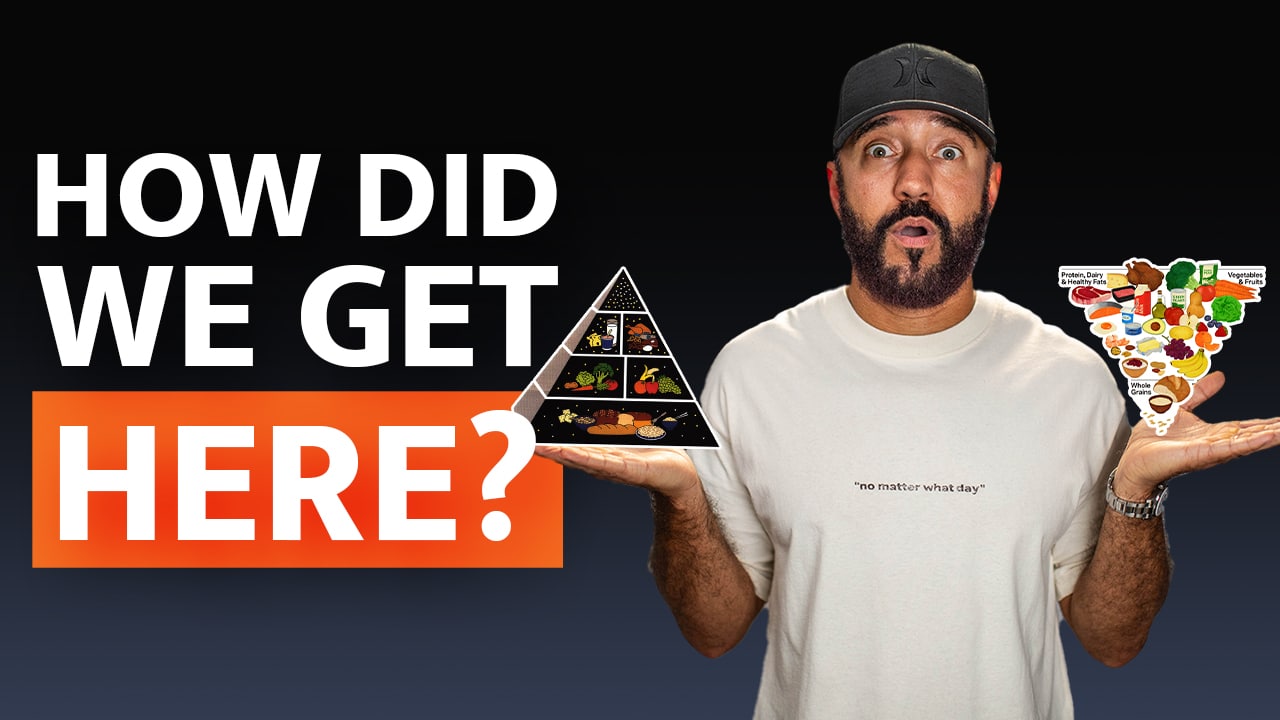
TMHS 969: The Food Pyramid Exposed: Here’s What No One Is Telling You!
This year, the USDA released a new set of Dietary Guidelines for Americans. The redesigned food pyramid maintains some long-standing recommendations but also introduces a shift away from processed food and toward high protein and healthy fats. These new guidelines have stirred up a lot of controversy, but today, we’re going to break it down in a commonsense way.
On this episode of The Model Health Show, we’re diving into the history and science of government dietary guidelines. You’ll learn about prior versions of USDA nutritional recommendations and how these policies impact food access for Americans. We’ll also talk about the pros and cons of the guidelines throughout history, as well as today.
You’re also going to hear about specific studies that outline the importance of proper nutrition for human health, including the truth about dietary fat, how calorie counting actually works, and the impact of high protein diets on weight and metabolism. Most importantly, we’re going to talk about taking control of your and your family’s health. I hope you enjoy this episode of The Model Health Show!
In this episode you’ll discover:
- What The Farmers’ Bulletin was and its purpose. (0:44)
- How different macronutrients translate to calorie counts. (4:31)
- Common misconceptions about calorie estimates. (5:15)
- How the human body processes ultra processed calories. (6:31)
- The history of the food pyramid. (13:46)
- Pros and cons of MyPyramid. (22:55)
- How obesity rates in the United States have changed in recent decades. (27:12)
- New additions to the USDA’s dietary recommendations. (28:12)
- The truth about saturated fat. (32:48)
- What percentage of the average American’s diet is ultra processed foods. (42:21)
- How the thermic effect of food works. (47:55)
- The health benefits of a higher protein diet. (48:55)
- Why USDA guidelines have an enormous impact on food access. (56:24)
- Who has the ultimate authority over your diet and health. (1:06:03)
Items mentioned in this episode include:
- Beekeepersnaturals.com/model – Save up to 30% on natural remedies!
- Eat Smarter – Read my national bestselling book for more nutrition tips!
This episode of The Model Health Show is brought to you by Beekeeper’s Naturals.
Reinvent your medicine cabinet for with clean, effective products powered by the beehive & backed by science. Claim up to a 30% discount at beekeepersnaturals.com/model.
Transcript:
SHAWN STEVENSON: Welcome to the Model Health Show. This is fitness and nutrition expert Shawn Stevenson, and I'm so grateful for you tuning in with me today. The US Nutrition guidelines have undergone some changes, and I think you're gonna be surprised at how we actually got here. When I was in college in the late 1990s, my nutritional science class was built on the principles of the food pyramid. That education and that perspective of food helped to shape a generation. Now, we've all been told what to eat, but very few people actually know where those ideas come from. To find out, we have to go all the way back in time to the very first published dietary guidance by the USDA.
It was called the Farmer's Bulletin, written in 1894 by American Chemist and one of the directors at the USDA, A man named Wilbur Atwater. Atwater suggested diets for Americans based on content of protein, carbohydrates, fat, and mineral matter, also known as ASH at the time. Now, keep in mind, vitamins and food had yet to be discovered, and so his proposal was to focus on proteins, fats, carbohydrates, and being ashy. Atwater initiated the scientific basis for connecting what's in different foods, how much of each food to eat, and how it affects our health. And emphasizing the importance of variety, proportionality, and moderation in healthful eating.
He stated, " unless care is exercised in selecting food, a diet may result, which is one-sided or badly balanced - that is one in which either protein or fuel ingredients, carbohydrate and fat are provided in excess. The evils of overeating may not be felt at once, but sooner or later they are sure to appear, perhaps in an excessive amount of fatty tissue, perhaps in general deity, perhaps in actual disease." And Wilbur Atwater shared this sentiment in 1902 and it's truly profound. Well, over a century ago, one of the heads of the USDA knew that overeating the wrong foods can cause diseases. However, decades later, educational nutrition has been minimized in medical training in lieu of focusing on medications to treat the diseases caused by poor nutrition.
Now Atwater's research on food composition and nutritional needs set the stage for the development of a food guide for everybody. The purpose of the food guide was to translate nutrient intake recommendations into food recommendations because humans eat food, not isolated nutrients. This is an important tenet for all of us to understand and to remember in the conversation about the ever evolving food guidelines.
Now, the first USDA food guide was called Food for Young Children, and it appeared in 1916 that categorized recommended nutrition into five groups. Milk and meat, cereals, vegetables and fruit, fats and fatty foods, and the final group was sugars and sugary foods. This guide was created by nutritionist Caroline Hunt, and it was followed closely in 1917 by dietary recommendations targeted to the general public based on these five food groups. And this was created by Caroline Hunt and Wilbur Atwater. This guide titled How to Select Foods Truly Set the Stage for the Way We Perceive Food Today. Now, what I'm about to share is very important in under understanding the grand scheme of things in relationship to how we perceive foods today. So it deserves a quick aside in this story timeline.
Wilbur Atwater and his colleagues work have left a permanent imprint on the way that we view nutrition today. For instance, the calorie estimates on your food labels, you have Wilbur Atwater to thank for that. Those calorie counts come from the Atwater system. It's a method for estimating calories based on experiments using respiration calorimeters to determine the energy from macronutrients.
The system assigns four calories per gram of protein in the food for calories per gram of carbohydrates in the food, and nine calories per gram of fat in the food. That's it. It's just math. His system though, purely a means of estimation, remains the dominant way that people perceive calories in food and on food labels to this day. Unfortunately, most people don't know that it's an estimation and that it can vary significantly. Additionally, most people don't know that the calorie estimate of a food is not the actual amount of calories that your body will absorb, utilize, or hold on to. For instance, take the 2012 peer reviewed study titled "Discrepancy Between the Atwater Factor Predicted."
Researchers at the US Department of Agriculture used almonds to measure how accurate the Atwater system really is. Surprisingly, the scientists found that when the average person eats 170 calories of almonds, they actually only received about 129 calories from it. The calorie count on the package would be a 32% overestimation of what you actually receive from that food, and that's a huge difference when you scale it for the amount of food that someone eats in a day, in a week, or even over years.
The bottom line, different foods can easily be overestimated or underestimated in their caloric impact, and what this information tells us is that the perceived calories in a food are not what your body ends up absorbing, utilizing, or even holding onto. And I use the words holding onto for a very specific reason. Enter the sandwich study. I popularized the data from this study from my national bestselling book, eats Smarter. That came out at the end of 2020,. And this study was published in the peer review journal, food and Nutrition Research. And it set out to find the difference in caloric expenditure, how much your body expends the calories that you eat based on the composition of two different sandwiches.
One sandwich being what was deemed to be a whole food version of a sandwich, which was whole grain bread and cheddar cheese, very simple ingredients. While the processed or ultra processed version of that sandwich was white bread and cheese product, which would be akin to say craft singles, which the amount of cheese is actually not accurate enough to legally call it cheese. All right, so you've got these two sandwiches, essentially the same amount of calories on paper, similar amounts of fats, proteins, and carbohydrates. You should have the same metabolic impact if it's just about the calories, but something remarkable happened after participants ate their respective sandwiches.
When individuals ate the processed food sandwich, that a 50% reduction in their amount of calories that they burned after eating that sandwich, versus when they ate the whole food version of the sandwich, their metabolic rate slowed down. Their body's ability to expend the energy that they just consumed went down.
Something happened when eating that ultra processed version of that food. It changed the way that their body's associated with those calories. Now again, what people tend to miss in this study is that this is a temporary thing. The body has this ability to reach homeostasis, balance things out over the course of the day or the week, but the question arises what happens when you eat this way based on calorie counts, with disregard for the quality of the food meal after meal, day after day, year after year, and how the body has its tendency to hold on to these calories when it's coming in the form of these ultra processed foods.
The Atwater system is great for an estimation, but the conversation around calories has been unfairly oversimplified. And so what we're doing today is opening up this conversation to look at the big picture. We're not going to get lost in the metaphoric sauce. We're gonna zoom out and look at everything and to look at everything intelligently so we can paint a clear picture and understand how we got here and what we can do with the guidance that we're receiving as a nation.
And also make decisions based on us as individuals, as families, and as communities. Now let's jump back in our time machine and see how the nutrition recommendations changed and shifted after their initial rollout in that 1917 food guide. For that, we'll take a trip to 1943 when the USDA launched its biggest nutrition recommendations to date, they called it the Basic seven. The Basic seven was promoted with its own newly created nutrition graphic that you can see right here on this video. Now you have to think about the times that people were living in when this came out. This was the later years of World War II, and not only was it important to have a fit country, it was also important to be efficient with the food choices you're making, not to overeat and not to waste food.
So the Basic Seven encouraged Americans to eat some food from each group each day, and with it, the USDA was encouraging individuals to focus more intentionally on diversity. The basic seven food groups were green and yellow vegetables. Group two was oranges, tomatoes, and grapefruit. Yes, they got their own category. Group three was potatoes and other vegetables and fruits. Group four was milk and milk products. Group five was meat, poultry, fish, or eggs. Group six was bread, flour, and cereals, and group seven was butter and fortified margarine. Now right in the middle of the basic seven graphic is a family with the caption saying, quote, " US needs us strong. Eat the basic seven every day."
While another version of this graphic, as you can see right here, literally says, don't waste food in big, bold print. Now, from here we take a jump to the final set of recommendations in this early era, which was seen more as a consolidation of the recommendations. In 1965, the USDA launched its promotion of the basic four. The basic four food groups families were recommended to eat each day were as follows. Group one, milk and milk products. Group two, meat, poultry, fish, eggs, and dry beans. Group, three vegetables and fruits. Group four, red and cereals. And in an effort to simplify and consolidate things they did away with targeting different colored foods.
Obviously they put vegetables and fruits together in one category and parted ways with the category specifically for fats. From 1916 through the 1960s, this was the first chapter in nutrition guidance for the United States. At its foundation, it was about addressing deficiencies and survival within the context of uncertain times, wars, scarcity, and industrialization. Our health was radically different back then, but things were about to change dramatically.
It was in the 1970s that obesity and chronic diseases began to trend upwards. And then in the 1980s, obesity and chronic disease rates skyrocketed in the United States. Rates of obesity essentially doubled within one decade, and with our society's growing waistline and health problems, we needed a dietary scapegoat, and that culprit was determined to be dietary fat. So within just a few short years, government nutrition guidance encouraged drastic reductions in dietary fat and a purposeful increase in the consumption of grains. It was the birth of the low fat, high carbohydrate diet promotion for the general public ushering in a new era of nutrition recommendations with 1992's food pyramid.
The food pyramid was a visual way to depict what's recommended each day for good health at the base of the pyramid was six to 11 servings of, and this is what it was actually called, six to 11 servings of the bread, cereal, rice and pasta group. Please note, this foundation of the pyramid included both refined or ultra processed and whole grains.
It did not place emphasis on the grain foods being whole grains. Then you move up from the foundation of the pyramid and you move to the vegetable group at three to five servings a day, right next to the fruit group at two to four servings per day. And then we go up another level in the pyramid with increasingly smaller portions, and you'll find the milk, yogurt, and cheese group at two to three servings per day next to the meat, poultry, fish, dry beans, eggs, and nuts group, quite a mouthful, recommended to get two to three servings only from this entire group each day.
Then at the very tippy top of the pyramid is where you'll find fats, oils, and sweets lumped together with the mantra to use sparingly. Again, this is the food pyramid that shaped the nutrition beliefs of a generation. And this wasn't just theory for me, this was curriculum. My professor was teaching from this pyramid in my university level, nutritional science class. And the functional message we received was, of course, eat fruits and vegetables, eat your fruits and veggies. But our biggest focus was to be adamant about avoiding fat and eat mostly grain-based foods to be healthy.
This was the functional message that I got in that classroom and I believed it, and I abided by that, and I recommended that for others as we were taught to do. Now, food manufacturers took advantage of this prevailing guidance and store shelves were increasingly being filled with grain-based, low fat products that would easily check the boxes of any dietician back then. And the challenge was that these guidelines created what's referred to as the halo effect. Basically, you take a positive sounding aspect of the guidelines, like lowfat foods being really good for you, and make products to highlight that one tenant and disregard everything else. Essentially, if it's low fat, it's good for you.
So now you have low fat and fat free cookies and chips and cereal bars and ice cream and snack cakes and solid dressings and microwave meals. The list goes on and on and on. I was pulled almost magnetically to those low fat options and those fat free options is fat free because we also had a problem with semantics and believing that fat and foods equaled fat on our bodies, and that's just not how this universe works. That's akin to thinking that blueberries are going to make us blue or green beans are going to make us green. It isn't this even exchange of fat making us fat. For sure overeating any macronutrient category or food in general, we can add on body fat. But this perception that fat was making us fat and causing all manner of chronic diseases was embedded in into our culture.
And again, food manufacturers took full advantage of this and shifted the accessibility to more and more ultra processed foods that had the large printing right there on the packaging that it's fat free, it's low fat. And so I remember getting those Kellogg's cereal bars fat free, not paying much attention to the fact that the carbohydrate ratio in the ratio of sugars was exceedingly high to be consistently eating that and recommending that to other people. And also the mantra would be as part of a balanced diet. And oftentimes it would be a commercial for a low-fat or fat free breakfast cereal like Cheerios. What's more wholesome than Cheerios? And also on the box, it's heart healthy.
You know it's low fat, fat free in these different iterations part of a balanced breakfast, which they would show you what the balanced breakfast looked like, which is a bowl of that cereal. Low fat or fat free milk, a cup of juice and some toast. Ah, balanced breakfast. All right. Now again, today we have evolved in this thinking, but this is just the nature of the times and looking and trusting that this is what's going to be healthier for my family.
I'm not eating the white bread. I even made whole wheat toast and I have the whole grain cheerios. And this is what, again, helped to shape the beliefs of a generation. Now, unfortunately, during this next decade, obesity and chronic diseases continued to rise sharply. In 1980, the obesity rate was around 15% of the population, and by 1990, it was approximately 23% here in the United States, and by 2000, the obesity rate was near 31% and still rising. Now, it will cover the impact of this a little bit more coming up, but let's take our next jump in the guidelines to 2005 when the USDA sought to make improvements to the food pyramid with the launch of the My Pyramid Food Guide.
The mission behind my period was to provide clarity. Researchers believe that the prior food pyramid was confusing to many people because it recommended servings instead of communicating common measurements like cups and ounces. So that's what the new guidelines brought forward, as well as a well-intentioned attempt to help people personalize nutrition for themselves with directives, for people to visit their website and to take advantage of the new tools.
Previously, any type of grain product was sufficient in the food pyramid, but my pyramid was the first major federal shift where whole grains were explicitly emphasized. The messaging included phrases like, " make at least half your grains whole." And although this started off as a food guide for the previous 100 years, my pyramid stressed to add physical activity to your plate.
The new version of the food pyramid even showed someone climbing stairs up the side of it, which can actually get you arrested or banned from certain countries if you are actually going up the side of a pyramid. But again, there were so many well-intentioned changes with the new My Pyramid rollout. But researchers found that it still felt confusing to many people because ironically, my pyramid required more explanation, relied heavily on a website and gave less at a glance clarity than the original pyramid. It looked akin to a game of shoots and ladders, or in some countries, I don't think a lot of people know this. It's snakes and ladders. I could see why they would change the branding in some countries to be shoots and ladders, which is slides. But someone's running up the side of it and you've got these color coated strands going down that end in a pot of gold, IE, whatever that food group is.
It's very colorful and encouraging and cool looking, but it was causing more confusion and so to continue to progress. Next up to the table in 2011, the USDA launched their newest guidelines in the form of a program called MyPlate. The mission behind MyPlate was again, to provide clarity and response to the missteps before. Instead of personalization and the abstract nature of eating from a pyramid, my plate sought to use an instantly recognizable meal based visual. Specifically, it was a plate, basically, they were like, people don't know what a serving is. They can't measure, so let's just put on a plate for them. And my plate used a plate visual that was divided into four sections of approximately 30% grains, 40% vegetables, 10% fruits, and 20% protein, accompanied by a smaller circle representing dairy, which could be a glass of say, milk or a yogurt cup.
My plate also provided supplementary information such as, " make half your plate fruits and vegetables. Switch to skim or 1% milk, make at least half your grains whole. Vary your protein food choices twice a week. Make seafood the protein on your plate. Keep meat and poultry portions small and lean and eat the right amount of calories for you." This nutrition advice continued the messaging of the previous food pyramids to eat low fat foods. But one of the primary differences with MyPlate was reducing the emphasis on grains, making up the bulk of the diet. Now, unfortunately, even with these new guidelines, rates of obesity and chronic diseases continue to climb.
By 2018, we surpassed 40% obesity rate here in the United States, and we are still hovering around that today. With approximately 70% of US adults, now being overweight or obese, and approximately 75% of American adults having at least one chronic disease. Now, this is far from being about vanity metrics. Today, the US has exceeded over $5 trillion being spent on healthcare annually with nearly 90% of that money being spent to treat chronic conditions, which according to a meta-analysis published in the Journal of the American Medical Association, the number one contributing factor to our chronic disease epidemics is poor diet.
We clearly have some critical work to do as a community, and now we're gonna fast forward to today 2026. As of this recording and the USDA has launched its new dietary guidelines with a new iteration of the food pyramid. This version is visually flipped on its head so that it resembles more of a funnel than a pyramid. The top portion of this funnel, the largest portion of this funnel, has protein, dairy, and healthy fats side by side with vegetables and fruits. Visually, these food groups make up the majority of the recommended diet with a smaller section at the tip of the pyramid being dedicated to not just grains, but explicitly whole grains.
One of the other major changes with this new pyramid is adding healthy fats as part of the primary messaging. Now, this is a far cry from the low fat recommendations to explicitly say healthy fats as part of the primary messaging. Now, other specific messaging includes, and these are directly from the new USDA guidelines. "Hydration is a key factor in overall health. Choose water still or sparkling and unsweetened beverages. They also state swap deep fried cooking methods with baked, broiled, roasted, stir, fried, or grilled cooking methods. When consuming dairy include full fat dairy with no added sugars. Dairy is an excellent source of protein, healthy fats, vitamins, and minerals."
One of the more notable updates also addresses the emerging science on gut health. Stating," your gut contains trillions of bacteria and other microorganisms called the microbiome. A healthy diet supports a well-balanced microbiome and healthy digestion. Highly processed foods can disrupt this balance while vegetables, fruits, fermented foods, eg sauerkraut, kimchi, key fer, miso, and high fiber foods support a diverse microbiome which may be beneficial for health."
Again, these are all supplemental points that come along with these new USDA nutritional guidelines. To go a little bit further, they state that "we should prioritize high quality nutrient-dense protein foods as part of a healthy dietary pattern. Eat a variety of colorful nutrient dense vegetables and fruits."
They also state to incorporate healthy fats. Healthy fats are plentiful in many whole foods, such as meats, poultry, eggs, Omega-3 rich seafood, nuts, seeds, full fat, dairy, olives, and avocados. They also state in general, saturated fat consumption should not exceed 10% of total daily calories. Significantly limiting highly processed foods will help to meet this goal. And they state prioritize fiber rich whole grains and significantly reduce the consumption of highly processed, refined carbohydrates. The recommendations go on to have expansive education about limiting ultra processed foods and sugar sweetened beverages well as advice on limiting alcohol. Now, there isn't much debate about these principles.
There is a lot of good stuff for the public to embrace and to talk about and to look forward to, and many of these principles are actually mirrored or expanded on by the nutrition recommendations that came before them. But let's specifically talk about some of those that don't. Some of these changes that people are concerned about.
One of them being that healthy fats are now expressly recommended. This is vastly different from the messaging to consume low fat options. The new guide says " are healthy fats part of eating real foods?" In answer to that question, they share. Yes. "Healthy fats are a natural part of real foods, such as meat, seafood, dairy, nuts, olives, and avocados. These fats support brain health, hormone function, and nutrient absorption when consumed in their natural forms." These guidelines are not at all recommending a high fat diet, but some people can see it that way because of the framing. More specifically, critics are pointing out that foods higher and saturated fats are now more prominently featured in the pyramid graphic.
They rightfully feel, it suggests that people eat significantly more of these foods. But it could also be indicating that these are more foods for people to choose from in order to meet the whole food, good protein, healthy, fat requirements. Now, this is the challenge with an ambiguous animated pyramid, it leaves so much open to interpretation. With that said, without making a snap judgment, the recommendations in these new guidelines for saturated fats are still the same as the previous recommendations. Advising the public to keep saturated fat below 10% of total daily calories. Now, another argument can be made that that's not really even possible with the foods that they're recommending.
And again, this is based on the appearance of a graphic and not the actual advice. And so we can absolutely construct a nutrition format for ourselves and for our families that is under 10% of saturated fat and getting in a wide variety of these different foods at the same time. But regardless of this fixation on saturated fat, this is an important point of reference because most people, including people working in the healthcare industry, are largely unaware of why saturated fats are such a volatile issue in the first place.
I know that I was taught in my university education point blank that saturated fat is "bad fat," and it increases the risk of heart disease. But is this true? Well, let's start this understanding of saturated fat with the only food that we know for sure is a human food. And it's the first food that we have when we come into this world, and it's enabled us to have life here on this planet and to continue to grow and evolve as a species.
And of course, I'm talking about human breast milk and the fats that make up this first and primary human food. The fats that make up breast milk are 35% to upwards of 50% saturated fat. It's critical for the development of our brain and nervous system, as well as creating the membranes of all of our cells and so much more. Giving this example, this does not mean that we need copious amounts of saturated fat as an adult human. Not at all. But it's a point to illustrate that looking at a nutrient that has enabled us to develop as a species and build our complex brain and nervous system to simply categorize it superficially as bad is dangerous and silly at this point.
This just immature to label this critical fat for our survival as bad, it's, we've got to move beyond that. We've got to move beyond that. With that said, where did the demonization of saturated fat come from and do we have studies affirming that saturated fats are dangerous? Of course we do. For one, we have the often cited nurses' health study. It determined that , " higher dietary intakes of major saturated fatty acids are associated with an increased risk of coronary heart disease." But we have to look at the quality of the data that was collected. This was not a randomized controlled trial. This was largely observational information based on surveys that people filled out every couple of years about what they remembered eating.
Can we find value in this? Yes, absolutely. This type of information can give us trends and correlations for us to further investigate by constructing randomized trials. But the bottom line is there is no causality found between saturated fat and disease in a study like this whatsoever. There's no causality.
It's pretty loose correlation, and that's okay. We're continuing to ask questions and to investigate and to find out what is true for ourselves and for our families. And of course, we have other well vetted observational studies that find the exact opposite. For instance, another massive decade long study that included over 130,000 participants and data from 18 countries used national surveys and found that total fat and saturated fat and unsaturated fats were not significantly associated with risk of myocardial infarction or cardiovascular disease mortality.
The study also found that higher saturated fat intake was associated with lower risk of stroke. They found that higher carbohydrate intake was associated with an increased risk of mortality. This study, like the nurses study, was published in one of our most prestigious medical journals. This one being The Lancet, but also just like the Nurses' health study, this is pointing to associations and trends and it cannot possibly prove causality. Now, compare these studies to an actual randomized trial comparing notable sources of saturated fat, specifically butter, olive oil, and coconut oil for more real world clarity. The scientists are now far better able to track the food and amounts consumed, which minimizes confounding data and bias seen in those other studies. This study titled randomized trial of coconut oil, olive oil, or butter on blood, lipids and other cardiovascular risk factors in healthy men and women was published in the BMJ. One of the findings from this study was that while coconut oil is approximately 90% saturated fat, almost pure saturated fat, it was found to significantly lower the risk of cardiometabolic disease.
Remarkably, the results of the study affirmed it's not merely the presence of saturated fat, but, “the processing methods as well as the foods in which they are found in." This is what Wilbur Atwater was pointing to. It's not just about these ratios, it's also about the foods that we find them in, and he was existing at a time when ultra processed foods were not lining our grocery store shelves or surrounding, dare I say, inundating our communities with fast foods and ultra processed foods. It's a different time where that point of clarity didn't have to be so strong, but it was still a point of clarity. Yes, we want to be mindful of these macronutrients, but we also need to be mindful of the sources that they're coming from and not isolating food into nutrients because humans eat food, not just isolated nutrients.
In essence, your body doesn't respond to saturated fat and abstract. It responds to the structure, the chain length metabolism, and the food matrix that the fat comes packaged in. The bottom line being that there is a key difference in naturally occurring saturated fats, which are found in ample amounts in things like avocados versus deep fried foods. Little Debbie snack cakes, a little Debbie snack cake can be around seven grams of saturated fat per serving, and this is one of my favorites growing up, like when they would have the Valentine's ones come out, the little Christmas, the little tree cakes and the zebra cakes. Oh my goodness favorite. It's the saturated fat in ultra processed foods like these cakes and cookies and chips and fast foods, and newly invented products.
Not the saturated fats found in real, natural health, affirming foods that humans have been eating for thousands of years. We've gotta stop this. We've got to stop vilifying foods that humans have been eating for thousands of years, and minimizing the effect of these newly invented ultra processed foods that have become the dominant foods that we have access to, and also the dominant foods that we are now eating as a society.
According to the most recent estimates, American adults are now eating around 60% ultra processed foods as far as the makeup of the overall diet. We're not even having a conversation. We're talking about these new guidelines about real food. People are battling about this in this echo chamber. People are going back and forth and having these criticisms, constructive criticisms, but also outright hatred and other people are just full on endorsing and supporting the whole thing, and it's an echo chamber.
People are preaching to the choir. They're missing the point on what is most important and real for the people who are not even looking at these guidelines and just eating based off of what is around them and what they can survive on. That's where I come from. The real issue is not real food. The real issue is all of the fake food, the newly invented food that is now lining our store shelves. And so we'll dig deeper into some of these specific sentiments and some of the criticisms for this pyramid and previous. That helps to bring it all together so we can know where these ideas come from and we can make better choices for ourselves. But the bottom line here is in this context of encouraging the consumption of healthy fats, this should have never been straight away from, this has always been a focus of healthy human beings around the world.
Before we even knew what the term dietary fat was, it was just in the context of eating real food. This war on framing fat as a villain has to come to an end. In a 2002 meta-analysis from researchers at Harvard, they stated, " within the United States, a substantial decline in the percentage of energy from fat during the last two decades has corresponded with a massive increase in the prevalence of obesity." We've got to do better. We've got to support each other and come together and have healthy discussions and start to look at the bigger picture and not just isolating these small pieces so that we can find something to be upset about. The fact that we are all talking about these nutrition guidelines is a win.
It's a huge win for us as a society because I've been in this field for well over 20 years, and I have never seen this much conversation around nutrition. I was working in this field in the days of. It just didn't matter that much in the context of health, and this was according to the education that I was getting in a university setting. Nutrition education was minimized in lieu of studying diseases and medications and treatments for the diseases that are caused by poor nutrition. Right? And also our nutrition guidelines dictating that we be very adamant about avoiding fat with no context for that fat, and being adamant about including upwards of 11 servings of grains without any context for those grains.
We've made some great strides and we should celebrate that. This is not perfect. We are not in a perfect place, but we need to get together and operate. With more intelligence and cohesiveness regardless of where the nutrition information is coming from. It's up to us as individuals, and it's so powerful that we're able to have these conversations and to share our voice, but we need to be much more responsible with that.
Now, another point of contention are the guidelines that emphasize the inclusion of as the new guideline state, "high quality nutrient-dense protein foods as part of a healthy dietary pattern." Again, it's recommended as a part of a healthy diet pattern, not to eat an excessively high protein diet, as it can easily be mistaken to be, because again, this ambiguous, silly cartoon graphic has got a lot of turbulence attached to it, and I didn't see this when I was in my nutritional science class in college. People were not upset about the food pyramid, which this is awesome that we're talking about it, but again, it's not recommending a high protein diet. And there are two specific reasons that I can stand behind and understand in the context of encouraging with intention, high quality food-based, real whole food-based sources of protein.
From a purely metabolic standpoint, increasing the emphasis on high quality protein can be beneficial for our metabolically unhealthy and overweight population. One, we have the thermic effect of food. When you eat a food, there's a gross intake of calories, of course, that we believe to be there, and there's a net intake of those calories. In other words, your body burns calories to process the calories that you just consumed. And protein burns more calories than anything else, giving you a significant less net calorie absorption. When it comes to protein, you're going to be burning 20 to 30% of the calories that you consume with that protein and processing that protein, so you're gonna be burning 20 to 30% of it.
When it comes to carbohydrates, it's gonna be in the ballpark of five to 10% of it is gonna be burned to process it. While when it comes to digesting fats, only zero to 3% of our energy that we're consuming is gonna go into processing that fat that we're choosing to eat. Now, couple this protein intake with multiple studies affirming its standalone benefits as far as the significant increase in satiety hormones that get produced, as well as the reduction of hunger related hormones, if you've got a pretty powerful one-two punch for supporting weight loss and fat loss, and we'll share more on that later.
And these metabolic effects are why you see results like what was seen in a study that was published in the Journal of Nutrition in 2015, showing that increasing protein intake led to enhanced weight loss and reduced cardiometabolic risk. In study participants, the researcher stated, "higher protein diets are associated with lower body mass index and waist circumference and higher hDL cholesterol compared to protein intakes at the recommended daily allowance levels. Our data suggests that Americans who consume dietary protein between one and one and a half grams per kilogram of body weight potentially have a lower risk of developing cardiometabolic disease." That amount that is affirmed in that study is 0.45 grams to 0.68 grams per pound of body weight, which is spot on with the new protein recommendations from the USDA.
Again, it's not about having a high protein diet, it is a more intentional focus on making sure that we're meeting those protein requirements to get those metabolic benefits. And you see this information didn't come out of nowhere. By the way, the new recommendations from the USDA are not actually new. This information has been around for a long time. As a matter of fact, the study that we just cited that included nearly 25,000 people was from over a decade ago, and it was conducted by the highest levels of nutrition research by the US Army. Now, to take this a Euro step further, Danish scientists at Copenhagen University Hospital, published research featured in the American Journal of Clinical Nutrition, revealing that over the course of a five-year study, no macronutrient reduced the amount of belly fat for study participants more than protein had.
The scientists noted that the outstanding results were particularly from animal-based protein, which is another point of conflict, stirred up with the new USDA recommendations, but I think it's causing us, again, to miss the force for the trees. This is not recommending a carnivore diet or anything of the sort when I shared multiple aspects of it.
Eat plenty of fiber rich foods, fermented foods, pay attention to your microbiome, eat whole grains. There are plenty of sentiments regarding that, but it's as if a carnivore diet is suddenly being recommended for some people, but it's not anything of that sort. The new recommendations make an emphasis on making the majority of your diet plant foods.
Still, this is still holding true, including well-established sources of plant proteins and the common critiques to this point of animal foods. The data has affirmed in study after study that the more concerning forms of those foods are the processed or ultra processed versions of it. You know, these hot dogs and things like that. So the connection is between processed meats and poor health, but this new model isn't recommending any processed meats. It's doing the opposite. And so that is in alignment with previous iterations of the food pyramid as well. Now, let's talk about this shift in protein and healthy fats and reducing consumption of refined grains in the context of a real world scenario.
A remarkable study conducted by researchers at St. Louis University, my hometown, and published in the International Journal of Obesity, sought to discover what happens with weight loss when you eat a high carbohydrate breakfast, which was a bagel in this study, versus a naturally high protein and dietary fat breakfast that being eggs. When the calorie count of the meals is exactly the same again, on paper, same amount of calories, two different sources of those calories. One low fat, highly refined. A very popular carbohydrate based breakfast, which I had so many bagels in my life as well, that being a bagel versus a high protein and dietary fat, whole food source of nutrition in the form of eggs.
Now, the researchers had the study participants to decrease their overall caloric intake by 1000 calories a day in this study, but had different people to use different macronutrient ratios for their first meal. Here's what they found after the eight week study period, the study participants in the egg breakfast group showed a 61% greater reduction in body mass index, a 65% greater weight loss, a 34% greater reduction in waist circumference, and a 16% greater reduction in body fat percentage.
Please hear me. That is remarkable. It doesn't make any sense if we're looking at things through the lens of conventional thinking that it could have such an impact by choosing that food for breakfast. But I'm here to tell you it's not just about the protein and the fat. It's the fact that is a real food that humans have existed on, thrived on for thousands of years, versus this newly invented thing with a hole in it that is delicious cream Cheez-It.
There's so many ways to have a bagel, and it's not to vilify the bagel. You could have a bag, you could have that in the mix. It's, it could be a part of the, the matrix that you create for yourself, but our emphasis should clearly not be on those foods like it was for decades. And so shifting that ratio and opening ourselves up to appreciating real food, to normalizing real food so that there's more real food on our store shelves, so that our accessibility to more real foods through our government spending is in alignment with what is real, with what is supportive of human health.
Now, to be clear, these new guidelines are not the first to encourage the reduction of highly refined carbohydrates and grains in general as being the predominant part of our diets. Previous iterations have done that, my plate did that, but we've also got to understand that these different iterations of nutrition guidelines have not made much of a difference as far as the health of our society improving, and that's where we are today. And, this wasn't merely about individual choice and compliance, because that can be an argument. Well, if people just followed this, then they would get better. They would get the results. It's not merely about that. Of course, that's partially true. The guidelines that have come forward over the years, including the 1992 food pyramid, they changed what was accessible to our society.
They changed what was accessible to our families. WIC program, snap, or when I was a kid, it was food stamps, school lunch programs, nutrition for the military. All of these programs and more have to be compliant with the USDA guidelines, and so these guidelines have tremendous influence that way as well. Again, I'm not speaking from theory, I'm speaking from experience as a child who grew up. In a low income environment. And I was at the cash register with my mom getting the foods from the WIC program. And the majority of what we were able to bring home were breads, cereals, low fat milk, beans and juice.
Of course you get car, the eggs as well thrown in the mix, but it's mostly all of these carbohydrate dominant, highly refined grains and the like. And so with this being said, again, even in that exp experience, I know what it's like. I wasn't, it wasn't a good cereal, by the way. It's king Vitamin. Damn, king vitamin.
All right. To this day, I wanted the Frosted Flakes, you know, the tricks, fruity Pebbles, all that stuff. And we'd occasionally get that, but you know, we'd get the free stuff and that's what we'd have. That's what we'd have to eat. And so these guidelines shape what families have access to in that context as well. So it does absolutely matter on multiple levels. And now with all of this rollout, there's now this sudden concern about who's funding these government nutrition programs and conflicts of interest. And I've been talking about this for over two decades. There's an argument to make that the whole thing, the whole thing, dating back the food pyramid and beyond, that the whole thing is saturating conflicts of interest.
Even though special interest groups like the National Dairy Council have been influencing nutrition policies for decades. Right there at the top of the list of special interest groups influencing the dietary guidelines for Americans to this day, is an organization known as Consumer Brands Association. They represent the nation's largest ultraprocessed package food companies. With the top brands in candy chips and ultra processed breakfast cereals, they're the most powerful player, arguably in the whole thing. Grain-based companies like General Mills, the North American Meat Institute, the National Dairy Council, the American Beverage Association, consumer Brands Association, and others have far reaching influence in nutrition policy in the United States.
That's a fact. It isn't suddenly just meat and dairy lobbyists calling the shots. It's been this way for decades, but the biggest one being called out with these changes is the ultra processed food companies, and we should be celebrating that. It's the most important thing. It's the most important thing in the context of human nutrition. That is the most abnormal aspect of our diets. And fighting amongst ourselves in fighting in this echo chamber about nuances with real foods. We have a much bigger target that we can focus on as a society, as people who are dedicated to improving the health of our society. And this is addressing the influence and the power that these ultra processed food companies have and the grips that they have on all aspects of our government and the very food environment that we're existing in right now as a people.
So in essence, we think that we're making decisions about the foods that we're choosing or these nutrition guidelines are making the decisions about the foods that we're choosing. But we don't know, what we don't know. Myself growing up in a low income environment and what is now turned to be a glorified food desert.
I didn't know that there was a difference. What I knew was these ultra processed foods were the things that were most available to me, that I was most exposed to. And there have been very intentional structures created in our society to make that possible. And even with these new nutrition guidelines coming out and expressly saying these ultra processed foods are the biggest problem, we've gotta address this. We want the public to be mindful of this. This is something that anybody with a heart, even the Grinch with the small, he got the whatever size is too small heart, he can get behind this. But, unfortunately one of the major arguments about this change in the nutrition recommendations is not about the science and the recommendations, it's about the people that is perceived to be coming from even the United States Health and Human Services.
Viral post about these new changes via social media comes along with the headline "under President Trump's Leadership common Sense Scientific Integrity and Accountability have been restored to federal food and health policy for decades. The dietary that guidelines favored corporate interests over common sense, science driven advice to improve the health of Americans. That ends today. The new dietary guidelines call for prioritizing high quality protein, healthy fats, fruits, vegetables, and whole grains, and avoiding. Highly processed foods and refined carbohydrates." Now, here's the rub. Whether or not we can agree with the sentiment to eat more real food and to encourage our society to avidly avoid ultra processed foods.
Like that statement is saying that first part of the statement is giving credit under President Trump's leadership, and it's highly volatile, highly inflammatory. But we also have to understand these new guidelines are not a result of President Trump's scientific assessment. No matter what you feel about him, he's not the one who created these guidelines, nor is he remotely following these guidelines himself. He eats like a child, specifically, he eats like Macaulay Culkin and Home alone too, when he's in that hotel by himself. And ironically, he bumped into Trump in that movie. All right. And this was affirmed by Secretary Robert F. Kennedy and describing Trump's diet.
ROBERT F. KENNEDY JR. : The interesting thing about the president is that he eats really bad food, which is McDonald's, and then, you know, candy and a Diet Coke. But he eats, drinks the Diet Coke all times. He has a constitution of a deity. I don't know how he's alive.
SHAWN STEVENSON: He like a child who hit the lottery and his parents aren't around, so this information is not coming from him. And still, he's not the only cast of these characters that people have these views about, that many of them, rightfully so, that can dissuade us from working together and honoring and really locking in. Some of the benefits that can be seen for our society is a lot going wrong. Absolutely. Absolutely. But we don't want to allow ourselves to ignore or fight against any benefits for our communities because of where they're perceived to be coming from. And I know that's very difficult, it's very difficult to say that right now. But the changes that we're seeing right now, we would've never foreseen.
You know, just even a few years ago, the good and the bad as well. And when I say bad, I do not mean saturated fat. And so what I want us to do is to, again, to have some introspection, to have some patience, to not make snap judgements and for us to work together. And the fact that we have both sides is a problem. And the fact that we have two, if we're gonna have sides to have only two is crazy pants as well. And so with these new guidelines affirming eating more real food and reducing the consumption of ultra processed foods, let's stand behind that. We could talk about some of the semantics and some of the small pieces within the context of real food.
Absolutely. Let's debate, let's talk about that. Let's come together and work together on that. But this is our opportunity more than ever before, to choose the story that we're going to write for our families moving forward. These people do not have the power. We have the power. I did not know that growing up in an environment where I was inundated with the results of those who would mean to take advantage of my health and my family's health, and the small resource resources that we did have.
But even in that environment, once I realized that I had agency and I had the power to choose, I no longer let any of these people control me. This has been my life and my life's purpose. With that being said, it's so volatile and I stood firmly on the fact that we have to work together as families and communities. This is grassroots. Yes, we want top down change too, but I am here. My job, my purpose is to empower you. You said yes. You click play on this because you want to be better, you want better, you want better for yourself and for your family, and that's what I'm here for. And so I appreciate you so much for being on this mission with me and it's up to us.
Truly, we are writing the story for our families, for our children, for our grandchildren, for our great-great-great grandchildren with the decisions that we're making today. And finally, finally, we're having conversations like this and it's beautiful, but we do not wanna miss the forests for the trees. And I'm asking for those who need to hear this to be more complimentary and to be more understanding and to be more patient. This does not mean that we do not have our feelings of distrust and anger. This means that we reach out and connect and have civility and love and care in our communication. And I know that change is at hand.
This is a very, very important time in our history. There are a lot of problems. I know that, but the things that we can do and the things that we can change as a healthy nation, but that health, it's not just gonna come from the top down, it's from the bottom up and the decisions that we make, that we make each and every day where we're investing our dollars as families. That's where the real change is gonna come from. And you have access to that information and that empowerment. And if we work together, we extend a hand and help our neighbor. There's nothing we can't do. These people cannot control us. It's up to us. And we can influence the change that's happening, but we've gotta see it. We've gotta see the influence. We've got to appreciate the influence. And appreciate these conversations instead of letting it drive us to more disenchantment and separation.
I appreciate you so much for being a part of this mission with me. If you enjoyed this exploration and trip throughout time, I would appreciate it. If you're watching on YouTube or on Spotify, leave a comment below and share your voice. It really does mean a lot. And please know that we are not stopping anytime soon. We've got the most amazing, amazing masterclasses in store for you, some of the most incredible guests in the world today, in store for you. So be ready. I appreciate you so much. Take care. Have an amazing day, and I'll talk with you soon.
Other episodes you might be interested:


Maximize Your Energy
Get the Free Checklist: “5 Keys That Could Radically Improve Your Energy Levels and Quality of Life”
HEALTHY MEALS EVERYONE WILL LOVE
The Greatest Gift You Can Give Your Family is Health
When you gather your family around the table to share nutritious food, you’re not only spending quality time with them - you’re setting them up for success in all areas of their lives.
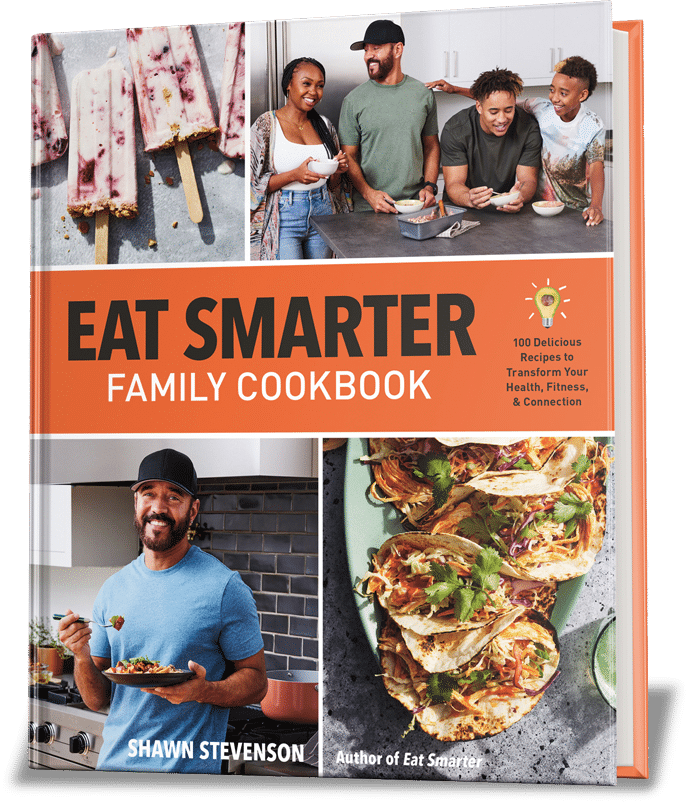
The Eat Smarter Family Cookbook is filled with 100 delicious recipes, plus the latest science to support the mental, physical and social health of your loved ones.


Share Your Voice
0 comments. Be the first to leave a comment.