Subscribe to The Model Health Show:


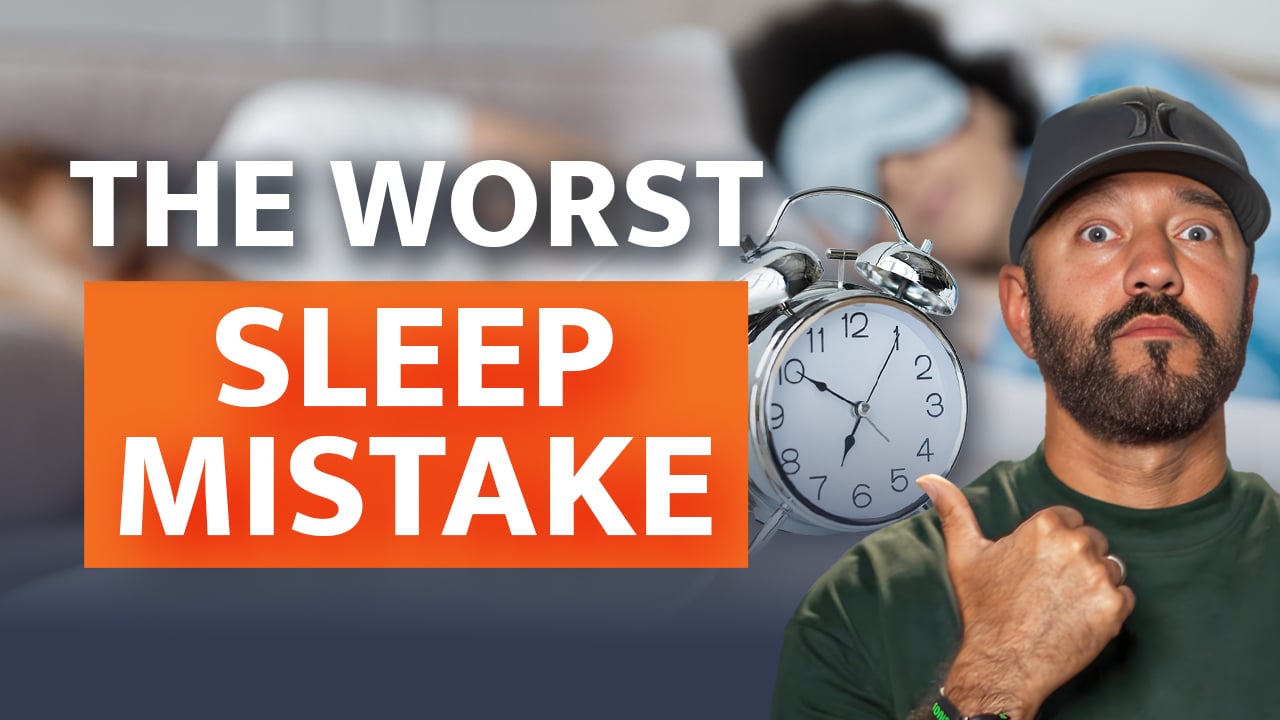
TMHS 977: The #1 Thing That Destroys Your Sleep Quality
Getting better sleep can help you reach your health and fitness goals, operate at your highest potential, and feel better on a day-to-day basis. But for many people, getting high quality sleep is easier said than done. Today, you’re going to uncover the biggest lever you can pull to get more restorative sleep at night.
On this episode, you’re going to learn about the #1 thing that is harming your sleep quality, plus three specific ways to overcome it for a better night’s sleep. You’re going to learn about the science of the human body’s circadian timing system, how it works, and the specific inputs it needs for optimal function.
You’re also going to learn about three science-backed tactics to start improving your sleep quality immediately. This episode is full of the latest science, plus actionable tips you can implement today. I hope you enjoy this episode of The Model Health Show!
In this episode you’ll discover:
- What the circadian timing system is. (0:35)
- The difference between a reactive system and an anticipatory system. (2:32)
- What your circadian clocks influence. (3:32)
- The connection between circadian disruption and metabolic dysfunction. (5:26)
- How social jetlag can contribute to obesity. (7:15)
- The #1 thing contributing to poor sleep quality. (9:52)
- What entrainment is. (13:43)
- How using blue light emitting devices before bed can harm your health. (17:12)
- Three specific steps you can take to improve your sleep quality. (19:34)
- Ideas for replacing your screentime before bed. (21:03)
- How natural light inputs from the sun impact your circadian rhythm. (29:59)
Items mentioned in this episode include:
- Boncharge.com/model – Use my code MODEL for 15% off blue light blocking glasses!
This episode of The Model Health Show is brought to you by Bon Charge.
Bon Charge carries the world’s largest selection of science-backed blue light blocking technology to enhance your sleep and overall wellness. Use my code MODEL at boncharge.com/model for 15% off blue light blocking glasses and more.
Transcript:
SHAWN STEVENSON: You are now listening to the Model Health Show with Sean Stevenson. For more, visit the Model health show.com. Welcome to the Model Health Show. This is fitness and nutrition expert Sean Stevenson, and I'm so grateful for you tuning in with me today. You are about to discover the number one thing that's controlling your sleep quality.
You're going to learn how the wrong use of this one thing is destroying the sleep quality for millions of people and how the right use of this one thing. We'll have you sleeping like a blissful baby in no time. To understand how it all works, you first need to understand what your circadian timing system is.
Every one of your trillions of nucleated cells have literal clocks in them. Now, when you hear the word clock, you might conjure up ideas of an alarm clock or that creepy grandfather clock from stranger things. But what is a clock? In actuality, what does a clock actually do? Well, a clock is an instrument for measuring.
Or indicating time, and this is precisely what the biological clocks in your cells do. In fact, it's scientifically accurate to say that your trillions of cells contain intrinsic circadian clock machinery. And the ultimate purpose of these clocks is to anticipate when things need to happen in an outdated perspective of human biology.
Our cells, our bodies. Our survival is believed to merely be reactive to the world around us. But the real more accurate perspective of human biology affirms that our circadian clocks exist to allow ourselves to anticipate predictable environmental changes rather than merely reacting to them. Our cells, these biological clocks, are predictive machines, and when it comes to survival and to health.
Anticipation is far more powerful than reaction. Life evolved on our planet with a 24 hour light dark cycle, and life changed dramatically across that cycle. Every day. Light transitioned into dark feeding, transitioned into fasting. Activity transitioned into rest and or hiding In safe quarters, temperature shifted from warmer to cooler and much more based on this 24 hour light dark cycle.
SHAWN STEVENSON: All of life was attuned to this, and cells that could predict these changes had a survival advantage over cells that waited until the change happened. Our circadian clocks helped us to anticipate when things would happen so that our biology ran far more efficiently. For example, a reactive system says glucose just entered the bloodstream, respond.
An anticipatory system says it's morning food is likely coming in. Prepare insulin signaling machinery right now so that we are prepared. That difference is. Enormous metabolically. A reactive system can effectively shut your body down as it's trying to react and figure out what just happened when that food is coming in.
While an anticipatory system is already prepared to handle the introduction of food with more ease, grace, and efficiency. So what do all of these biological clocks control and anticipate? The answer is everything about you and how you live your life. Your circadian clocks control or influence the release of all of your hormones and neurotransmitters.
Your digestive function, including the rate of nutrient absorption, speed of food transit throughout your GI tract, elimination and more the behavior of your microbiome, your trillions of bacteria all have circadian clocks. Two, your blood pressure, your body temperature and thermal regulation, your sleep cycles, and sleep efficiency.
Your muscular strength and reaction time, your sexual arousal, reproductive cycles, and production of sex hormones, your mental alertness, mental acuity, and so much more. Now the question is, what are these biological clocks exactly? Well, researchers at the Salk Institute for Biological Studies. Have uncovered that our biological clocks are in fact functional genes and proteins that control all of your other genes and proteins.
We are designed to have certain things happen at certain times, and our circadian clocks are biological scheduling systems, and they optimize when specific cellular processes occur. This is very, very important so that energy use, repair, detoxification, and growth don't compete with one another. Certain things in the body happen at certain times for the greatest efficiency, and our experience of that efficiency is better health.
SHAWN STEVENSON: Now, these cellular clocks that are controlling or influencing literally everything about you, the question is. What happens when they get out of sync? Well, circadian disruption has been shown in a mountain of studies to contribute to metabolic syndrome, insulin resistance, obesity, and countless other chronic and acute conditions.
For example, a remarkable study was published in the journal Diabetes titled Circadian Misalignment Augments Markers of Insulin Resistance and Inflammation Independently of Sleep Loss. This was a well constructed controlled inpatient ward study, and researchers found that yes, being sleep deprived increases insulin resistance, but more shockingly, they found that even if people got what was perceived to be an adequate amount of sleep, they can still develop insulin resistance when they were not going to sleep at normal nocturnal times AKA the nighttime.
Specifically being up at night and then sleeping during the day can significantly increase insulin resistance and systemic inflammation in the body independent of how much sleep you're getting. Now you might have heard the term social jet lag by now. We know that the phenomenon of jet lag is a physiological condition that occurs when a person's internal biological clock is out of sync with the time zone that they're in.
Similarly, social jet lag is defined as a physiological condition that occurs when there is a mismatch between a person's internal biological clocks and their social obligations, such as work. School or Netflix schedules often resulting in irregular sleep patterns, feelings of fatigue and other health issues.
And this leads us to another recent study titled Social GED, lag and Obesity That was published in the journal Obesity Reviews. This was a meta-analysis of 43 studies and included the data from over 200,000 people. The analysis revealed that weekly variation in sleep timing was found to increase rates of overall fat mass, body fat percentage, BMI, waist circumference, and other markers of overweight and obesity.
The researcher stated quote, social jet lag is positively and consistently associated. With multiple obesity related an anthropometric measures unquote, to provide one more example of the proven impact that circadian disruption has on our health. It's also been shown to increase the risk of the number one killer in our world today.
SHAWN STEVENSON: A study conducted by scientists at Harvard University's Division of Sleep Medicine titled Circadian Misalignment increases cardiovascular Disease Risk Factor in Humans Found that. Circadian disruption dramatically increases the risk of, you guessed it, cardiovascular disease. We know the impact that circadian disruption has on chronic health conditions.
Again, this is well established in science, but the average person is still unaware. But most glaringly, it's the impact that circadian disruption has on our sleep. Scientists at Harvard published a study in the Annals of Medicine detailing how acute or frequent changes to our sleep schedule changes how quickly we fall asleep, how well we stay asleep, and how efficient and consolidated our sleep turns out to be.
While countless other studies highlight one of the most obvious instances of abnormal sleep schedules and the impact that it has on sleep. This being the phenomenon of shift work. For instance, a meta-analysis published in the BMJ that included nearly 300,000 people, affirmed that shift work contributes to higher rates.
Of all manner of sleep disturbances. The bottom line is our bodies are always attempting to sync up our circadian clocks. With systems that have evolved to correspond with the 24 hour solar day, the more that we can entrain our bodies to match the natural rhythms of life, the better our sleep and the better our health overall.
Which leads us to the number one thing. It's the number one thing that's contributing to poor sleep quality for millions of people every single day, and it's highlighted in a study cited in the Journal of Clinical Endocrinology and Metabolism. The scientists took over 100 test subjects and expose them to standard room light.
Or dim light in the hours preceding their bedtime for five consecutive nights. After compiling all the data at the end of the study, the scientists discovered that compared with dim light exposure to room light before bedtime, significantly suppressed melatonin resulting in a later melatonin release in 99% of people.
SHAWN STEVENSON: The scientists also found that exposure to standard room light during the usual hours of sleep suppressed melatonin by greater than 50% in most of their trials. Melatonin is well established to be a regulatory sleep related hormone, but it plays so many other roles. Yes, it has a powerful role when it comes to sleep, but it also has powerful roles in helping to repair our DNA and reducing the onset of various cancers.
It has a huge role in how our metabolic health is working and how our body fat, in particular, our brown adipose tissue is functioning. The list goes on and on and on. Melatonin isn't this one pithy thing, but we know that it is a master as far as. Hormones are concerned. A master regulator of our sleep and our sleep efficiency and our exposure to light in the evening can suppress our melatonin release by more than 50%.
Again, we could do all of these activities. We could take all of these supplements, we can do all of these external things to try to get better sleep, but if our body is not producing. The actual chemistry to make the sleep happen and happen efficiently. We're going to continue to struggle, and so this is where we need to point our attention.
It is a light that is the number one controller of our circadian rhythms, coupled with cycles of darkness. Light cues are the primary controller of when our cells, and thus our bodies do all the things that they do. Again, nearly every nucleated cell in the human body contains its own intrinsic circadian clock, and they are all coordinated by a master clock in the brain.
In the Supra cosmetic nucleus or the SCN. Now, this is located in the hypothalamus, largely considered to be a master gland of the human body overall, and it receives direct light inputs from our retina and synchronizes the body to the light dark cycle. And again, the super cosmetic nucleus or the SEN doesn't run the body alone.
It coordinates. Clocks throughout our entire body, and that is just one source of the inputs of light. Our skin also has photoreceptor sets, picking up data to try to coordinate these clocks as well. It is this beautiful symphony when we are living in accordance to these natural rhythms. And the number one thing that controls this master clock, again, are light and dark cycles.
SHAWN STEVENSON: Inputs of light and darkness. Now I'm going to state this one more time as clearly as I possible can. These inputs of light and darkness are controlling everything about us, everything about when our bodies are doing what they're doing. There's this constant drive for ourselves to sink up and find these rhythms.
It's called entrainment. Entrainment refers to the process by which the body's internal circadian rhythms synchronize with external environmental cues, such as, again, light and darkness. Also, there's influence with temperature with food inputs, but it is a light and darkness that have the strongest impact, and in particular as our conversation is pointed to today in our sleep and wake cycles.
Now, this leads us to. The biggest culprit that's disrupting our sleep quality in our modern world, and it has to do with light inputs. It is the use of our tech devices, especially in the evening hours, and there's so much to see. We've got our smartphones, we've got our computers, we've got iPads, we've got our e-readers, we've got our televisions, and there's.
Infinite amounts of things to see and to discover. It's, it's glorious, it's amazing, and it's also causing us to become dramatically less healthy and it's rapidly deteriorating our sleep quality when we are engaging in these things in the evening without awareness, without. Proper precautions, and this is what this is all about.
It's about awareness as the first domino and what can we do proactively and practically so that we can still enjoy all the goodies that are out there. I made a Stranger Things reference earlier. I love it. All right. We've benched some stranger things here or there, but is keeping this stuff in context and aligning ourselves to the best of our ability to create that entrainment to where.
We are sleeping consistently and healthfully and going through our sleep cycles efficiently because that's the key. It's not just about sleeping as. We noted in an earlier study we can get a certain amount of sleep, but it's going through our sleep cycles efficiently. It's a great analogy that we look at our minutes of sleep and the quality of those minutes being akin to the quality of calories.
SHAWN STEVENSON: We know that not all calories are created equal. They can do dramatically different things where that. Calorie source is coming from in regards to what our hormones are doing, what insulin is doing, what serotonin is doing, what our microbiome is doing based on the calories that we choose. In the same way, not all sleep minutes are created equal.
We can be unconscious. And still not go through our sleep cycles efficiently and effectively, where we're getting the proper time needed in the deepest, most anabolic stages of sleep. In light sleep where we get a lot of repair taking place, and you know, things like a ramping up of our G lymphatic system and cleaning the metabolic waste in our brain.
There's so many incredible things that happen at different stages of sleep, and it's all dependent on these circadian clocks, on this stuff happening efficiently and effectively. And now at this point, we've got tons of studies that are affirming this interaction with our tech devices and destroying our sleep quality.
And there are more and more and more being conducted as we speak, but one of the most glaring. Was researched from Brigham and Women's Hospital and associated with Harvard University, and it suggests that the use of our light emitting electronic devices, tablets, smartphones, e-readers, laptops, and the hours before bedtime can negatively impact our overall health, our alertness and our circadian clock.
During the two week inpatient study, so this is award study, they've got people in these controlled conditions. 12 participants read eBooks on light emitting iPads for four hours before bedtime each night for five consecutive nights, and followed the same regimen with printed books. The researchers found that participants reading on an iPad took longer to fall asleep, spent less time in rapid eye movement or REM sleep, had reduced secretion of melatonin.
Had a delayed circadian rhythm of more than an hour or less sleepy before bedtime, and as a result, we're sleepier and less alert the following day. The scientist stated quote, we found the body's natural circadian rhythms were interrupted by the short wavelength enriched light, otherwise known as blue light from these electronic devices, unquote.
SHAWN STEVENSON: Again, this isn't just a superficial thing where. This input of light is suppressing melatonin and disrupting our sleep quality. This is impacting our metabolic health. This is impacting our cardiovascular system. This is impacting our brain, our gut health. There isn't a part about our biology that isn't being influenced by staring at these devices in the evening or having these rooms that are illuminated with artificial light.
With that being said, we live in the world and it's a lot of fun stuff to do, and we can be in this world, but we don't have to be fully of this world. We can be aware. As we're engaging with these things and take precautions, create parameters so that we can associate with these things without as much metabolic impact, without as much impact on the quality of our sleep, and thus the quality of our days.
With this being said, yes, number one, as far as our tactical things to walk away with today. End the time before bed to the best of our ability. Let's give ourselves a little bit of some screen free time. Let's give ourselves a little bit of time to be off of our devices, preferably in a dim lit environment and with the simple.
Practices we can give our bodies the opportunity to increase melatonin production, reduce that fight or flight sympathetic drive, reduce cortisol levels as they naturally would, and help to transition into high quality sleep. Our bodies know what to do, just like our ability to breathe, our ability to digest our food, our bodies know how to sleep.
It's just the way that we are living today and how we're associating. With this modern environment that's causing so much disruption when it comes to getting good sleep. And so we're going to entrain our bodies. We're gonna reassociate by giving ourselves a little bit of a screen curfew to the best of our abilities.
Tactic number one, it is science-backed. It is simple, but it's not necessarily easy. And here's the rub, especially if we are addicted to the stuff that we're doing with our tech devices in the evenings. We've got to come in here and start to replace that habit with something of equal or greater value to the best of our abilities.
SHAWN STEVENSON: So what does that look like for you? It's going to be dependent on you. This could be for some people. If they like to, you know, be on their iPad reading an ebook. This could be reading a physical book. This could be listening to a podcast where we don't have to stare into a device. We can have the lights dim, you know, maybe it's a, a salt lamp or you know, we got the red light going, or candlelight, you know, whatever that looks like.
But just being able to relax, can listen to an audio book. This could be journaling. This could be spending time with the people that we care about. You know, whether this is a, a phone call, whether this is of course, in person, in proximity with our significant other or with our kids. This could be winding down with a nice bath, right?
Nice relaxing bath with the Epsom salt and the candle vibes and the spa music. If you wanna get crazy. Whatever that looks like for you to have ourselves an intentional evening routine. We as adults are in many ways, just big adult babies. We have this incredible biology that's always looking to sync up and to find out what time it is.
Our kids have a nighttime routine, a bedtime routine, a bedtime, whereas adults, we just tend to stumble into sleep and see what happens. Alright? So it's taking more intentional control of our evening schedule to make sure that we're getting that sleep that we really desire and deserve. So giving ourselves a screen curfew.
So that's number one. Number two, and this is one of the most practical science back things that we could do today in our modern world, where they're. Are so many things for us to engage in in the evening. We do have these artificial light exposures, and just being able to, again, have a science-backed way to engage with life.
When the sun goes down, it will be in your best interest to get yourself some blue light blocking glasses. This is something that I've been doing for literally 15 years, and the technology has come so far. I've got pictures from 15 years ago holding the baby, you know, 14, 15 years ago, holding my baby with these blue eye blocking glasses on.
And I'm grateful that my wife was still feeling me because some of those early iterations of the blue eye blocking glasses are somewhat blue. Eye blocking glasses. Were not that sexy, but now. The styles have improved, the technology has improved, and this is something that I do every single night to this day.
For 15 years. 15 years. I would not be doing this if it was not effective, and it is a part of my nighttime routine. You know, in the summers when the nights are a bit shorter, you know, basically when the sun goes down, my blue light blocking glasses come on. But, you know, in the wintertime, you know, it might be a couple of hours 'cause the sun goes down earlier, but then a couple hours before bedtime, I put on my blue light blocking glasses and going about my business.
SHAWN STEVENSON: So whether we're watching a, a game, you know, watching the NBA game like I was last night with my son, or, you know, we're just hanging out, chopping it up and maybe playing. Uno, you know, whatever the case might be. I'm wearing my blue light blocking glasses. Now listen, clearly, not just any blue light blocking glasses will do.
There are so many iterations of blue light blocking glasses out there because of the popularization of this technology and their effectiveness. But the reality is most blue light blocking glasses are not. Blocking blue light efficiently, nor is it blocking other problematic spectrums of light, like green light.
That's been proven to influence and disrupt our sleep quality as well. They're not actually lab tested to be effective. And this is why the blue light blocking glasses that I wear exclusively that are right there on the arm of my couch that I travel with as well are the blue light blocking glasses from Bon charge.
These blue light blocking glasses are scientifically engineered to block out 100% of melatonin disrupting blue and green light for improved sleep and regulated circadian rhythms. These glasses are FDA registered and proven to be effective, and they're made in actual optics laboratories by trained optical technicians.
And because of this, they're able to provide you with prescription lenses as well as the non-prescription lenses like I wear, plus, they look amazing. There's so many incredible styles. I pop on my bond charge glasses and go on about my business, hanging out with my family, whether I have to work or just kicking it.
And you'll notice a difference, you know, for many people because of having that pattern or that process, that schedule that they create for themselves. They start to maybe feel the sleepiness come on as soon as they pop the glasses on, or within a very short time afterwards, just because it's a part of their overall bedtime routine.
So I love the team over at Bon Charge, and again, they've got so many incredible styles. The ones that I have right here, these are the Morris frames, but I love the Magnums and they've got smaller frames as well for, you know, for, for youngsters and people with the little heads, but not like small, like the Beetlejuice type little head.
But you can get different sizes as well. And so again, head over their, check them out, bond charge.com/model. And you're going to get hooked up with 15% off all of their frames and all of their wonderful technology. Alright? That's bond charge.com/model. That's B-O-N-C-H-A-R-G e.com four slash model. Use the code model at checkout for an exclusive 15% off the team that is amazing.
SHAWN STEVENSON: Speaking of those light inputs, they also have cutting edge FDA registered. Red light therapy devices as well. And I have one of their larger panels that I use on a regular basis, and it's a game changer. So head over there, check them out, bond charge.com/model for 15% off. And again, keep in mind, we don't necessarily have to turn our lives upside down to improve our sleep in the evening, but we need to be smart about this.
Have some practices to have what's effectively. Some protective interaction, you know, some eye protection in the evening when we're interacting with all of this artificial light because it is in fact throwing off our circadian clocks and causing all manner of disruption. Now for some people, like my wife, she could sleep through anything.
It doesn't matter. She could watch all the stuff, all the lights lit up, she's going to sleep when she sleeps. All right. I remember, you know, back in St. Louis, there was one evening there was a earthquake. There was a earthquake, right. And I'd been doing a lot of meditation at the time. I was like, it, it happened at night.
And so when, when the earthquake happened, I just thought it was me. And I had locked into like that avatar vibe, like, oh, and I talked to my wife in the morning. I was like, did you feel that last night? Because I'm in St. Louis, there's no way there was an earthquake. Thought it was me, and she was like, no, not at all.
And then we see the news. There was this really strong earthquake that took place and she slept through it like it was nothing. All right? She could literally sleep through an earthquake, but for individuals that don't necessarily have any outward expression of troubles with their sleep, this is still affecting us.
Again, that study affirmed, 99% of people were being affected. Namely with their melatonin secretion when they were exposed to artificial light in their environment before bed. So it's just being able to get the most from our sleep and our sleep minutes. But for individuals with chronic sleep issues or you struggle consistently with your sleep, this is one of the things to make a mandate.
It is the most powerful controller of our circadian rhythms and our sleep quality. So that's part one of it is. Helping to avoid or to have some protection from artificial light inputs in the evening, but we also need natural light inputs in the day. On the other side of the equation, it is the natural light inputs from the sun that helps to prompt the release of notable.
Wakefulness slash daytime hormones and neurotransmitters that set the rhythm for better sleep at night. Truly, a great night of sleep starts the moment that you wake up in the morning. Sunlight appears to cue special areas in our retina that cue the release of serotonin, which is a precursor for making melatonin.
SHAWN STEVENSON: Of course our skin has an inherent serotonergic system that appears to be capable of generating serotonin as well. So if we can get sun exposure on our skin, all the better. Now, where do we see this? Really notably? Well, it's seen across the board, of course, but. It's well established that sleep quality tends to deteriorate in the elderly, but recent data indicates that this practice of getting natural sunlight exposure in the morning can improve things for this age bracket as well.
This study published in 2017 titled effect of natural sunlight on sleep problems and sleep quality of the elderly staying in the nursing home. Found that exposure to direct sunlight between 8:00 AM and 10:00 AM for five days was effective in increasing the study Participant's sleep quality scores.
Alright, so this didn't mean two hours. Sun exposure. This is just getting some sun exposure between that time, 10, 15 minutes. And yes, direct sun exposure on our skin has many benefits, but that's gonna depend on our complexion as well, how much sunlight we're going to require, but also just having ambient light from the sun being in the room, or just being outside where the sun is shining.
Light is so powerful. It's always reflecting in its dynamic. And even on the most overcast day, the sun's rays are still making its way to us. And so keeping all of this in mind, it's really setting the stage and we've got some really incredible data affirming that sun exposure during the day helps to reduce our cortisol levels in the evening.
Alright, it's again, setting the table, setting the tone for great sleep. And so what are the tips here? Well, our body clock is most responsive to sunlight in the early morning. So this is between the hours of, and it depends on time zones and that whole circadian disruption is a whole other conversation with time changes.
But 6:00 AM to 8, 9, 10 am as indicated in that particular study. Exposure to sunlight later in the day, of course is beneficial and helps to get our bodies to synchronize that entrainment. Our body is always, our cells know far better what time it is, when it gets some exposure outside, no matter when it is.
SHAWN STEVENSON: And so keeping that in mind, but it's in those early hours of the morning especially. So with that being said, make it a mandate to the best of your ability to get 10 to 20 minutes outside. Get some sun exposure every single day. Now, of course, depending on where we live, there might be weather issues again, if we could just even get it into the environment, it's better than nothing.
You know, open up the windows and let in some of that sunlight, that ambient light, get into the room, do the best that we can. So not make excuses, just make it a practice. Make it a mandate to do the best that we can to get this input. Because it's the opening act, it's setting the stage for better sleep and better health overall.
And also when we're out and getting access to the sun, we want to ease up on the sunglasses. Alright, because again, that super cosmetic nucleus is trying to pick up that data and send signals to our brain. And so that whole phenomenon of being too cool for school got over my sunglasses as a time and place for all that stuff.
But you know, doing our best to allow our bodies to absorb that data is gonna help to entrain that system. And lastly, with everything that you've learned today, give yourself some grace. Give yourself some encouragement and start to take steps in the direction of utilizing light and dark inputs to improve your sleep and to improve your health.
But be patient with yourself. Be kind with yourself. You know? Especially if you have not integrated these practices on a regular basis, just take one step of at a time. If there's situations where you can't put on your blue light blocking glasses, it's okay If there's situations where you don't abide by your sleep curfew because you know, maybe your friend's in town, whatever, it's okay.
Life happens. We can adjust, but. What we do the majority of the time is what's really going to tell the tale of our sleep quality and our health at the end of the day. So do the best that we can, be as consistent as we can, and utilize the power of light and darkness to help to regulate your sleep and thus regulate your health.
If you enjoyed this episode, please share your voice in the comment section below, whether you're watching on YouTube or Spotify. We have Spotify video as well. What was your favorite part of this episode? Please share your voice and regardless of where you're watching or listening to this episode, please know that I have so much more in store for you.
We're just scratching the surface on what we're going to achieve together. I appreciate you so much for tuning in. Take care. Have an amazing day and I'll talk with you soon.
Other episodes you might be interested:

Maximize Your Energy
Get the Free Checklist: “5 Keys That Could Radically Improve Your Energy Levels and Quality of Life”
HEALTHY MEALS EVERYONE WILL LOVE
The Greatest Gift You Can Give Your Family is Health
When you gather your family around the table to share nutritious food, you’re not only spending quality time with them - you’re setting them up for success in all areas of their lives.
The Eat Smarter Family Cookbook is filled with 100 delicious recipes, plus the latest science to support the mental, physical and social health of your loved ones.



Share Your Voice
0 comments. Be the first to leave a comment.